SGK - Tiếng Anh 12
0/0
minus
100%
plus
Ghi chú
setting
share
Nền
Đọc offline

Lưu sách trên máy

Đang kiểm tra...

list Mục lục
list Mục lục
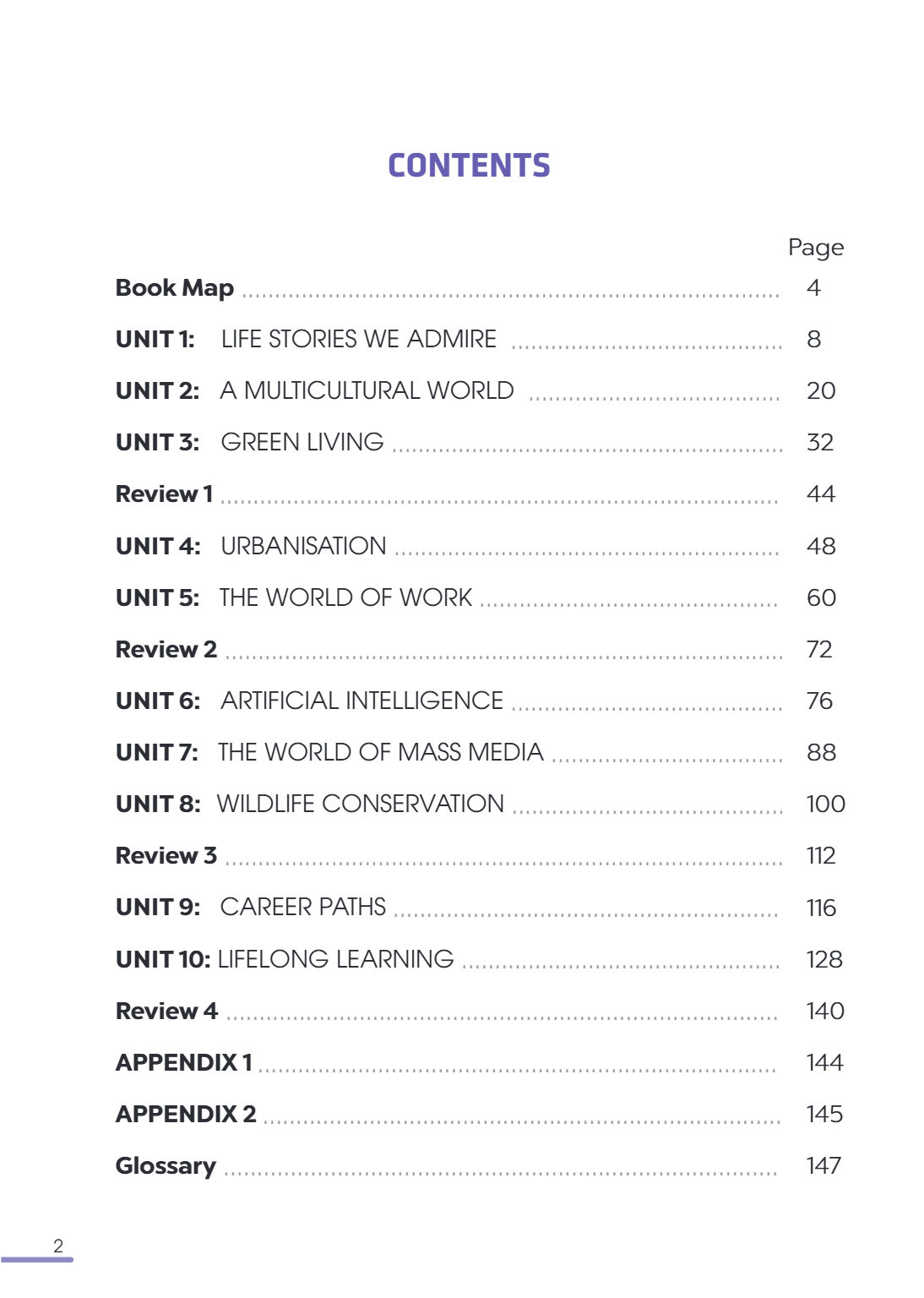
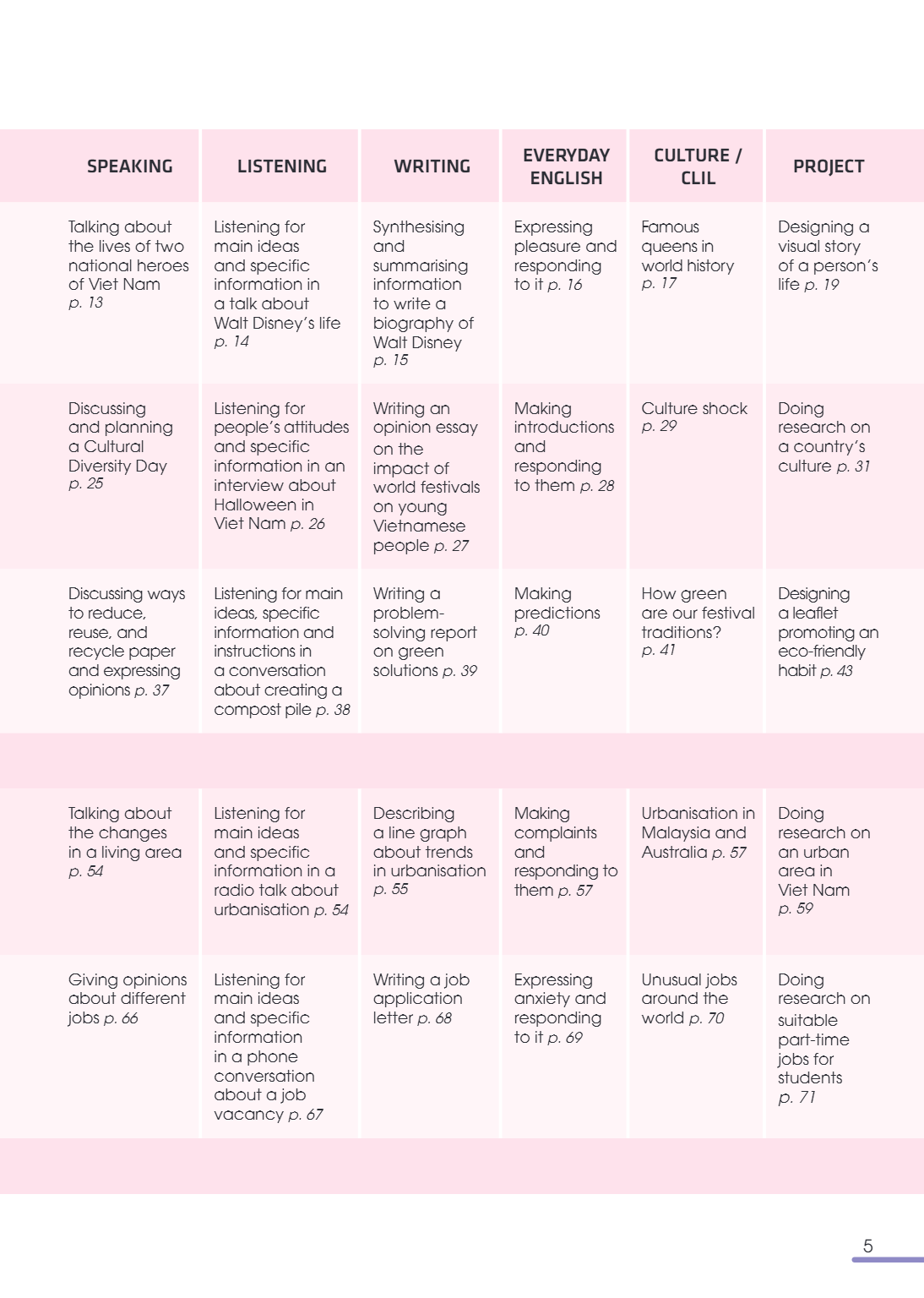
UNIT 1: LIFE STORIES WE ADMIRE
Getting started
Language
Reading
Speaking
Listening
Writing
Communication and Culture / CLIL
Looking back
UNIT 2: A MULTICULTURAL WORLD
Getting started
Language
Reading
Speaking
Listening
Writing
Communication and Culture / CLIL
Looking back
UNIT 3: GREEN LIVING
Getting started
Language
Reading
Speaking
Listening
Writing
Communication and Culture / CLIL
Looking back
REVIEW 1 & MID-TERM TESTS
Review 1
UNIT 4: URBANISATION
Getting started
Language
Reading
Speaking
Listening
Writing
Communication and Culture / CLIL
Looking back
UNIT 5: THE WORLD OF WORK
Getting started
Language
Reading
Speaking
Listening
Writing
Communication and Culture / CLIL
Looking back
REVIEW 2 & END-OF-TERM TESTS
Review 2
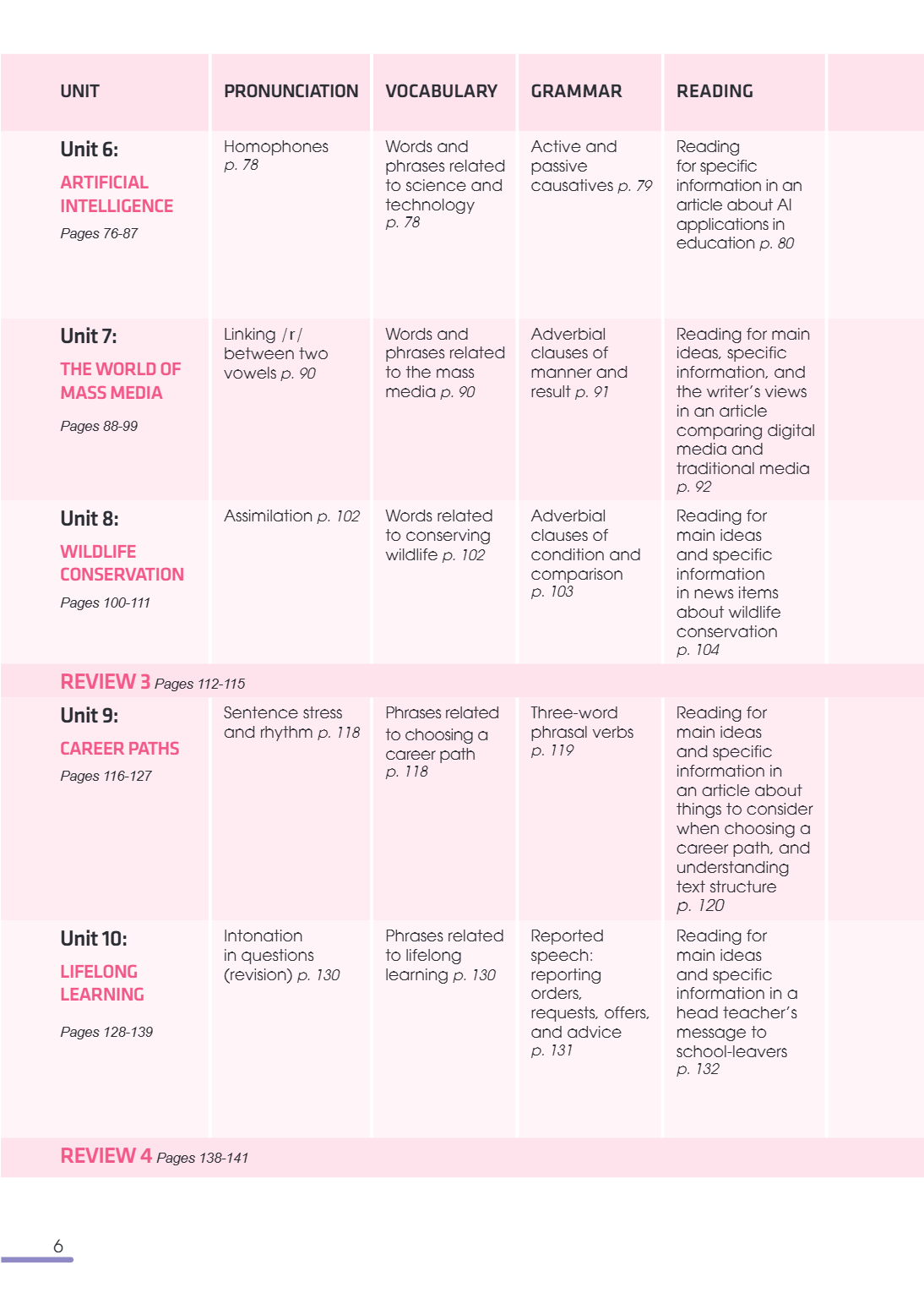
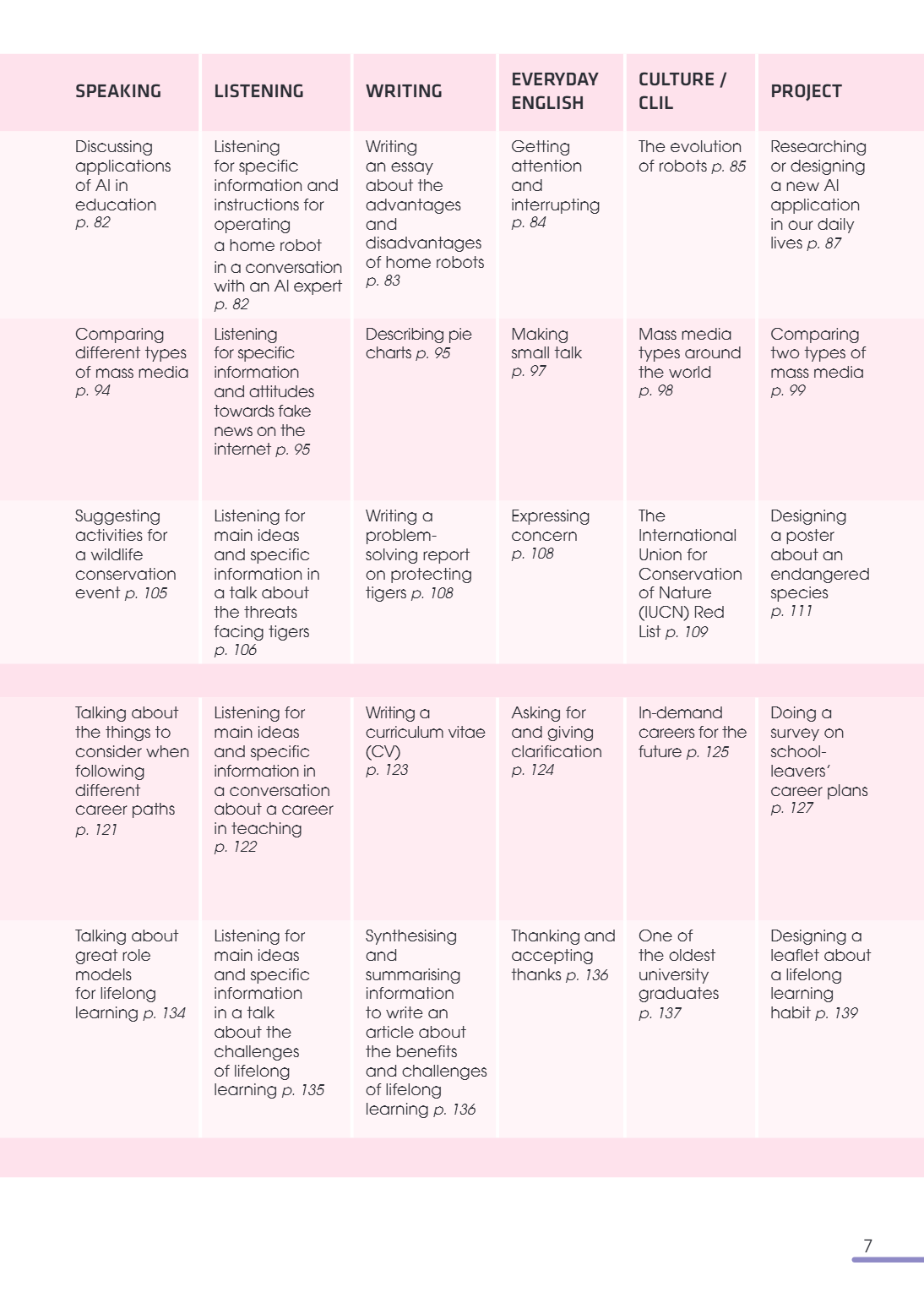
UNIT 6: ARTIFICIAL INTELLIGENCE
Getting started
Language
Reading
Speaking
Listening
Writing
Communication and Culture / CLIL
Looking back
UNIT 7: THE WORLD OF MASS MEDIA
Getting started
Language
Reading
Speaking
Listening
Writing
Communication and Culture / CLIL
Looking back
UNIT 8: WILDLIFE CONSERVATION
Getting started
Language
Reading
Speaking
Listening
Writing
Communication and Culture / CLIL
Looking back
REVIEW 3 & SECOND MID-TERM TESTS
Review 3
UNIT 9: CAREER PATHS
Getting started
Language
Reading
Speaking
Listening
Writing
Communication and Culture / CLIL
Looking back
UNIT 10: LIFELONG LEARNING
Getting started
Language
Reading
Speaking
Listening
Writing
Looking back
REVIEW 4 & SECOND END-OF-TERM TESTS
Review 4
Học liệu
Đang xem trang 0 Học liệu dưới đây tương ứng với nội dung bạn đang đọc
empty Không có học liệu bổ trợ
cover-first
page-1
Trang 1
Trang 2
Trang 3
Trang 4
Trang 5
Trang 6
Trang 7
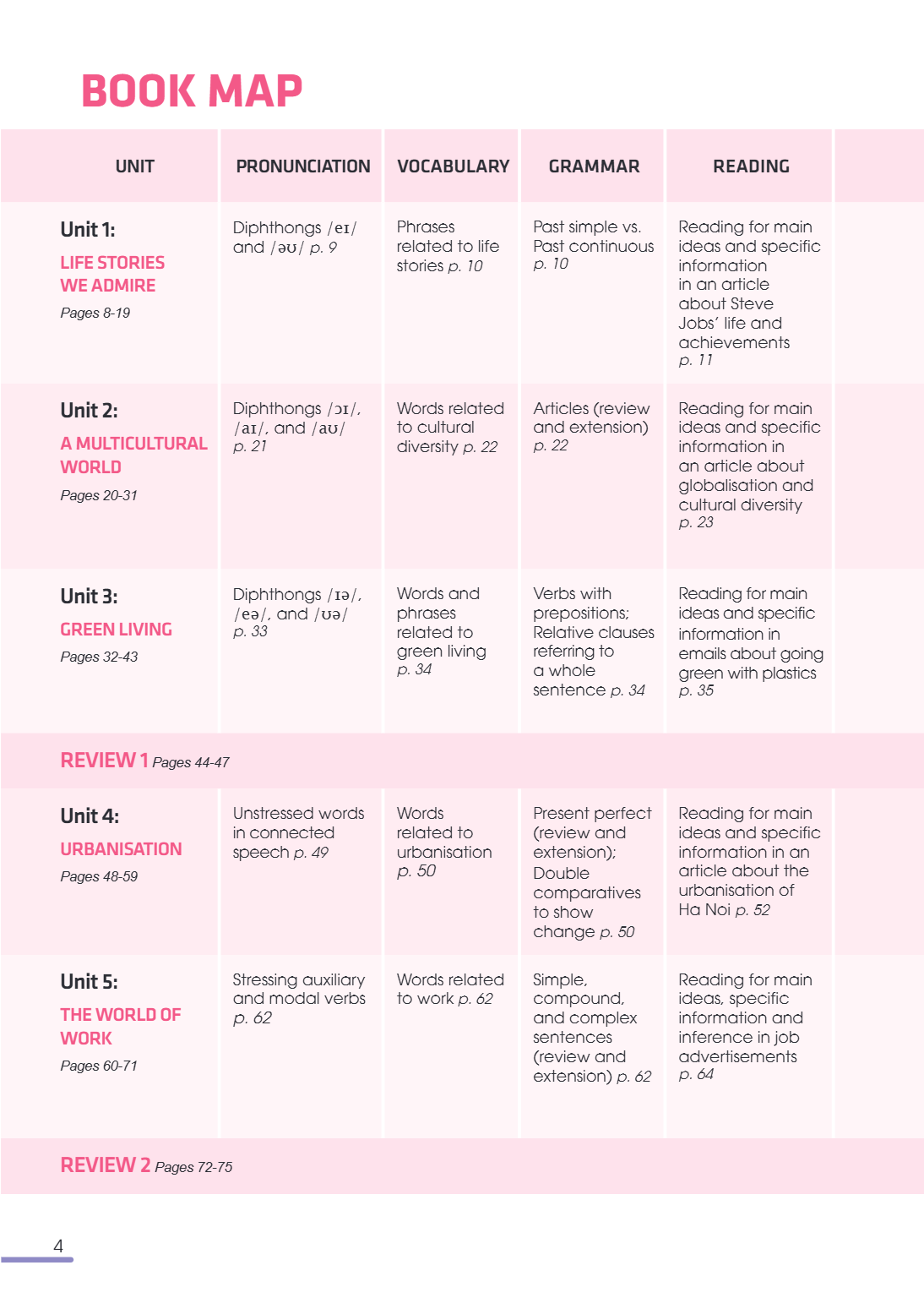
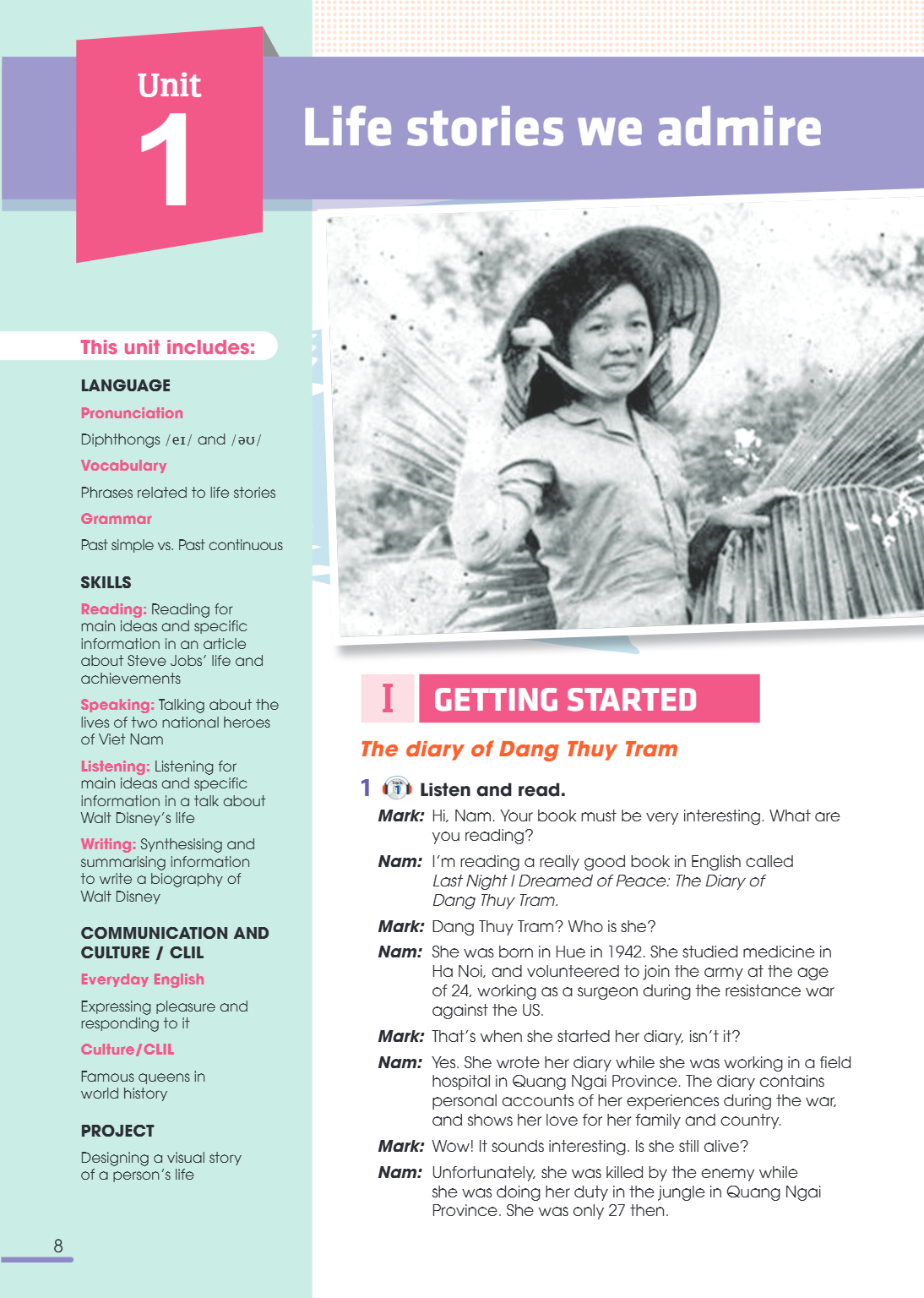
Unit 1. LIFE STORIES WE ADMIRE This unit includes: LANGUAGE Pronunciation Diphthongs /eɪ/ and /əʊ/ Vocabulary Phrases related to life stories Grammar Past simpl
Unit 1. LIFE STORIES WE ADMIRE
This unit includes:
LANGUAGE
Pronunciation
Diphthongs /eɪ/ and /əʊ/
Vocabulary
Phrases related to life stories
Grammar
Past simple vs. Past continuous
SKILLS
Reading: Reading for main ideas and specific information in an article about Steve Jobs' life and achievements
Speaking: Talking about the lives of two national heroes of Viet Nam
Listening: Listening for main ideas and specific information in a talk about Walt Disney's life
Writing: Synthesising and summarising information to write a biography of Walt Disney
COMMUNICATION AND CULTURE / CLIL
Everyday English
Expressing pleasure and responding to it
Culture/CLIL
Famous queens in world history
PROJECT
Designing a visual story of a person's life
I GETTING STARTED
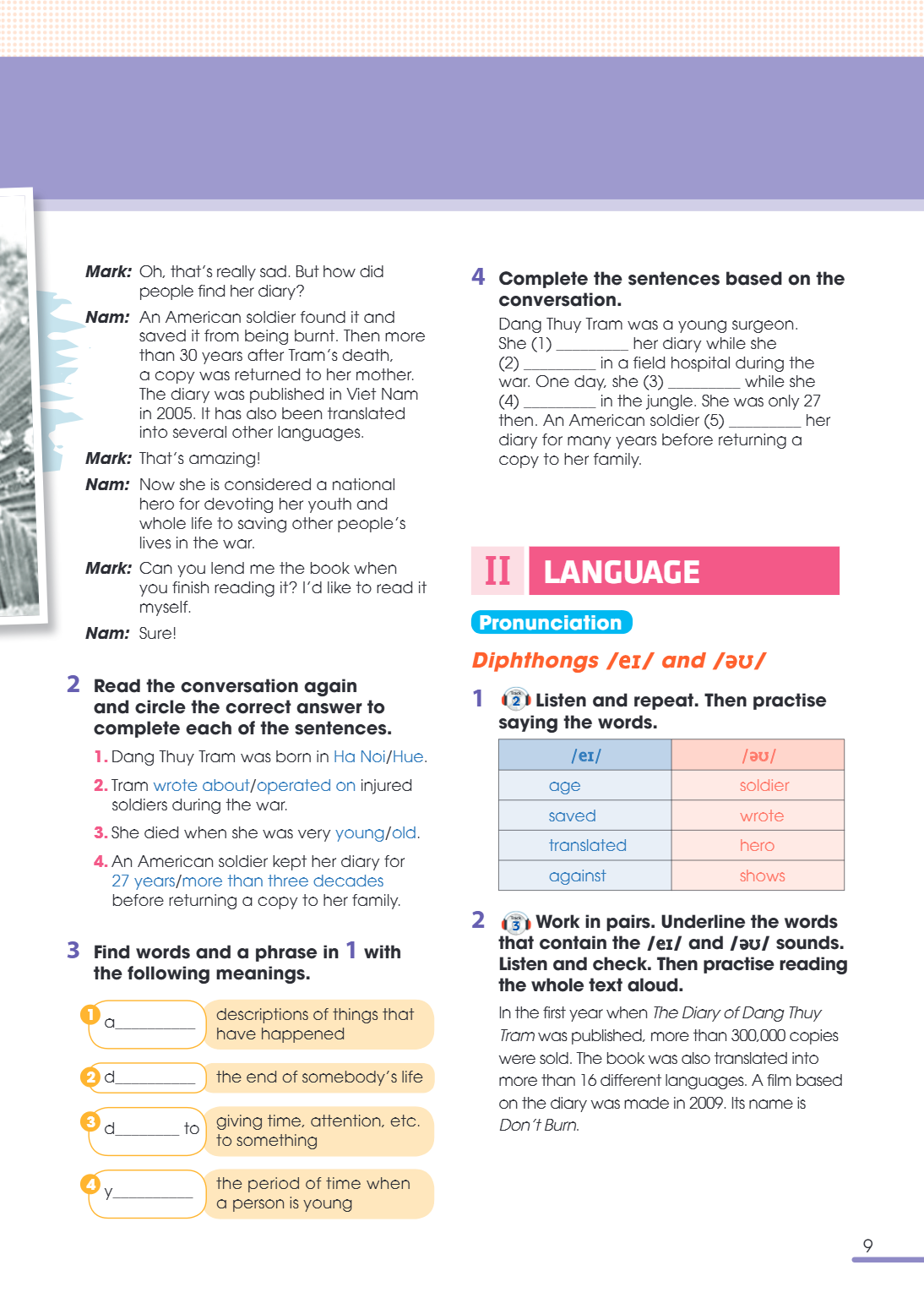
The diary of Dang Thuy Tram
1. Listen and read.
Mark: Hi, Nam. Your book must be very interesting. What are you reading?
Nam: I'm reading a really good book in English called Last Night I Dreamed of Peace: The Diary of Dang Thuy Tram.
Mark: Dang Thuy Tram? Who is she?
Nam: She was born in Hue in 1942. She studied medicine in Ha Noi, and volunteered to join the army at the age of 24, working as a surgeon during the resistance war against the US.
Mark: That's when she started her diary, isn't it?
Nam: Yes. She wrote her diary while she was working in a field hospital in Quang Ngai Province. The diary contains personal accounts of her experiences during the war, and shows her love for her family and country.
Mark: Wow! It sounds interesting. Is she still alive?
Nam: Unfortunately, she was killed by the enemy while she was doing her duty in the jungle in Quang Ngai Province. She was only 27 then.
II language Pronunciation Diphthongs /eɪ/ and /əʊ/ Listen and repeat. Then practise saying the words. Track 2 /eɪ/, /əʊ/ age, soldier saved, wrote translated, h
II language
Pronunciation Diphthongs /eɪ/ and /əʊ/
Listen and repeat. Then practise saying the words.
Track 2
/eɪ/, /əʊ/
age, soldier
saved, wrote
translated, hero
against, shows
Work in pairs. Track 3, Underline the words
that contain the /eɪ/, and /əʊ/ sounds.
Listen and check. Then practise reading the whole text aloud.
In the first year when The Diary of Dang Thuy Tram was published, more than 300,000 copies were sold. The book was also translated into more than 16 different languages. A film based on the diary was made in 2009. Its name is Don't Burn.
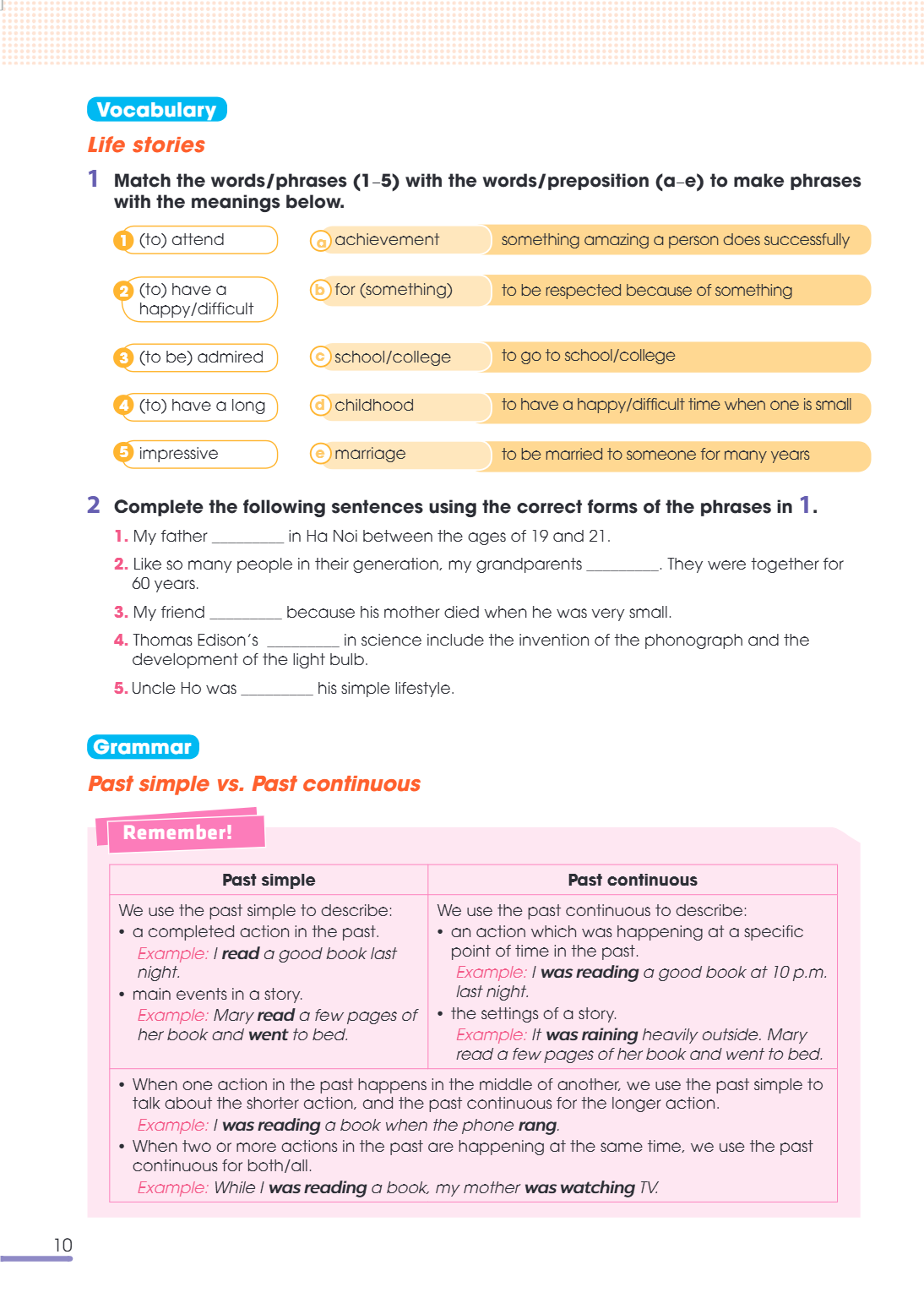
Vocabulary Life stories 1. Match the words/phrases (1–5) with the words/preposition (a–e) to make phrases with the meanings below. 1. (to) attend, a. achievemen
Vocabulary
Life stories
1. Match the words/phrases (1–5) with the words/preposition (a–e) to make phrases with the meanings below.
1. (to) attend, a. achievement, something amazing a person does successfully
2. (to) have a happy/difficult, b. for (something), to be respected because of something
3. (to be) admired, c. school/college, to go to school/college
4. (to) have a long, d. childhood, to have a happy/difficult time when one is small
5. impressive, e. marriage, to be married to someone for many years
2. Complete the following sentences using the correct forms of the phrases in 1.
My father ________ in Ha Noi between the ages of 19 and 21.
Like so many people in their generation, my grandparents ________. They were together for 60 years.
My friend ________ because his mother died when he was very small.
Thomas Edison's ________ in science include the invention of the phonograph and the development of the light bulb.
Uncle Ho was ________ his simple lifestyle.
Grammar
Past simple vs. Past continuous
Remember!
Past simple, Past continuous
We use the past simple to describe: • a completed action in the past. Example: I read a good book last night. • main events in a story. Example: Mary read a few pages of her book and went to bed., We use the past continuous to describe: • an action which was happening at a specific point of time in the past. Example: I was reading a good book at 10 p.m. last night. • the settings of a story. Example: It was raining heavily outside. Mary read a few pages of her book and went to bed.
• When one action in the past happens in the middle of another, we use the past simple to talk about the shorter action, and the past continuous for the longer action. Example: I was reading a book when the phone rang. • When two or more actions in the past are happening at the same time, we use the past continuous for both/all. Example: While I was reading a book, my mother was watching TV.
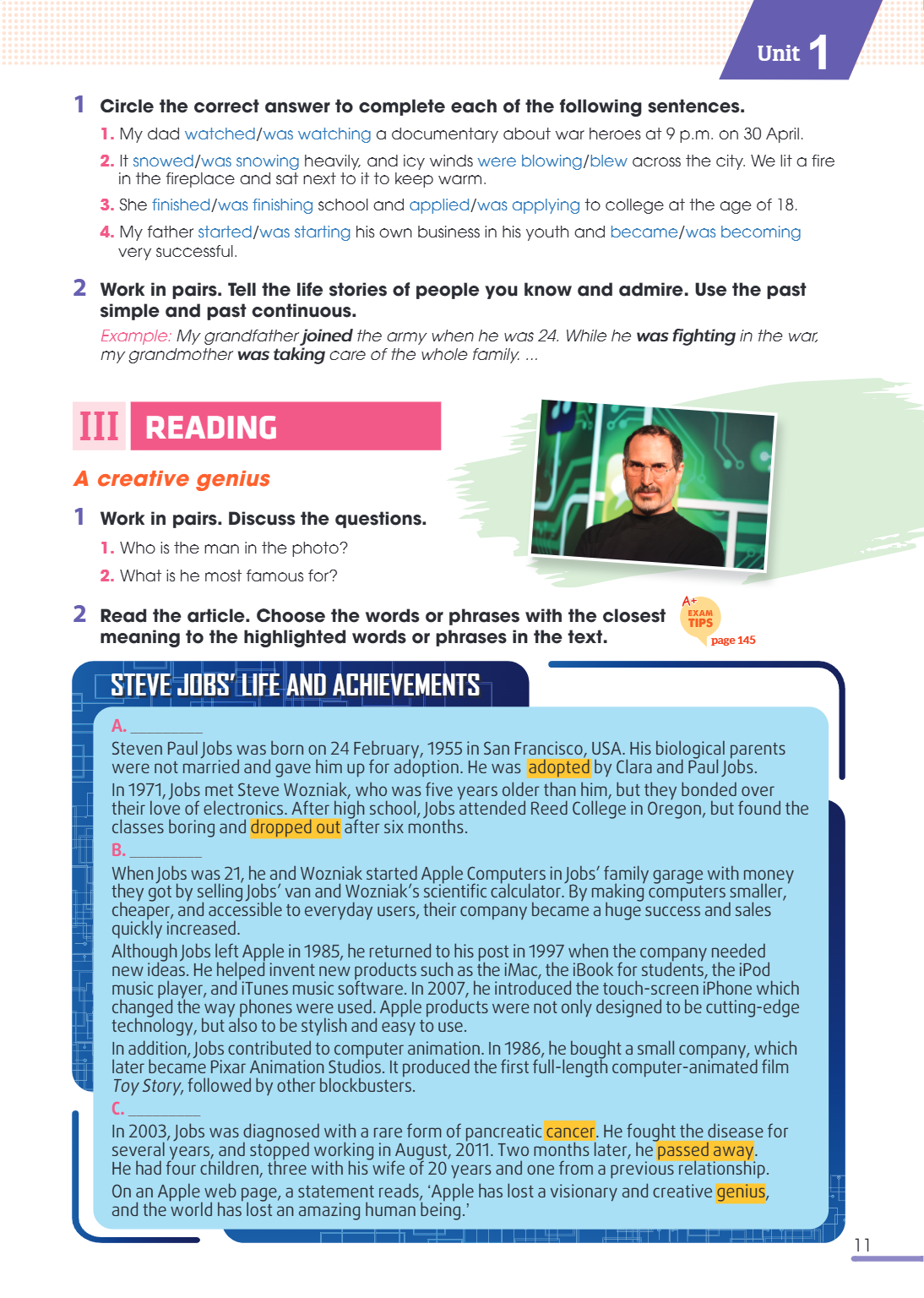
III reading A creative genius 1 Work in pairs. Discuss the questions. 1. Who is the man in the photo? 2. What is he most famous for? meaning to the highlighted
III reading
A creative genius
1 Work in pairs. Discuss the questions.
1. Who is the man in the photo?
2. What is he most famous for?
meaning to the highlighted words or phrases in the text.
page 145
STEVE JOBS' LIFE AND ACHIEVEMENTS
A. _________
Steven Paul Jobs was born on 24 February, 1955 in San Francisco, USA. His biological parents were not married and gave him up for adoption. He was adopted by Clara and Paul Jobs. In 1971,Jobs met Steve Wozniak, who was five years older than him, but they bonded over their love of electronics. After high school, Jobs attended Reed College in Oregon, but found the classes boring and dropped out after six months.
B. _________
When Jobs was 21, he and Wozniak started Apple Computers in Jobs' family garage with money they got by selling Jobs' van and Wozniak's scientific calculator. By making computers smaller, cheaper, and accessible to everyday users, their company became a huge success and sales quickly increased. Although Jobs left Apple in 1985, he returned to his post in 1997 when the company needed new ideas. He helped invent new products such as the iMac, the iBook for students, the iPod music player, and iTunes music software. In 2007, he introduced the touch-screen iPhone which changed the way phones were used. Apple products were not only designed to be cutting-edge technology, but also to be stylish and easy to use. In addition,Jobs contributed to computer animation. In 1986, he bought a small company, which later became Pixar Animation Studios. It produced the first full-length computer-animated film
C. _________
In 2003, Jobs was diagnosed with a rare form of pancreatic cancer. He fought the disease for several years, and stopped working in August, 2011. Two months later, he passed away. He had four children, three with his wife of 20 years and one from a previous relationship. On an Apple web page, a statement reads, 'Apple has lost a visionary and creative genius, and the world has lost an amazing human being.'
1. adopted A. given birth to B. taken by another family as their own child 2. dropped out A. continued to study B. left school/college before completing your st
1. adopted
A. given birth to
B. taken by another family as their own child
2. dropped out
A. continued to study
B. left school/college before completing your studies
3. cancer
A. a serious disease
B. a dangerous animal
4. passed away
A. died
B. went past something
5. genius
A. a very intelligent person
B. an ordinary person
3 Read the article again. Match each section (A–C) with a heading (1–5). There are TWO extra headings.
1. Achievements
2. Early life and education
3. Marriage and family
4. Contribution to animation
5. Health issues and family
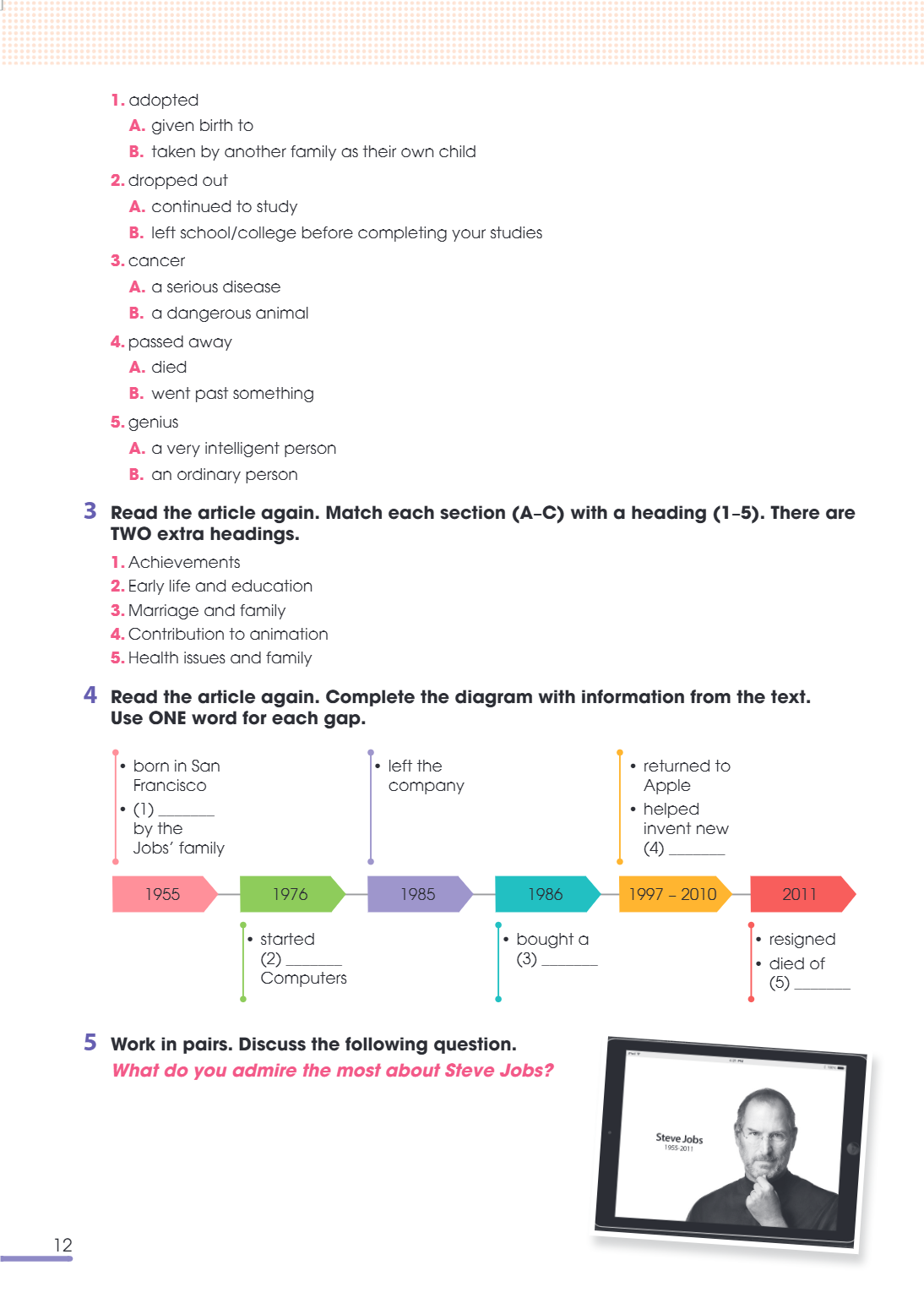
4 Read the article again. Complete the diagram with information from the text. Use ONE word for each gap.
born in San Francisco
(1) ______ by the Jobs' family
left the company
returned to Apple
helped invent new (4) ______
1955 - 1976 - 1985 - 1986 - 1997 – 2010 - 2011
started (2) ______ Computers
bought a (3) ______
resigned
died of (5) ______
5 Work in pairs. Discuss the following question.
What do you admire the most about Steve Jobs?
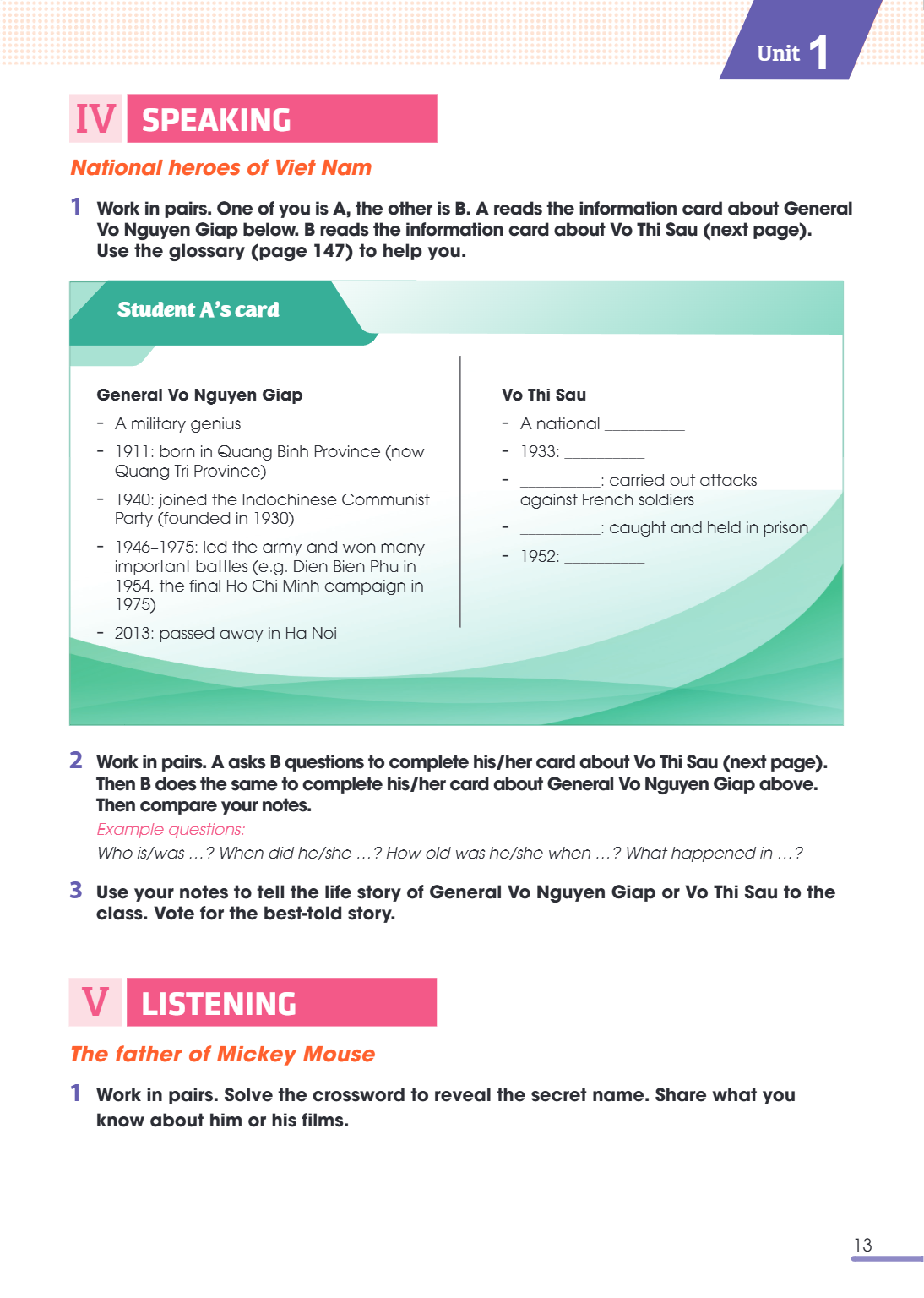
Unit1 IV speaking National heroes of Viet Nam 1 Work in pairs. One of you is A, the other is B. A reads the information card about General Vo Nguyen Giap below.
Unit1
IV speaking
National heroes of Viet Nam
1 Work in pairs. One of you is A, the other is B. A reads the information card about General
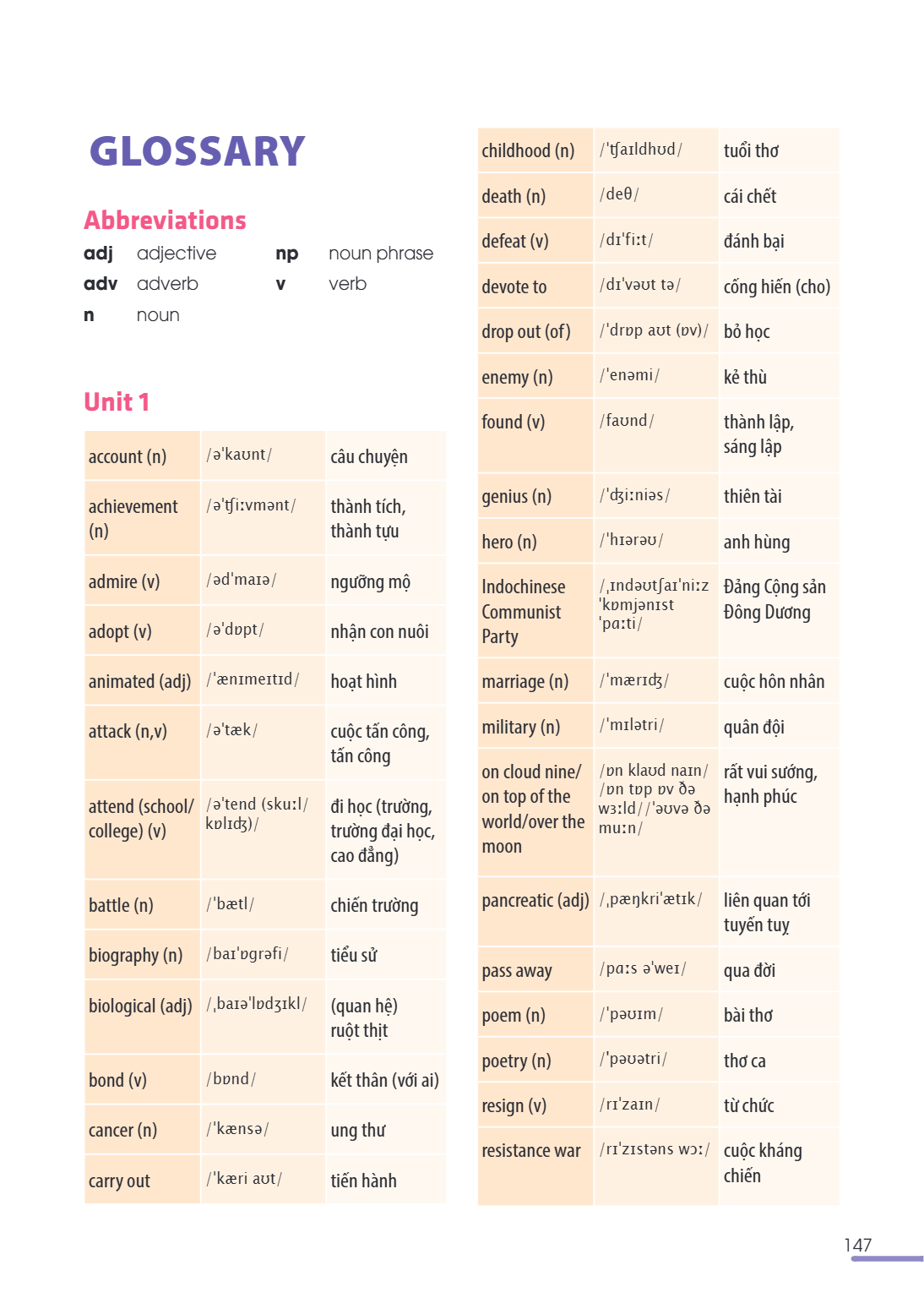
Vo Nguyen Giap below. B reads the information card about Vo Thi Sau (next page). Use the glossary (page 147) to help you.
Student A's card
General Vo Nguyen Giap
A military genius - 1911: born in Quang Binh Province (now
Quang Tri Province) - 1940: joined the Indochinese Communist
Party (founded in 1930) - 1946-1975: led the army and won many
important battles (e.g. Dien Bien Phu in 1954, the final Ho Chi Minh campaign in 1975) - 2013: passed away in Ha Noi
Vo Thi Sau
A national __________ - 1933: __________ - __________: carried out attacks
against French soldiers - __________: caught and held in prison - 1952: __________
2 Work in pairs. A asks B questions to complete his/her card about Vo Thi Sau (next page).
Then B does the same to complete his/her card about General Vo Nguyen Giap above. Then compare your notes.
Example questions: Who is/was …? When did he/she …? How old was he/she when …? What happened in …?
3 Use your notes to tell the life story of General Vo Nguyen Giap or Vo Thi Sau to the
class. Vote for the best-told story.
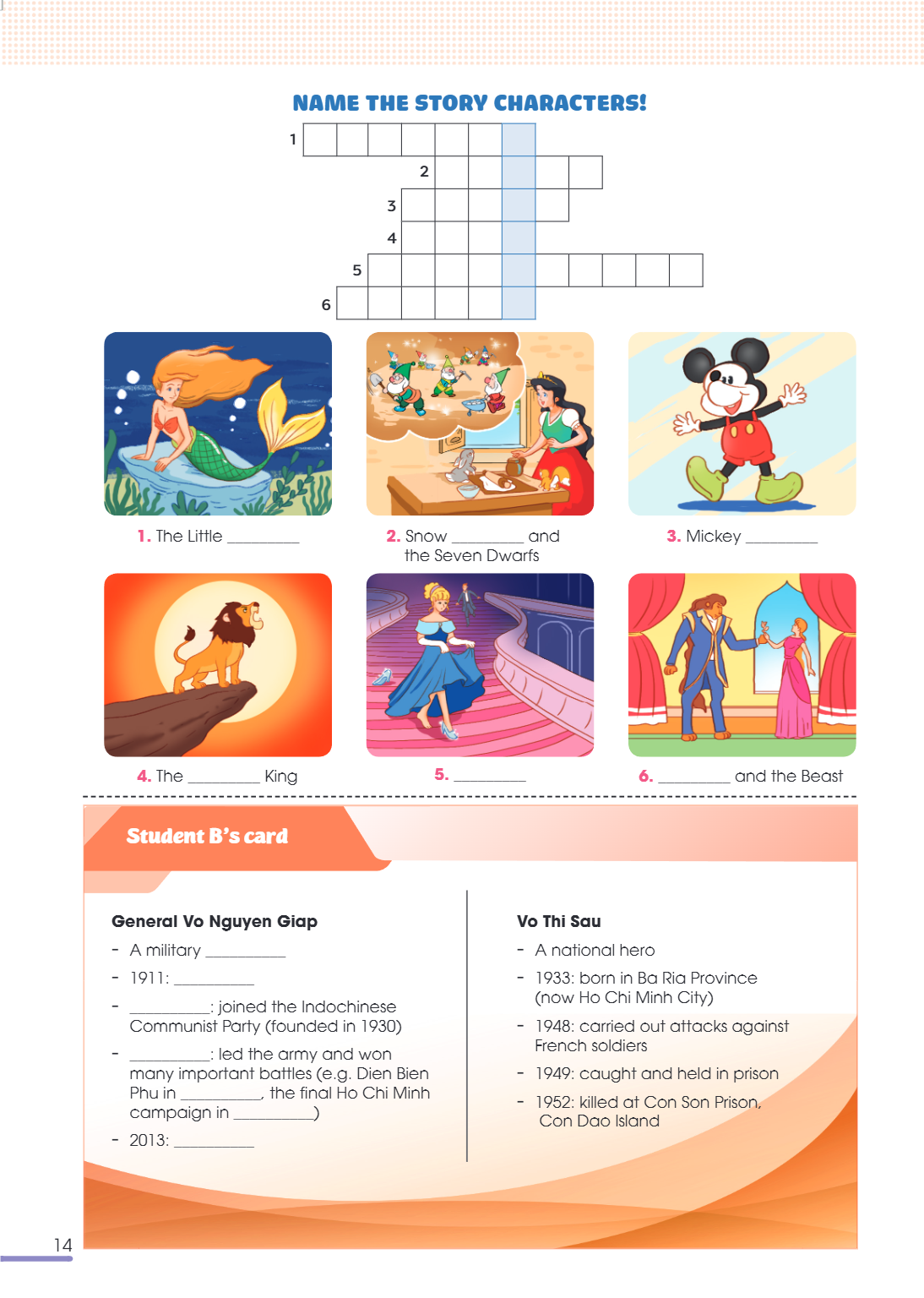
NAME THE STORY CHARACTERS! The Little _______ 2. Snow _______ and the Seven Dwarfs 3. Mickey _______ 4. The _______ King 5. _______ 6. _______ and the Beast Stu
NAME THE STORY CHARACTERS!
The Little _______
2. Snow _______ and the Seven Dwarfs
3. Mickey _______
4. The _______ King
5. _______
6. _______ and the Beast
Student B's card
General Vo Nguyen Giap, Vo Thi Sau
- A military _______, - A national hero
- 1911: _______, - 1933: born in Ba Ria Province (now Ho Chi Minh City)
- _______: joined the Indochinese Communist Party (founded in 1930), - 1948: carried out attacks against French soldiers
- _______: led the army and won many important battles (e.g. Dien Bien Phu in _______, the final Ho Chi Minh campaign in _______), - 1949: caught and held in prison
- 2013: _______, - 1952: killed at Con Son Prison, Con Dao Island
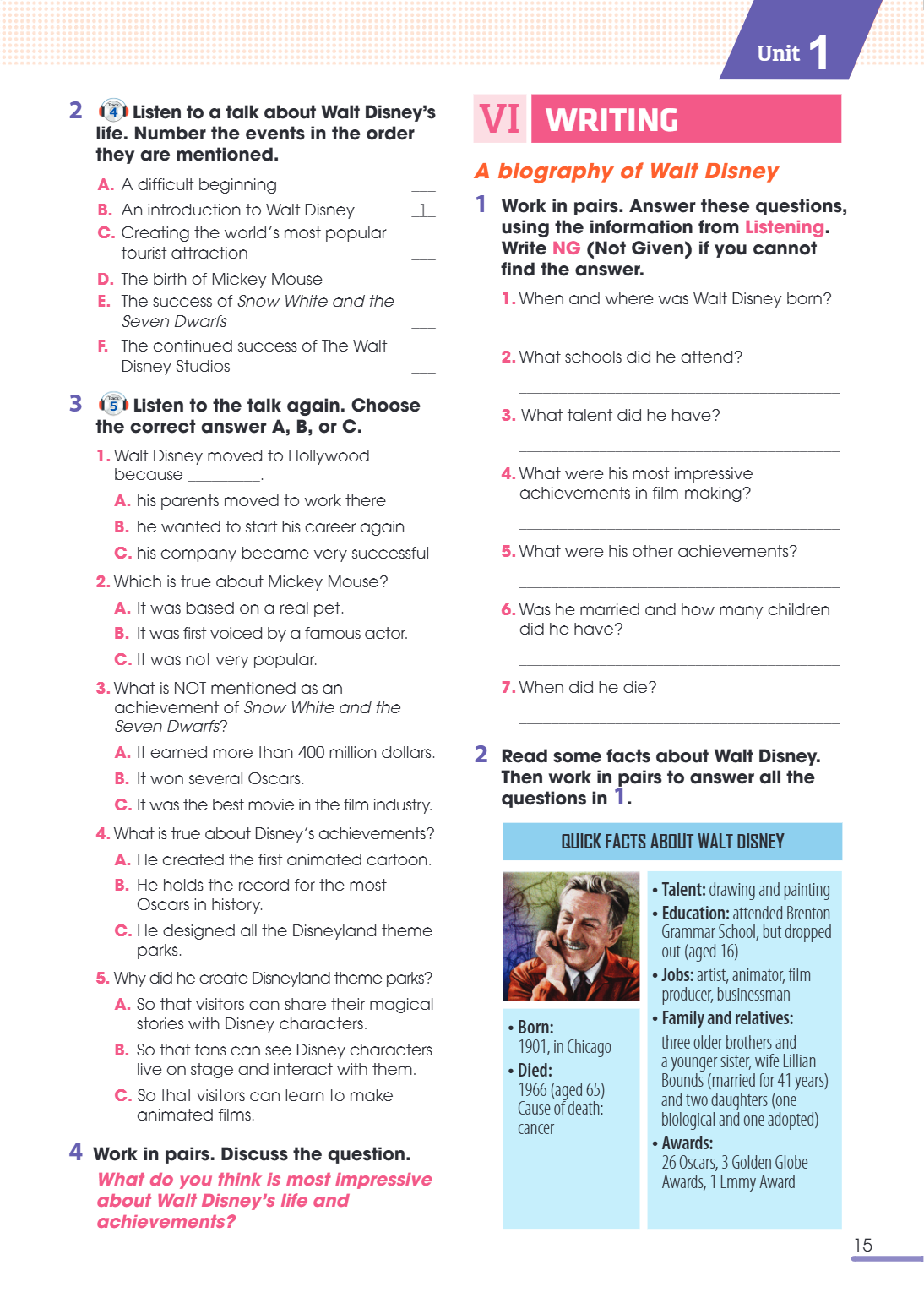
VI Writing A biography of Walt Disney Work in pairs. Answer these questions, using the information from Listening. Write NG (Not given) if you cannot find the a
VI Writing
A biography of Walt Disney
Work in pairs. Answer these questions, using the information from Listening. Write NG (Not given) if you cannot find the answer.
1. When and where was Walt Disney born?
2. What schools did he attend?
3. What talent did he have?
4. What were his most impressive
achievements in film-making?
5. What were his other achievements?
6. Was he married and how many children
did he have?
7. When did he die?
Read some facts about Walt Disney. Then work in pairs to answer all the questions in 1 .
QUICK FACTS ABOUT WALT DISNEY
Born:
1901, in Chicago
Died:
1966 (aged 65) Cause of death: cancer
•Family and relatives:
three older brothers and a younger sister, wife Lillian Bounds (married for 41 years) and two daughters (one biological and one adopted)
Unit1
•Talent: drawing and painting •Education: attended Brenton
Grammar School, but dropped out (aged 16)
Jobs: artist, animator, film
producer, businessman
Awards:
26 Oscars, 3 Golden Globe Awards, 1 Emmy Award
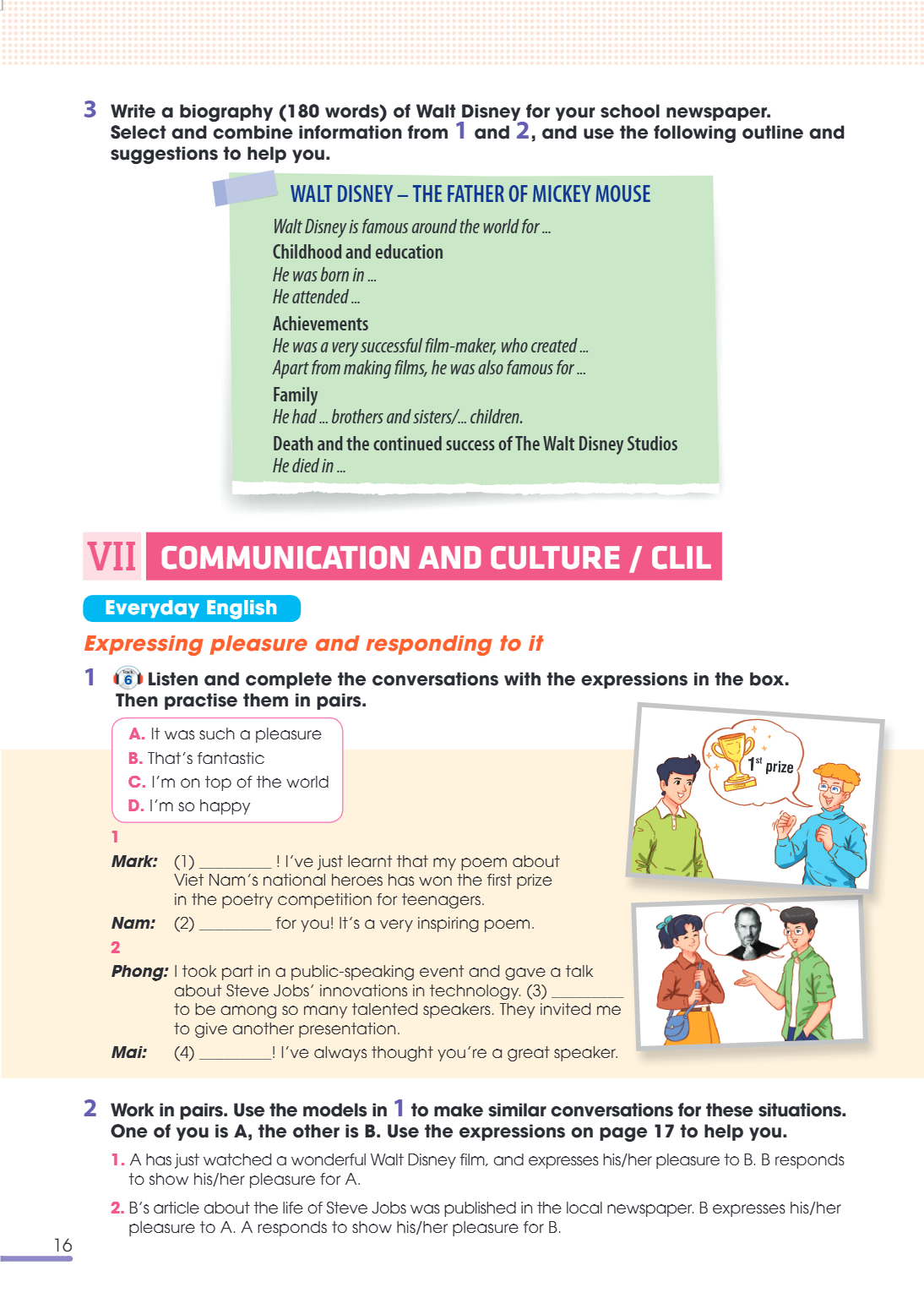
VII Communication and culture / clil Everyday English Expressing pleasure and responding to it 1 Listen and complete the conversations with the expressions in t
VII Communication and culture / clil
Everyday English Expressing pleasure and responding to it
1 Listen and complete the conversations with the expressions in the box.
Track 6
Then practise them in pairs.
A. It was such a pleasure
B. That's fantastic
C. I'm on top of the world
D. I'm so happy
1
Mark: (1) _________ ! I've just learnt that my poem about
Viet Nam's national heroes has won the first prize in the poetry competition for teenagers.
Nam: (2) _________ for you! It's a very inspiring poem.
2 Phong: I took part in a public-speaking event and gave a talk
about Steve Jobs' innovations in technology. (3) _________ to be among so many talented speakers. They invited me to give another presentation. Mai: (4) _________! I've always thought you're a great speaker.
2 Work in pairs. Use the models in 1 to make similar conversations for these situations.
One of you is A, the other is B. Use the expressions on page 17 to help you.
A has just watched a wonderful Walt Disney film, and expresses his/her pleasure to B. B responds
to show his/her pleasure for A.
B's article about the life of Steve Jobs was published in the local newspaper. B expresses his/her
pleasure to A. A responds to show his/her pleasure for B.
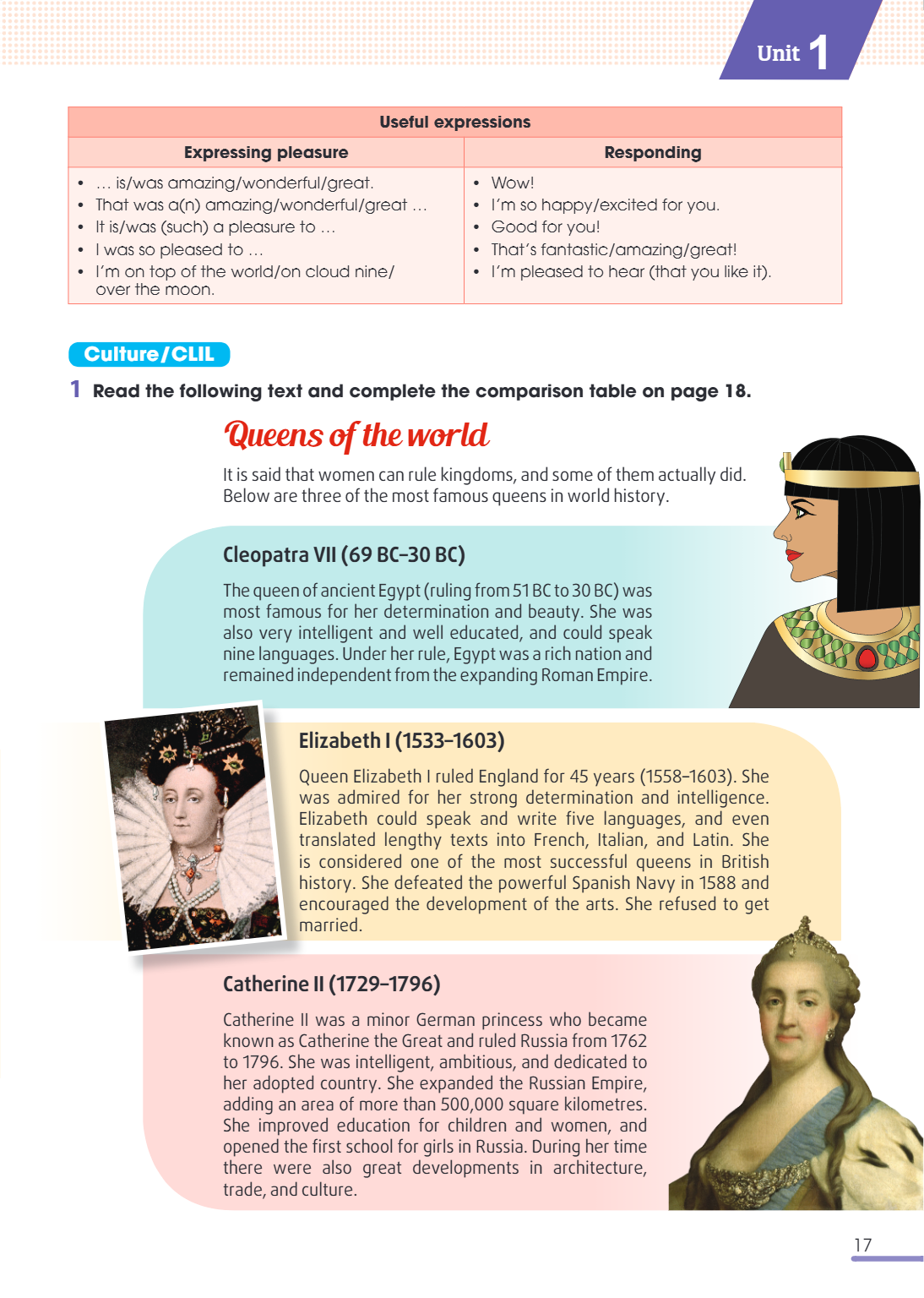
Unit1 Useful expressions Expressing pleasure Responding … is/was amazing/wonderful/great. • Wow! That was a(n) amazing/wonderful/great … • I'm so happy/excited
Unit1
Useful expressions
Expressing pleasure Responding
… is/was amazing/wonderful/great. • Wow!
That was a(n) amazing/wonderful/great … • I'm so happy/excited for you.
It is/was (such) a pleasure to … • Good for you!
I was so pleased to … • That's fantastic/amazing/great!
I'm on top of the world/on cloud nine/ • I'm pleased to hear (that you like it). over the moon.
Culture/CLIL
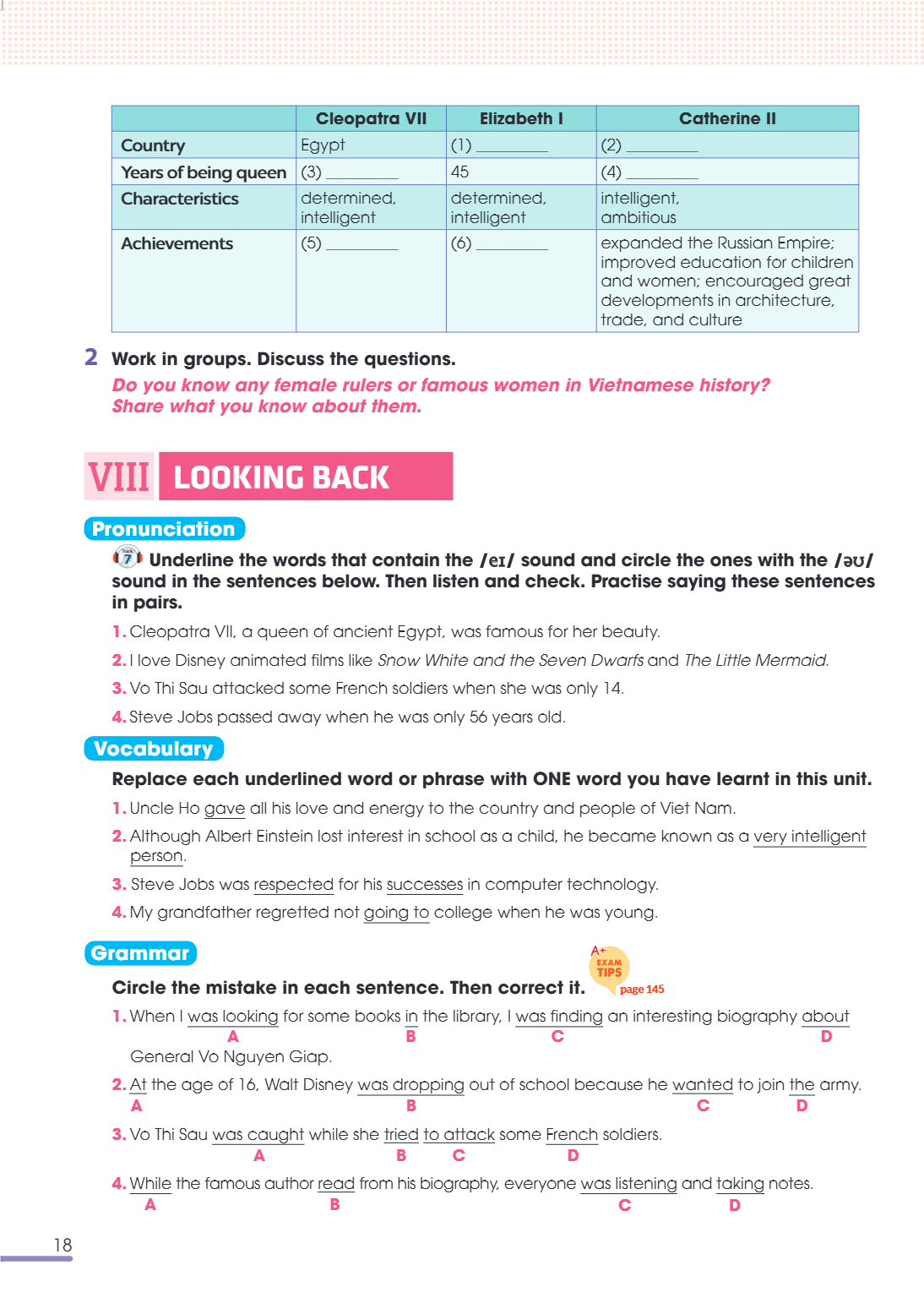
1 Read the following text and complete the comparison table on page 18.
Queens of the world
It is said that women can rule kingdoms, and some of them actually did. Below are three of the most famous queens in world history.
Cleopatra VII (69 BC-30 BC)
The queen of ancient Egypt (ruling from 51 BC to 30 BC) was most famous for her determination and beauty. She was also very intelligent and well educated, and could speak nine languages. Under her rule, Egypt was a rich nation and remained independent from the expanding Roman Empire.
Elizabeth I (1533-1603)
Queen Elizabeth I ruled England for 45 years (1558-1603). She was admired for her strong determination and intelligence. Elizabeth could speak and write five languages, and even translated lengthy texts into French, Italian, and Latin. She is considered one of the most successful queens in British history. She defeated the powerful Spanish Navy in 1588 and
encouraged the development of the arts. She refused to get married.
Catherine II (1729-1796)
Catherine II was a minor German princess who became known as Catherine the Great and ruled Russia from 1762 to 1796. She was intelligent, ambitious, and dedicated to her adopted country. She expanded the Russian Empire, adding an area of more than 500,000 square kilometres. She improved education for children and women, and opened the first school for girls in Russia. During her time there were also great developments in architecture, trade, and culture.
VIII Looking back Pronunciation Underline the words that contain the Track 7 sound in the sentences below. Then listen and check. Practise saying these sentence
VIII Looking back
Pronunciation
Underline the words that contain the
Track 7
sound in the sentences below. Then listen and check. Practise saying these sentences in pairs.
Cleopatra VII, a queen of ancient Egypt, was famous for her beauty.
I love Disney animated films like Snow White and the Seven Dwarfs and The Little Mermaid.
Vo Thi Sau attacked some French soldiers when she was only 14.
Steve Jobs passed away when he was only
Vocabulary
Replace each underlined word or phrase with ONE word you have learnt in this unit.
Uncle Ho gave all his love and energy to the country and people of Viet Nam.
Although Albert Einstein lost interest in school as a child, he became known as a very intelligent
person.
3. Steve Jobs was respected for his successes in computer technology.
4. My grandfather regretted not going to college when he was young.
Grammar
Circle the mistake in each sentence. Then correct it.
When I was looking for some books in the library, I was finding an interesting biography about
A
Elizabeth
I
(1) _________ 45 determined, intelligent (6) _________
Catherine
II
(2) _________ (4) _________ intelligent, ambitious expanded the Russian Empire; improved education for children and women; encouraged great developments in architecture, trade, and culture
/eɪ/ sound and circle the ones with the /əʊ/
56 years old.
page 145
B C
D
General Vo Nguyen Giap.
At the age of 16, Walt Disney was dropping out of school because he wanted to join the army. B C
A D
3. Vo Thi Sau was caught while she tried to attack some French soldiers.
B C
A D
While the famous author read from his biography, everyone was listening and taking notes. B C
A D
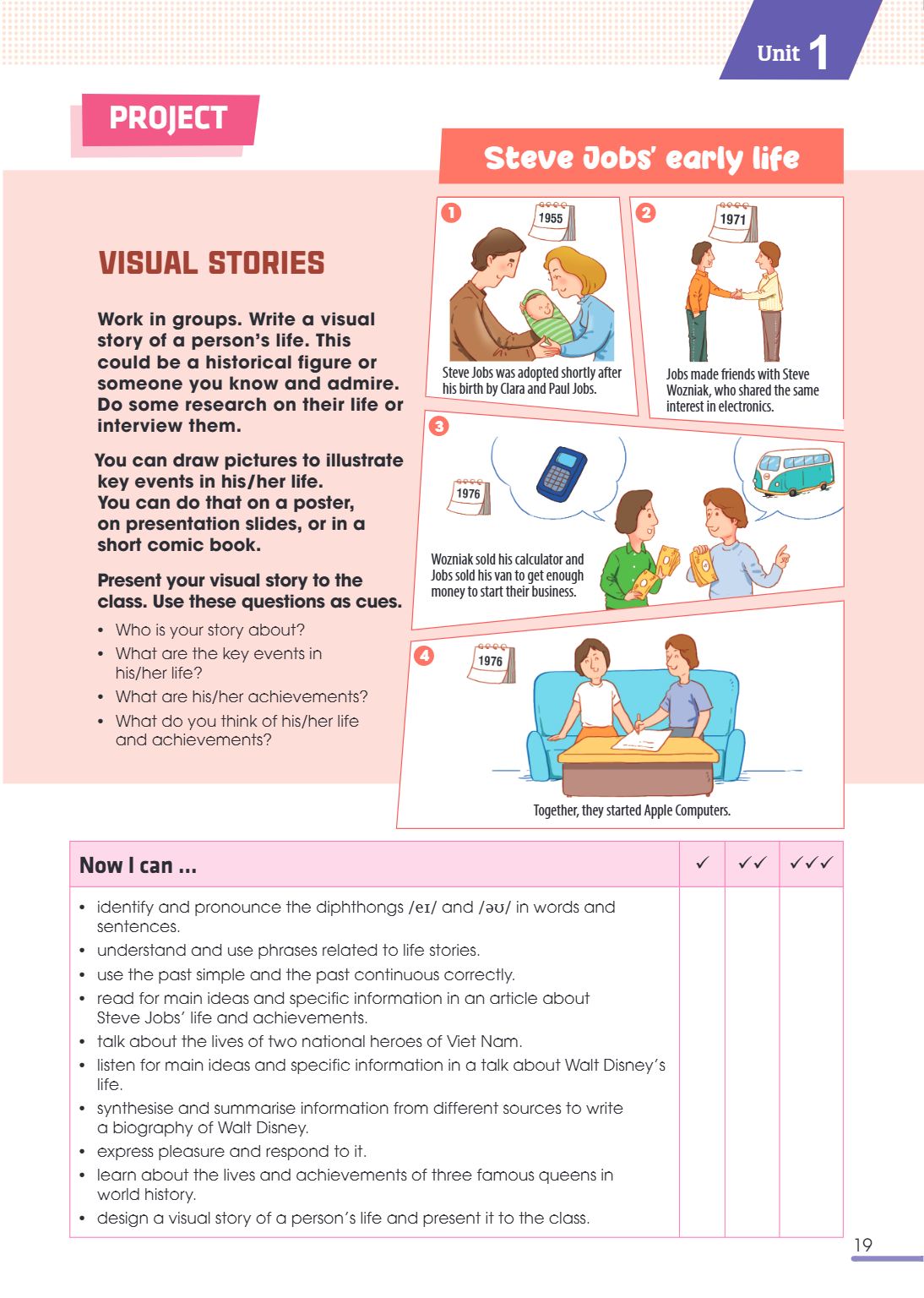
Unit 1. PROJECT VISUAL STORIES Work in groups. Write a visual story of a person's life. This could be a historical figure or someone you know and admire. Do som
Unit 1. PROJECT
VISUAL STORIES
Work in groups. Write a visual story of a person's life. This could be a historical figure or someone you know and admire. Do some research on their life or interview them.
You can draw pictures to illustrate key events in his/her life. You can do that on a poster, on presentation slides, or in a short comic book.
Present your visual story to the class. Use these questions as cues.
Who is your story about?
What are the key events in his/her life?
What are his/her achievements?
What do you think of his/her life and achievements?
Steve Jobs' early life
1.
Steve Jobs was adopted shortly after his birth by Clara and Paul Jobs.
2.
Jobs made friends with Steve Wozniak, who shared the same interest in electronics.
3.
Wozniak sold his calculator and Jobs sold his van to get enough money to start their business.
4.
Together, they started Apple Computers.
Now I can ..., ✓, ✓✓, ✓✓✓
• identify and pronounce the diphthongs /eɪ/ and /əʊ/ in words and sentences.
• understand and use phrases related to life stories.
• use the past simple and the past continuous correctly.
• read for main ideas and specific information in an article about Steve Jobs' life and achievements.
• talk about the lives of two national heroes of Viet Nam.
• listen for main ideas and specific information in a talk about Walt Disney's life.
• synthesise and summarise information from different sources to write a biography of Walt Disney.
• express pleasure and respond to it.
• learn about the lives and achievements of three famous queens in world history.
• design a visual story of a person's life and present it to the class.
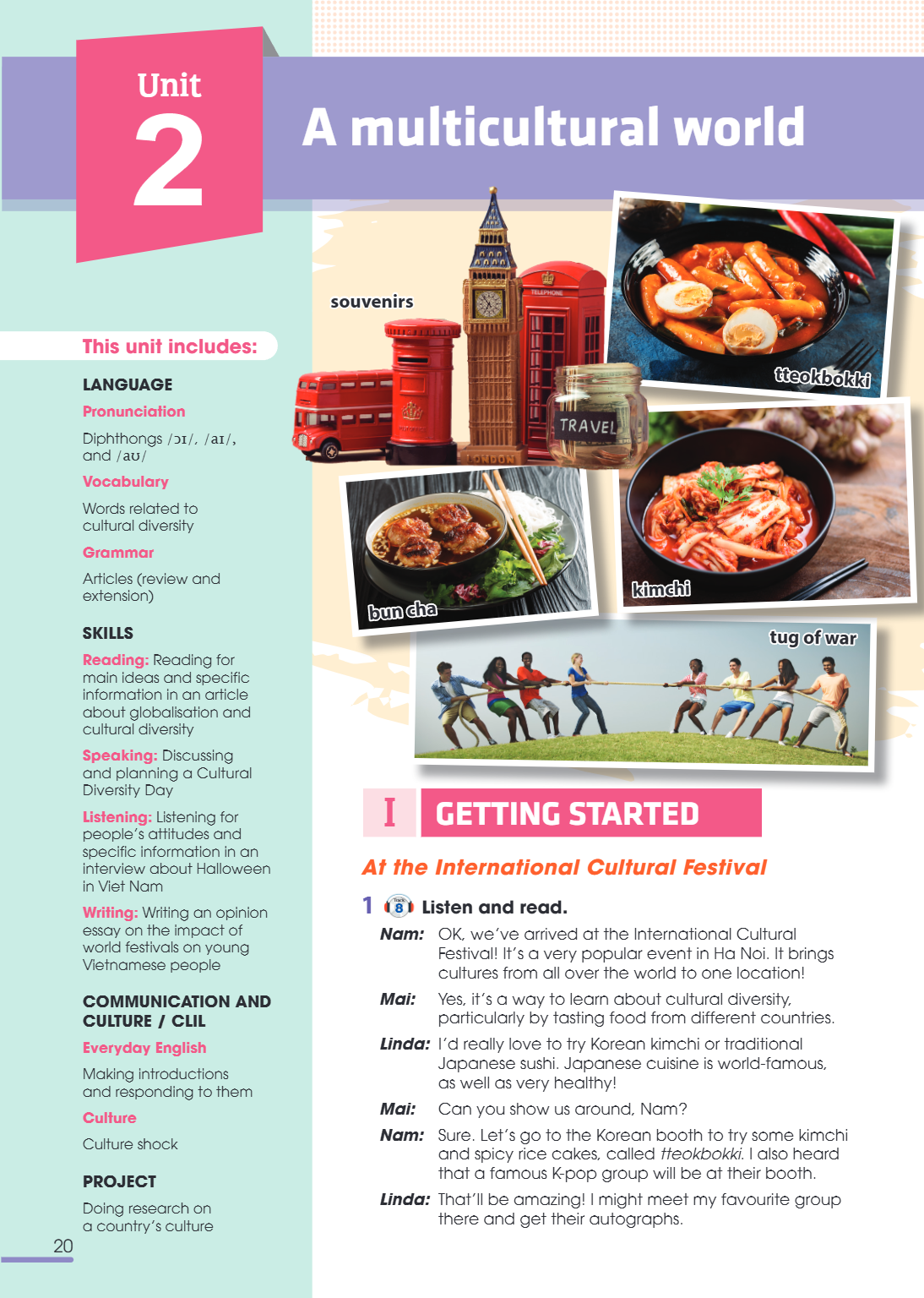
Unit 2. A MULTICULTURAL WORLD This unit includes: LANGUAGE Pronunciation Diphthongs /ʊɪ/, /aɪ/, and /aʊ/ Vocabulary Words related to cultural diversity Grammar
Unit 2. A MULTICULTURAL WORLD
This unit includes:
LANGUAGE
Pronunciation
Diphthongs /ʊɪ/, /aɪ/, and /aʊ/
Vocabulary
Words related to cultural diversity
Grammar
Articles (review and extension)
SKILLS
Reading: Reading for main ideas and specific information in an article about globalisation and cultural diversity
Speaking: Discussing and planning a Cultural Diversity Day
Listening: Listening for people's attitudes and specific information in an interview about Halloween in Viet Nam
Writing: Writing an opinion essay on the impact of world festivals on young Vietnamese people
COMMUNICATION AND CULTURE / CLIL
Everyday English
Making introductions and responding to them
Culture
Culture shock
PROJECT
Doing research on a country's culture
I GETTING STARTED
At the International Cultural Festival
1. 🎧 Listen and read.
Nam: OK, we've arrived at the International Cultural Festival! It's a very popular event in Ha Noi. It brings cultures from all over the world to one location!
Mai: Yes, it's a way to learn about cultural diversity, particularly by tasting food from different countries.
Linda: I'd really love to try Korean kimchi or traditional Japanese sushi. Japanese cuisine is world-famous, as well as very healthy!
Mai: Can you show us around, Nam?
Nam: Sure. Let's go to the Korean booth to try some kimchi and spicy rice cakes, called tteokbokki. I also heard that a famous K-pop group will be at their booth.
Linda: That'll be amazing! I might meet my favourite group there and get their autographs.
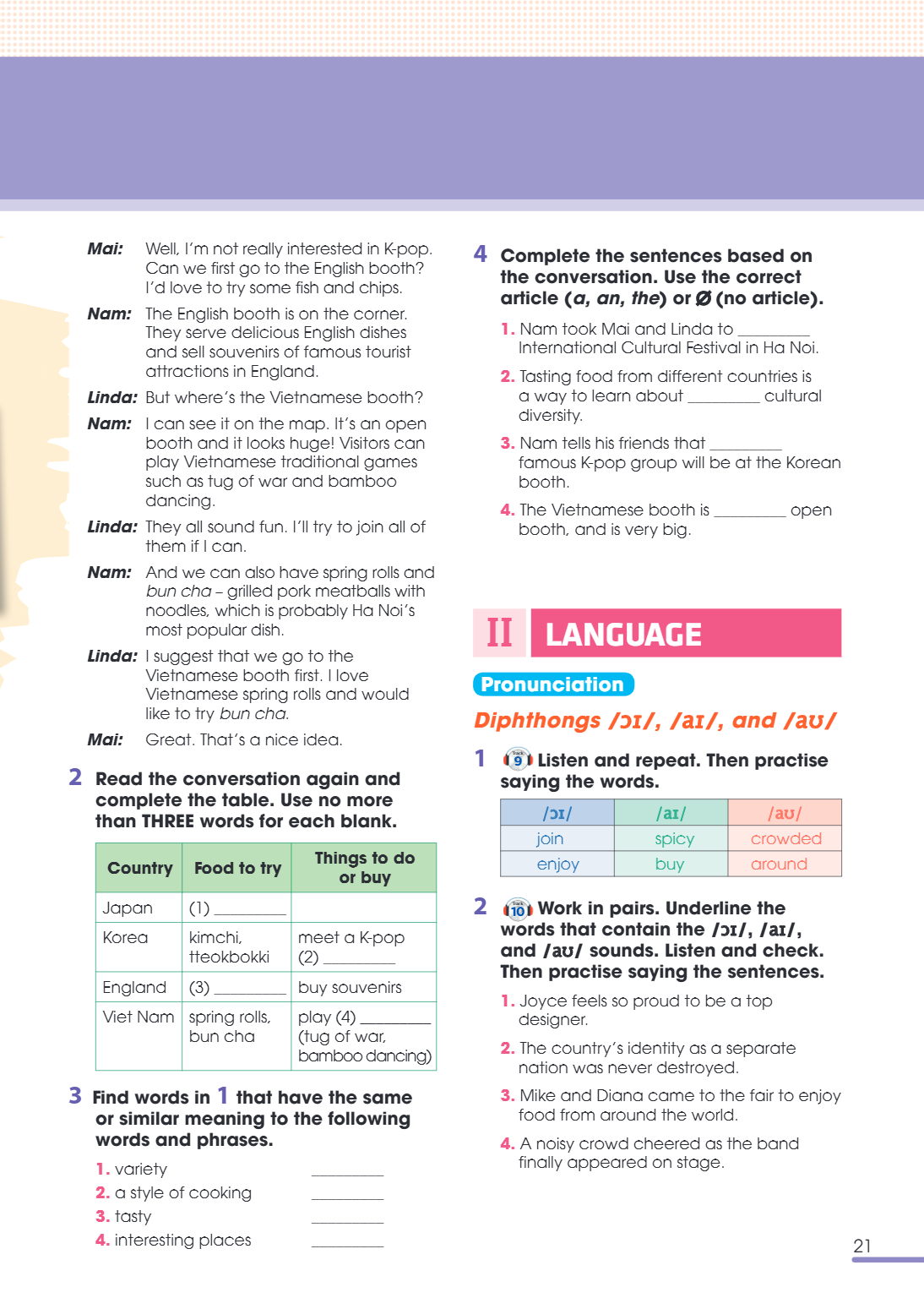
II LANGUAGE Pronunciation Diphthongs /ɔɪ/, /aɪ/, and /aʊ/ 1 Listen and repeat. Then practise saying the words. /ɔɪ/, /aɪ/, /aʊ/ join, spicy, crowded enjoy, buy,
II LANGUAGE
Pronunciation
Diphthongs /ɔɪ/, /aɪ/, and /aʊ/
1 Listen and repeat. Then practise saying the words.
/ɔɪ/, /aɪ/, /aʊ/
join, spicy, crowded
enjoy, buy, around
2 Work in pairs. Underline the words that contain the /ɔɪ/, /aɪ/, and /aʊ/ sounds. Listen and check. Then practise saying the sentences.
Joyce feels so proud to be a top designer.
The country's identity as a separate nation was never destroyed.
Mike and Diana came to the fair to enjoy food from around the world.
A noisy crowd cheered as the band finally appeared on stage.
Vocabulary Cultural diversity 1 Match the words with their meanings. 1 origin (n), a the state of being liked or supported by many people 2 popularity (n), b th
Vocabulary Cultural diversity
1 Match the words with their meanings.
1 origin (n), a the state of being liked or supported by many people
2 popularity (n), b the activities that are organised to celebrate a special event
3 identity (n), c the moment or place where something starts to exist
4 festivities (n), d a general direction in which a situation is changing
5 trend (n), e the characteristics or beliefs that make people different from others
2 Complete the sentences using the correct forms of the words in 1 .
1. Language is considered the most important feature of a nation's _________.
2. Most New Year's _________ begin on 31 December.
3. The _________ of that custom is still a mystery to local people.
4. This article discusses current _________ in fashion styles among young people.
5. The _________ of cycling among young people has increased.
Grammar Articles (review and extension)
Remember!
There are two types of articles in English: indefinite (a/an) and definite (the).
We use the indefinite articles a and an before singular, countable nouns when the reader or the listener does not know which one we are referring to. Example: I want to buy a souvenir.
We use the definite article the before singular or plural nouns when we think that the reader or the listener knows what we are referring to because of the following: - there is only one in general or only one in that context. Example: The sun rises in the east. - it has already been mentioned. Example: A boy lost a watch. A woman found the watch and returned it to the boy. - we refer to a musical instrument. Example: I'm learning to play the piano.
We also use the definite article the with: - countries whose names include words like kingdom or state, or countries which have plural nouns as their names. Example: the UK (the United Kingdom), the US (the United States of America), the Philippines - oceans, seas, mountain ranges, etc. Example: The Pacific is the largest of all oceans.
We do not need an article with plural, countable nouns or uncountable nouns which are used in a generic or non-specific way. Example: Tigers are endangered animals.
III READING Globalisation and cultural diversity 1. Work in pairs and choose the correct answers. Give examples to illustrate your choices. What is globalisatio
III READING
Globalisation and cultural diversity
1. Work in pairs and choose the correct answers. Give examples to illustrate your choices.
What is globalisation?
A. The limited trade between nations.
B. The integration and interaction between people, businesses and governments from different nations.
How does globalisation impact cultural diversity in the world?
A. It has no impact on cultural diversity.
B. It can increase cultural diversity.
2. Read the article and match each section (A–C) with a heading (1–5). There are TWO extra headings.
The effects of globalisation on cultural diversity As a result of globalisation, the world is becoming more and more connected. This has changed people's way of
The effects of globalisation on cultural diversity As a result of globalisation, the world is becoming more and more connected. This has changed people's way of life, beliefs, art and customs, or their culture, in many respects. Although, 1. Discovering K-pop music 2. Blending fashion styles 3. Fast food popularity 4. No borders for music 5. Variety of cuisines
people's experiences around the world have become very similar, globalisation has also encouraged cultural diversity. Below are some A. _________ Fast food chains and international restaurants have become popular, dishes and more food choices to local people. For example, here in Viet pizza or Japanese sushi, in addition to our traditional food. Moreover, local ingredients, which make them unique and more suitable to local Vietnamese specialities, such as phoand banhmi, are also gaining B. _________ Thanks to globalisation, people can quickly discover new music from all nowadays enjoy listening to music from different countries and cultures, languages. For example, American teens are captivated by K-pop music also many music festivals around the globe that bring artists and music connected world, it is very common for musicians across the world to share ideas together. C. _________ Globalisation has also impacted fashion by opening it up to a variety of around the world. Cross-cultural styles that blend both traditional and This presents opportunities for fashion designers to be creative and reflect world. It is now easier for people to keep up with fashion trends from express their identities in new and exciting ways. In conclusion, globalisation has helped strengthen cultural diversity in the appreciate different cultures and lifestyles., examples. offering a wide range of Nam, we can enjoy Italian some international dishes use tastes. On the other hand, popularity worldwide. over the world. People and in different and dance. There are fans together. In today's work on music projects and styles and influences from modern elements are on the rise. the cultural richness of the different cultures and regions, and world and made people
3 Read the article again and choose the correct answer A, B, or C.
1. How has globalisation affected people's eating habits?
A. It has decreased the popularity of traditional food. page 146
B. It has limited people's food choices to local dishes.
C. Local people are trying new cuisines.
Which of the following is NOT mentioned as something that local people can try in Viet Nam?
A. Dishes from other cultures using ingredients grown in Viet Nam.
B. Traditional dishes using international ingredients.
C. A Japanese dish of cooked rice and raw fish.
3. What can be inferred from the passage about music?
A. Music has connected people across cultures.
B. Teens around the world love listening to K-pop music.
C. It is easier to organise music festivals.
IV SPEAKING Planning a Cultural Diversity Day 1 Work in pairs. Discuss the differences between Vietnamese culture and some other cultures you know about. Use th
IV SPEAKING
Planning a Cultural Diversity Day
1 Work in pairs. Discuss the differences between Vietnamese culture and some other cultures you know about. Use the ideas in ==Getting Started== and ==Reading==, and the table and examples below to help you.
Country, Viet Nam, South Korea, ...
Cuisine, pho, bun cha, spring rolls, kimchi, tteokbokki
Music
Traditional clothing
Example:
A: South Koreans seem to eat a lot of spicy food, such as kimchi and tteokbokki, while our traditional dishes, like bun cha and pho, are not very spicy in general.
B: I agree. How about music? I think in both countries, young people like to listen to pop music, but K-pop focuses mainly on dance groups while our pop music is usually produced by solo artists.
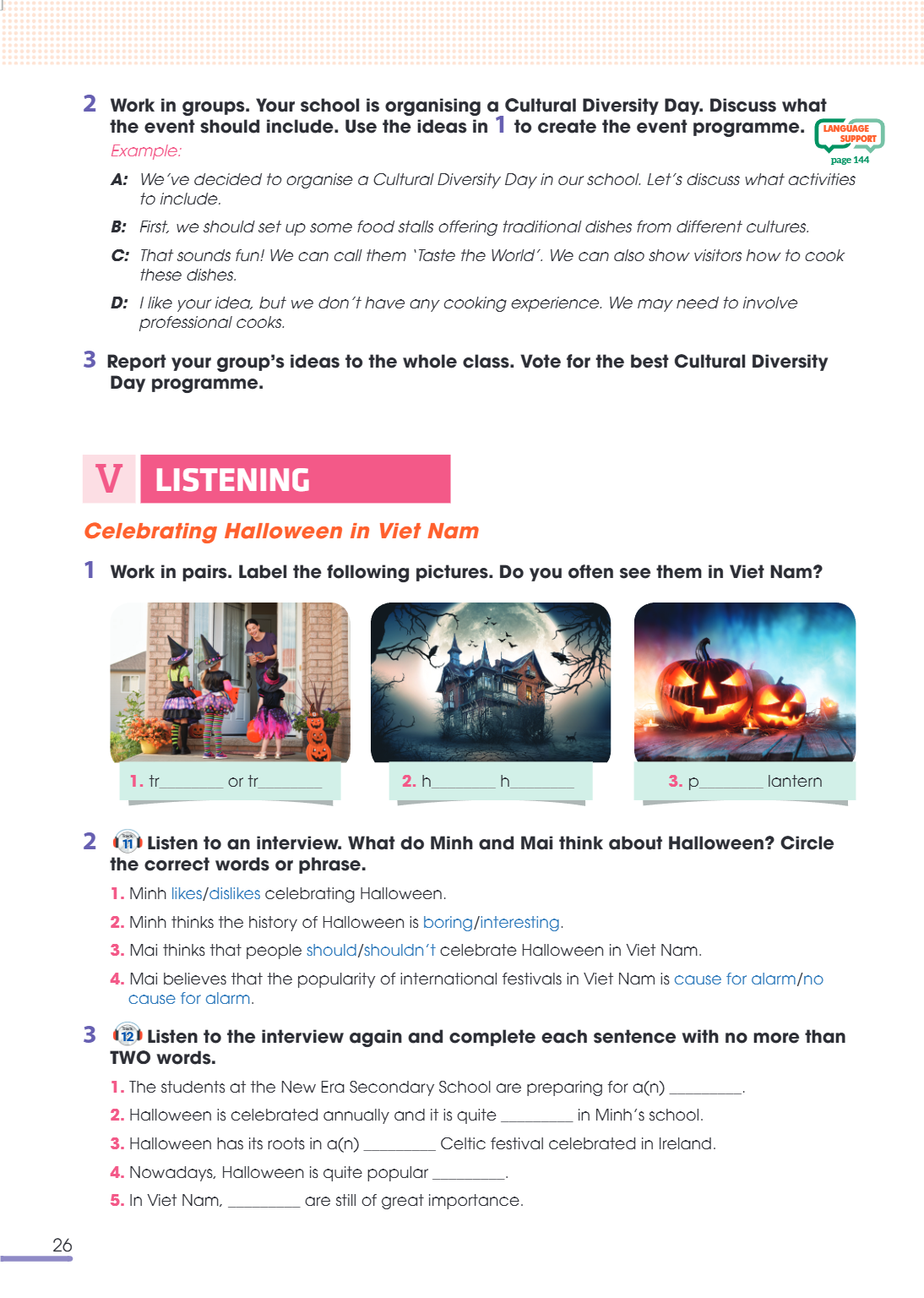
V listening Celebrating Halloween in Viet Nam 1 Work in pairs. Label the following pictures. Do you often see them in Viet Nam? tr________ ortr________ h_______
V listening
Celebrating Halloween in Viet Nam
1 Work in pairs. Label the following pictures. Do you often see them in Viet Nam?
tr________ ortr________
h________ h________
p________ lantern
2 Listen to an interview. What do Minh and Mai think about Halloween? Circle
the correct words or phrase.
Track
11
Minh likes/dislikes celebrating Halloween.
Minh thinks the history of Halloween is boring/interesting.
Mai thinks that people should/shouldn’t celebrate Halloween in Viet Nam.
Mai believes that the popularity of international festivals in Viet Nam is cause for alarm/no
cause for alarm.
3 Listen to the interview again and complete each sentence with no more than
TWO words.
Track
12
The students at the New Era Secondary School are preparing for a(n) _________.
Halloween is celebrated annually and it is quite _________ in Minh’s school.
Halloween has its roots in a(n) _________ Celtic festival celebrated in Ireland.
Nowadays, Halloween is quite popular _________.
In Viet Nam, _________ are still of great importance.
26
VI WRITING An opinion essay on the impact of world festivals on young Vietnamese people 1. Work in pairs. Decide whether the following points are positive or ne
VI WRITING
An opinion essay on the impact of world festivals on young Vietnamese people
1. Work in pairs. Decide whether the following points are positive or negative impact of celebrating world festivals. Discuss the reasons.
World festivals ..., Positive, Negative
1. encourage people to buy things they don't need.
2. encourage extracurricular activities.
3. may make people lose their sense of identity.
4. bring a lot of fun, happiness, and joy.
5. may make young people ignore local festivals.
6. help young people learn about other cultures.
Example:
A: I think world festivals are expensive to celebrate, which can have negative impact on young people.
B: I agree with you. Most students don't have a lot of money, and shouldn't waste their pocket money on things they don't often use like Halloween costumes or Christmas decorations.
2. Write an opinion essay (180 words) on the following topic. Use the ideas in 1 and the outline and suggestions below to help you.
Nowadays, more and more young Vietnamese people celebrate festivals such as Christmas and Halloween. Some people think there is nothing wrong with this while others are worried about the influence of foreign cultures. What is your opinion?
Introduction
Nowadays, more and more young people ... In my opinion, this has positive/negative impact on young Vietnamese people.
Body
Firstly, ...
Secondly, ...
Finally, ...
Conclusion
In conclusion, I firmly believe that ...
VII COMMUNICATION AND CULTURE / CLIL Everyday English Making introductions and responding to them 1. [13] Listen and complete the conversations with the express
VII COMMUNICATION AND CULTURE / CLIL
Everyday English
Making introductions and responding to them
1. [13] Listen and complete the conversations with the expressions in the box. Then practise them in pairs.
A. It's nice to meet you all
B. I'd like you to meet
C. this is
D. Pleased to meet you
1
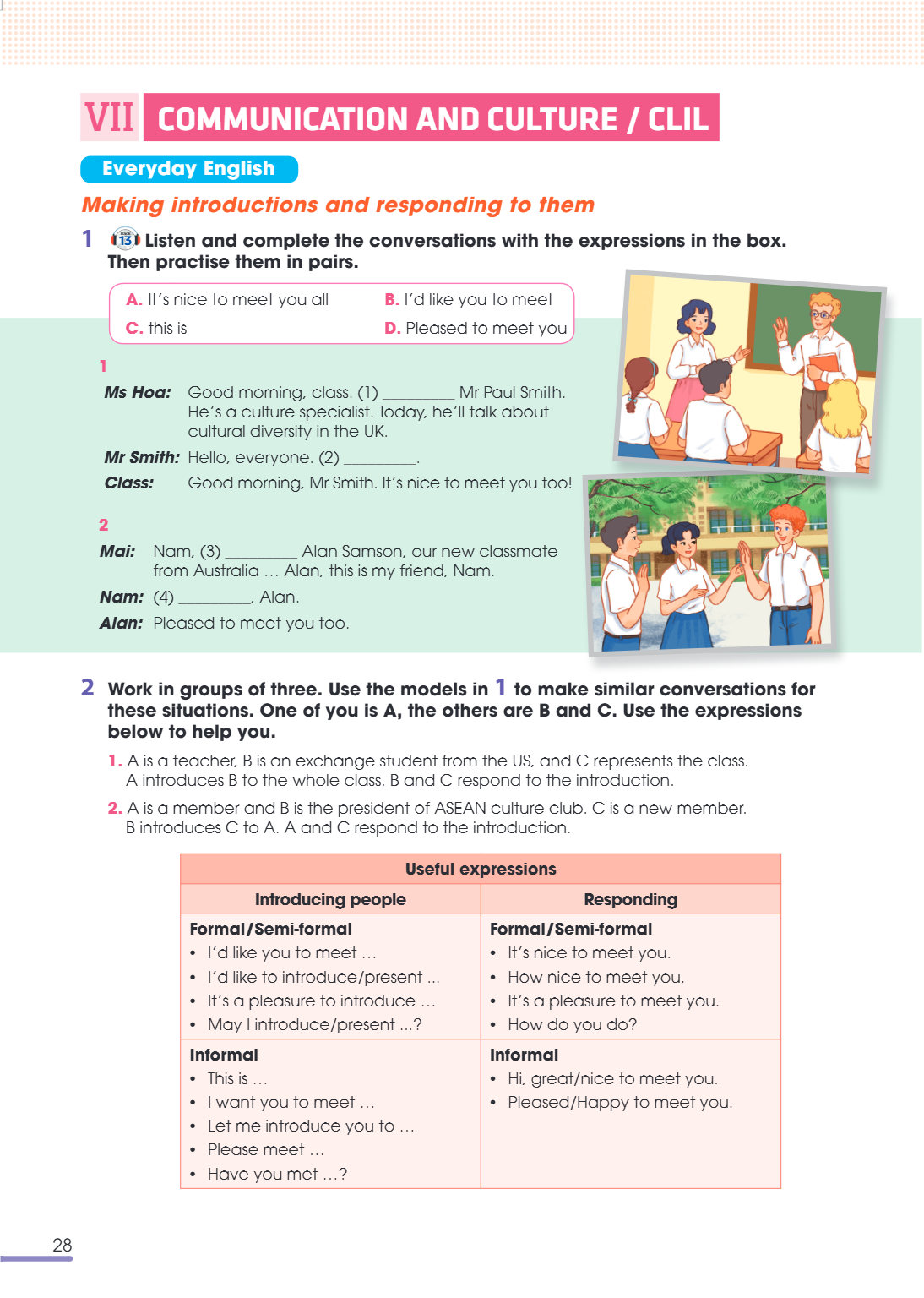
Ms Hoa: Good morning, class. (1) ______ Mr Paul Smith. He's a culture specialist. Today, he'll talk about cultural diversity in the UK.
Mr Smith: Hello, everyone. (2) ______.
Class: Good morning, Mr Smith. It's nice to meet you too!
2
Mai: Nam, (3) ______ Alan Samson, our new classmate from Australia ... Alan, this is my friend, Nam.
Nam: (4) ______, Alan.
Alan: Pleased to meet you too.
2. Work in groups of three. Use the models in 1 to make similar conversations for these situations. One of you is A, the others are B and C. Use the expressions below to help you.
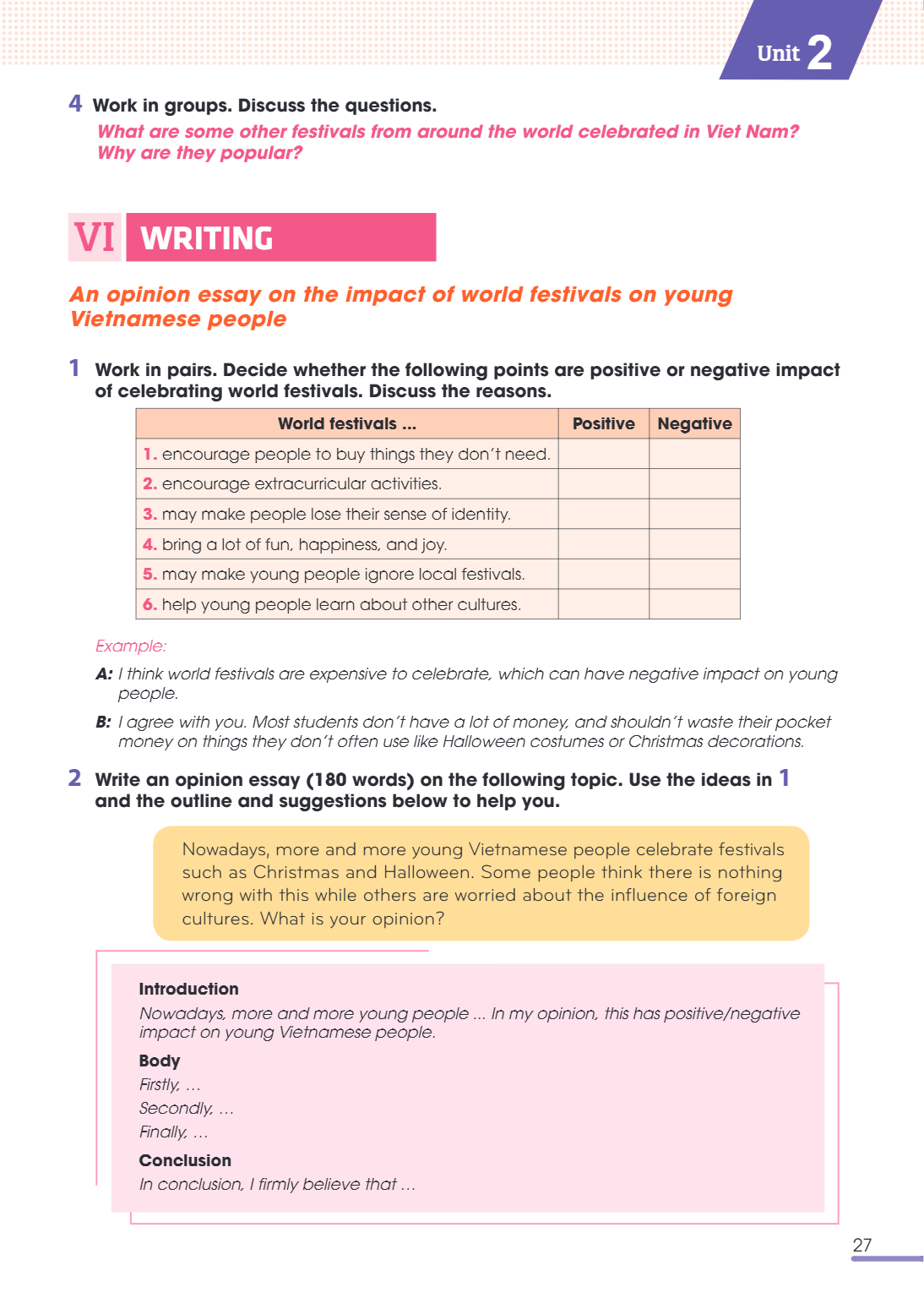
A is a teacher, B is an exchange student from the US, and C represents the class. A introduces B to the whole class. B and C respond to the introduction.
A is a member and B is the president of ASEAN culture club. C is a new member. B introduces C to A. A and C respond to the introduction.
Introducing people, Responding
Formal/Semi-formal • I'd like you to meet ... • I'd like to introduce/present ... • It's a pleasure to introduce ... • May I introduce/present ...? Informal • This is ... • I want you to meet ... • Let me introduce you to ... • Please meet ... • Have you met ...?, Formal/Semi-formal • It's nice to meet you. • How nice to meet you. • It's a pleasure to meet you. • How do you do? Informal • Hi, great/nice to meet you. • Pleased/Happy to meet you.
Unit2 Culture 1 Read the text and put a tick (✓) or cross (✗) in the box next to the pictures to show the appropriate behaviour in different cultures. Culture s
Unit2
Culture
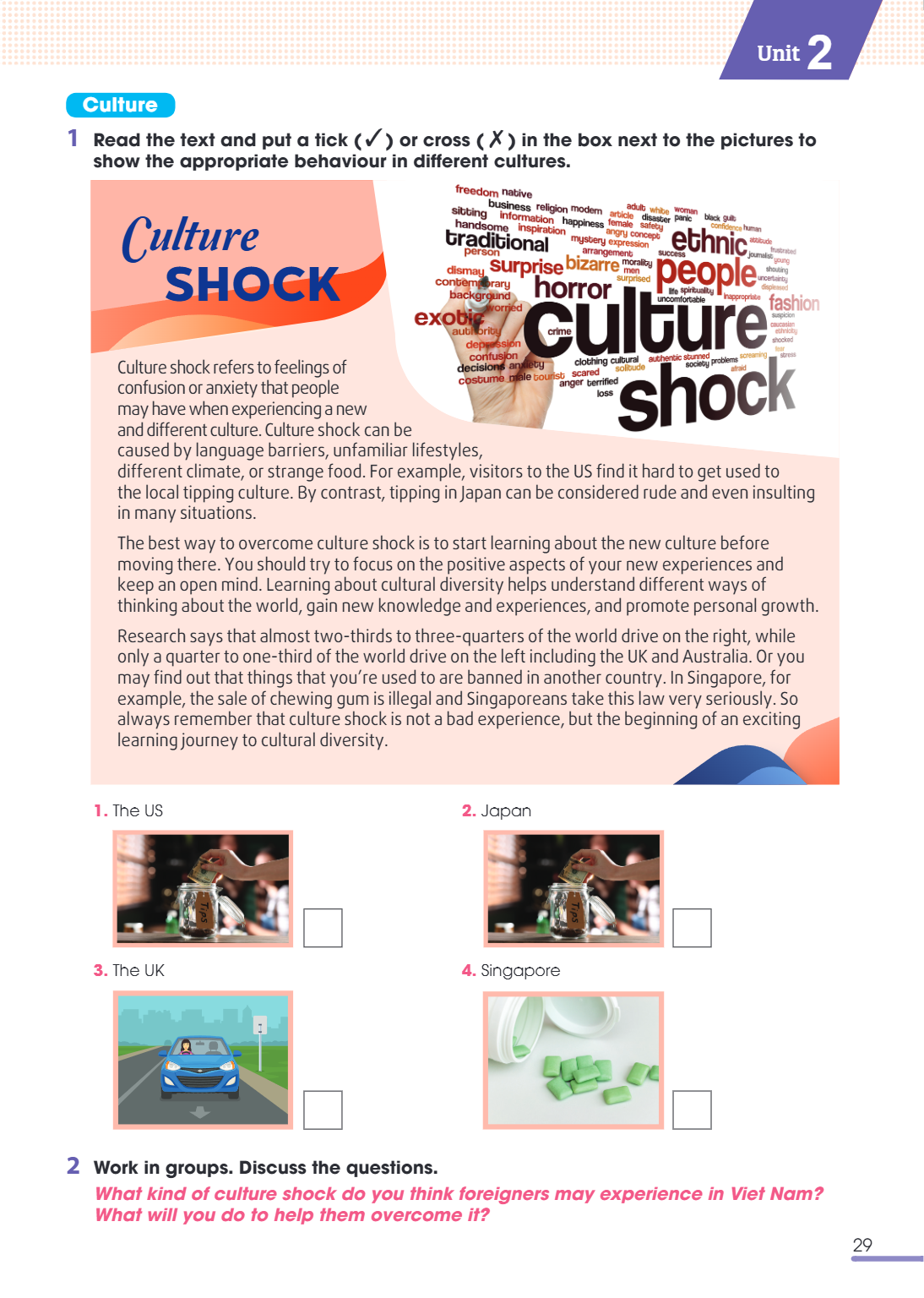
1 Read the text and put a tick (✓) or cross (✗) in the box next to the pictures to
show the appropriate behaviour in different cultures.
Culture
shock
Culture shock refers to feelings of confusion or anxiety that people may have when experiencing a new and different culture.Culture shock can be caused by language barriers, unfamiliar lifestyles, different climate, or strange food. For example, visitors to the US find it hard to get used to the local tipping culture. By contrast, tipping in Japan can be considered rude and even insulting in many situations. The best way to overcome culture shock is to start learning about the new culture before moving there. You should try to focus on the positive aspects of your new experiences and keep an open mind. Learning about cultural diversity helps understand different ways of thinking about the world, gain new knowledge and experiences, and promote personal growth. Research says that almost two-thirds to three-quarters of the world drive on the right, while only a quarter to one-third of the world drive on the left including the UK and Australia. Or you may find out that things that you're used to are banned in another country. In Singapore, for example, the sale of chewing gum is illegal and Singaporeans take this law very seriously. So
always remember that culture shock is not a bad experience, but the beginning of an exciting learning journey to cultural diversity.
1. The US 2. Japan
3. The UK 4. Singapore
2 Work in groups. Discuss the questions.
What kind of culture shock do you think foreigners may experience in Viet Nam? What will you do to help them overcome it?
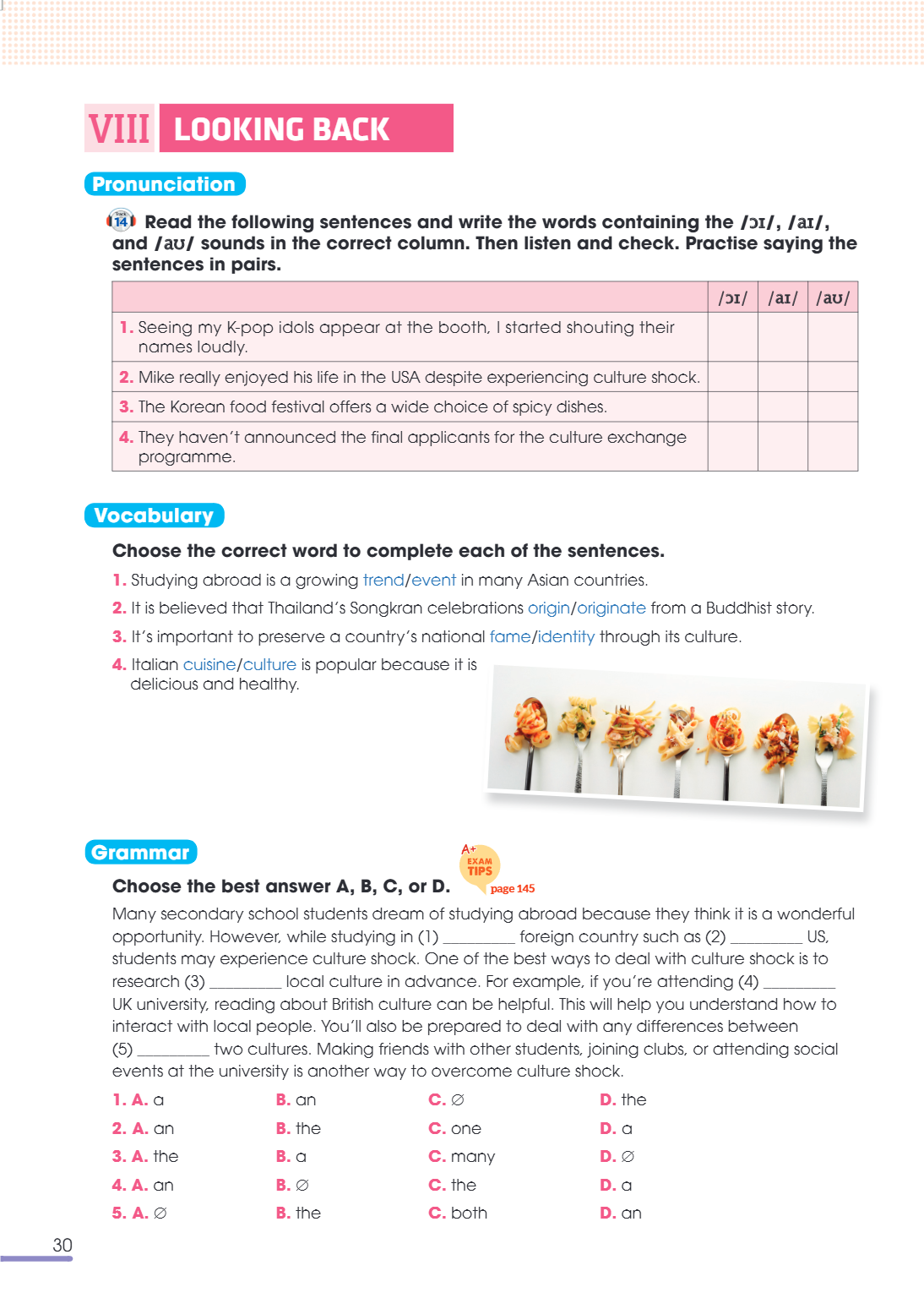
VIII LOOKING BACK Pronunciation 14 Read the following sentences and write the words containing the /ɔɪ/, /aɪ/, and /aʊ/ sounds in the correct column. Then liste
VIII LOOKING BACK
Pronunciation
14 Read the following sentences and write the words containing the /ɔɪ/, /aɪ/, and /aʊ/ sounds in the correct column. Then listen and check. Practise saying the sentences in pairs.
/ɔɪ/, /aɪ/, /aʊ/
1. Seeing my K-pop idols appear at the booth, I started shouting their names loudly.
2. Mike really enjoyed his life in the USA despite experiencing culture shock.
3. The Korean food festival offers a wide choice of spicy dishes.
4. They haven't announced the final applicants for the culture exchange programme.
Vocabulary
Choose the correct word to complete each of the sentences.
Studying abroad is a growing trend/event in many Asian countries.
It is believed that Thailand's Songkran celebrations origin/originate from a Buddhist story.
It's important to preserve a country's national fame/identity through its culture.
Italian cuisine/culture is popular because it is delicious and healthy.
Grammar
A+ EXAM TIPS page 145
Choose the best answer A, B, C, or D.
Many secondary school students dream of studying abroad because they think it is a wonderful opportunity. However, while studying in (1) ________ foreign country such as (2) ________ US, students may experience culture shock. One of the best ways to deal with culture shock is to research (3) ________ local culture in advance. For example, if you're attending (4) ________ UK university, reading about British culture can be helpful. This will help you understand how to interact with local people. You'll also be prepared to deal with any differences between (5) ________ two cultures. Making friends with other students, joining clubs, or attending social events at the university is another way to overcome culture shock.
1. A. a B. an C. Ø D. the
2. A. an B. the C. one D. a
3. A. the B. a C. many D. Ø
4. A. an B. Ø C. the D. a
5. A. Ø B. the C. both D. an
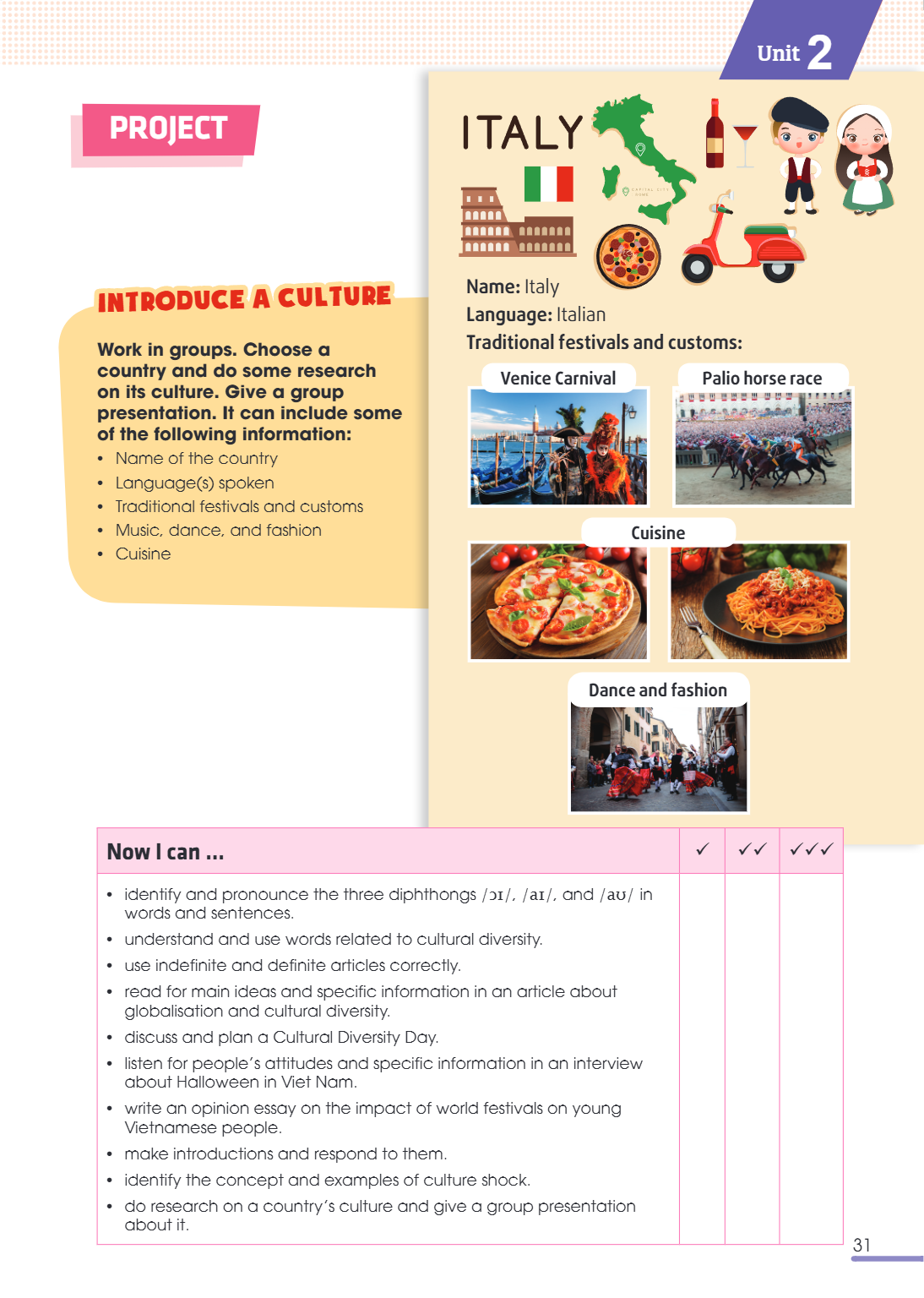
Unit2 Project INTRODUCE A CULTURE Name: Italy Language: Italian country and do some research Venice Carnival Palio horse race Work in groups. Choose a Tradition
Unit2
Project
INTRODUCE A CULTURE Name: Italy
Language: Italian country and do some research Venice Carnival Palio horse race
Work in groups. Choose a Traditional festivals and customs: on its culture. Give a group
presentation. It can include some of the following information:
Name of the country
Language(s) spoken
Traditional festivals and customs
Music, dance, and fashion Cuisine
Cuisine
Dance and fashion
Now can ...   
I
identify and pronounce the three diphthongs /ɔɪ/, /aɪ/, and /aʊ/ in words and sentences.
understand and use words related to cultural diversity.
use indefinite and definite articles correctly.
read for main ideas and specific information in an article about globalisation and cultural diversity.
discuss and plan a Cultural Diversity Day.
listen for people's attitudes and specific information in an interview about Halloween in Viet Nam.
write an opinion essay on the impact of world festivals on young Vietnamese people.
make introductions and respond to them.
identify the concept and examples of culture shock.
do research on a country's culture and give a group presentation about it.
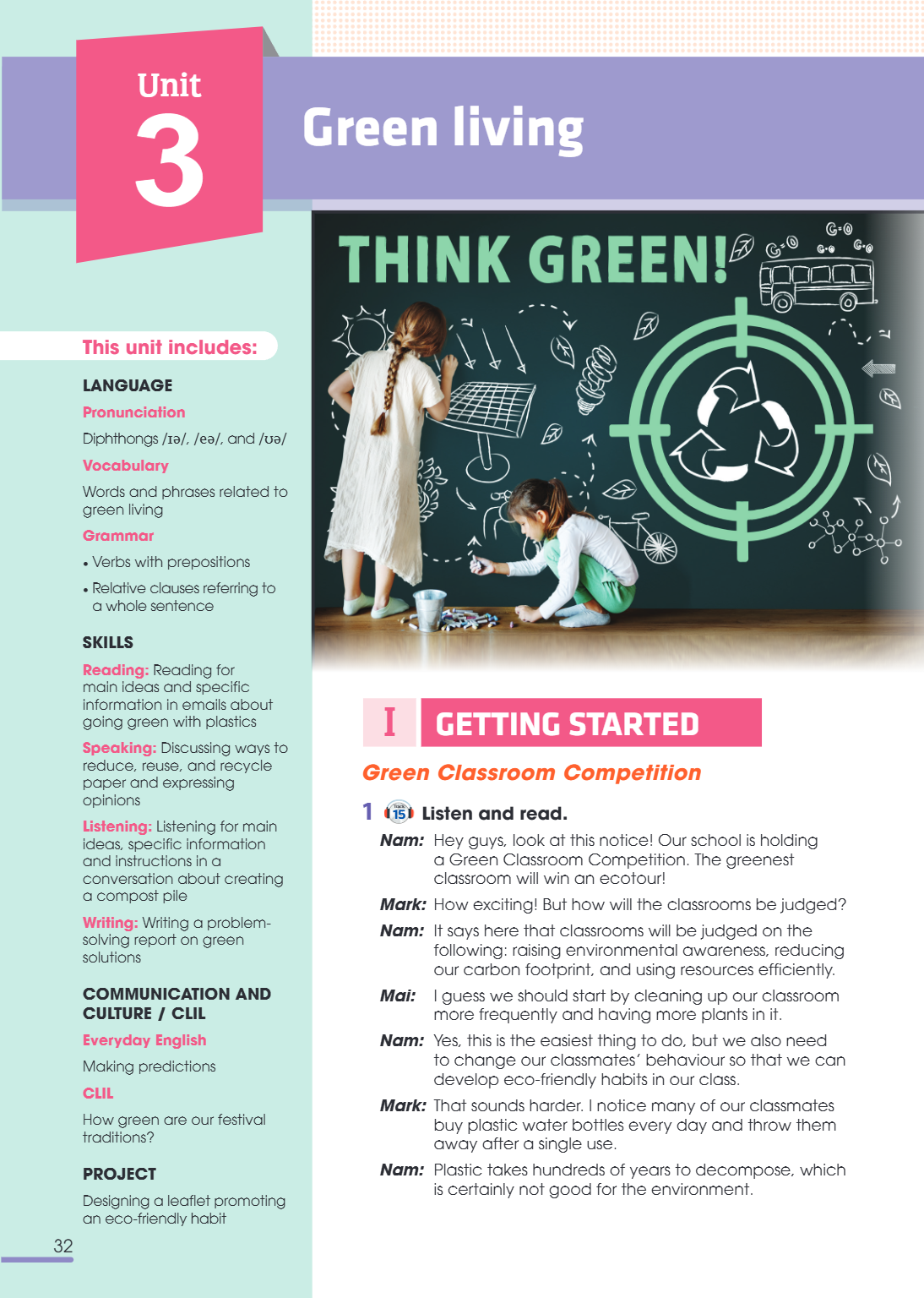
Unit 3. GREEN LIVING This unit includes: LANGUAGE Pronunciation Diphthongs /ʊə/, /eə/, and /ɪə/ Vocabulary Words and phrases related to green living Grammar • V
Unit 3. GREEN LIVING
This unit includes:
LANGUAGE
Pronunciation
Diphthongs /ʊə/, /eə/, and /ɪə/
Vocabulary
Words and phrases related to green living
Grammar
• Verbs with prepositions
• Relative clauses referring to a whole sentence
SKILLS
Reading: Reading for main ideas and specific information in emails about going green with plastics
Speaking: Discussing ways to reduce, reuse, and recycle paper and expressing opinions
Listening: Listening for main ideas, specific information and instructions in a conversation about creating a compost pile
Writing: Writing a problem-solving report on green solutions
COMMUNICATION AND CULTURE / CLIL
Everyday English
Making predictions
CLIL
How green are our festival traditions?
PROJECT
Designing a leaflet promoting an eco-friendly habit
I GETTING STARTED
Green Classroom Competition
1. Listen and read.
Nam: Hey guys, look at this notice! Our school is holding a Green Classroom Competition. The greenest classroom will win an ecotour!
Mark: How exciting! But how will the classrooms be judged?
Nam: It says here that classrooms will be judged on the following: raising environmental awareness, reducing our carbon footprint, and using resources efficiently.
Mai: I guess we should start by cleaning up our classroom more frequently and having more plants in it.
Nam: Yes, this is the easiest thing to do, but we also need to change our classmates' behaviour so that we can develop eco-friendly habits in our class.
Mark: That sounds harder. I notice many of our classmates buy plastic water bottles every day and throw them away after a single use.
Nam: Plastic takes hundreds of years to decompose, which is certainly not good for the environment.
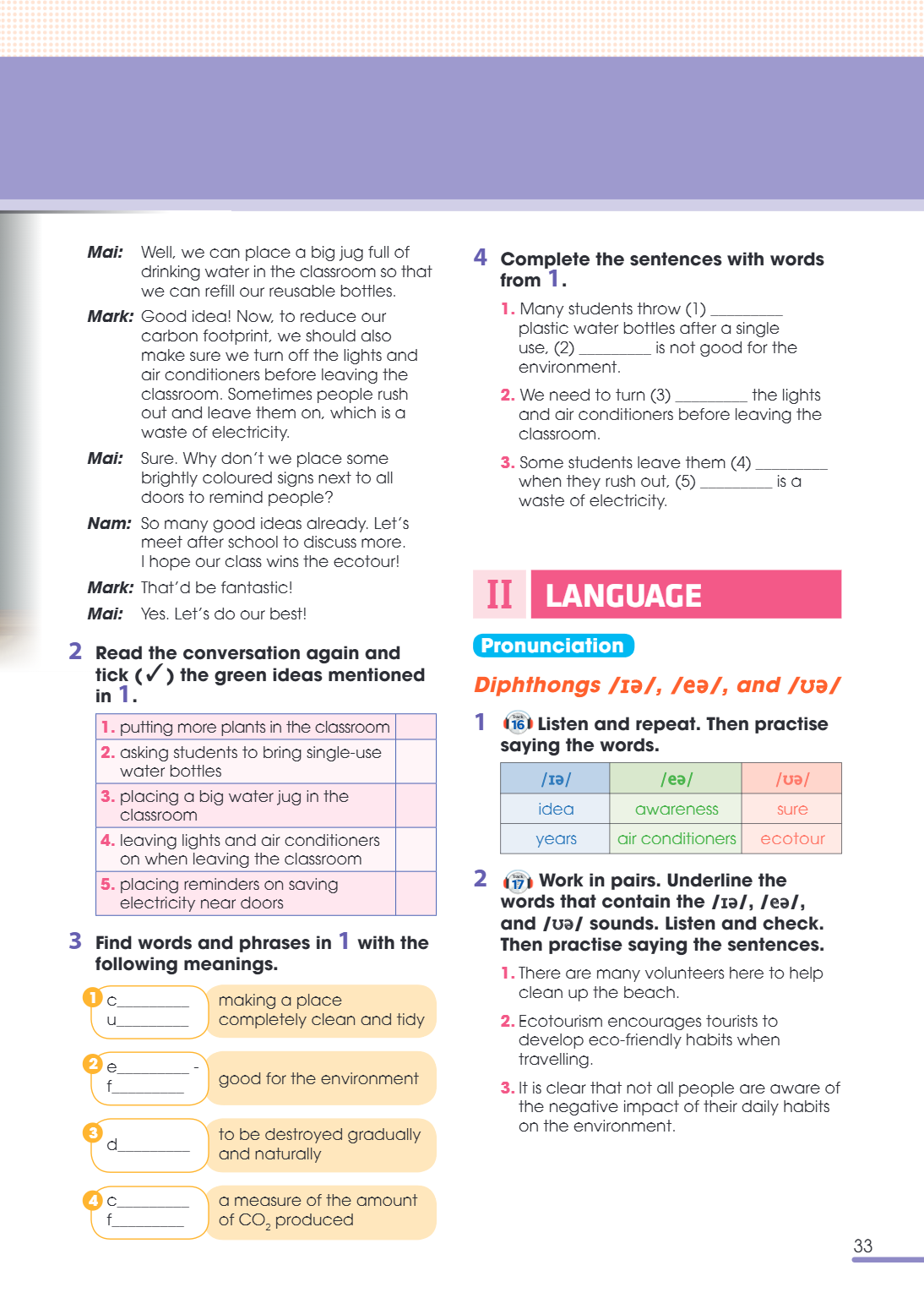
II LANGUAGE Pronunciation Diphthongs /ɪə/, /eə/, and /ʊə/ 1 Listen and repeat. Then practise saying the words. /ɪə/, /eə/, /ʊə/ idea, awareness, sure years, air
II LANGUAGE
Pronunciation
Diphthongs /ɪə/, /eə/, and /ʊə/
1 Listen and repeat. Then practise saying the words.
/ɪə/, /eə/, /ʊə/
idea, awareness, sure
years, air conditioners, ecotour
2 Work in pairs. Underline the words that contain the /ɪə/, /eə/, and /ʊə/ sounds. Listen and check. Then practise saying the sentences.
1. There are many volunteers here to help clean up the beach.
2. Ecotourism encourages tourists to develop eco-friendly habits when travelling.
3. It is clear that not all people are aware of the negative impact of their daily habits on the environment.
Vocabulary Green living 1. Match each word (1–5) with its meaning (a–e). 1 waste (n), a an area of land where waste materials are buried under the surface 2 lan
Vocabulary
Green living
1. Match each word (1–5) with its meaning (a–e).
1 waste (n), a an area of land where waste materials are buried under the surface
2 landfill (n), b materials used to wrap or protect things we buy from shops
c something such as a box or bowl that you can use to keep things in
d to use something again
e the act of using something in a careless way, causing it to be lost or destroyed
3 reuse (v)
4 packaging (n)
5 container (n)
2. Complete the following sentences using the correct forms of the words in 1.
We should fix the leaking tap. It's a _________ of clean water!
Takeaway food includes a lot of unnecessary _________ such as single-use containers and plastic bags.
We always try to buy food packed in recyclable _________.
A creative way to _________ old greeting cards is to make gift tags and bookmarks.
The waste in open _________ sites can release harmful gases into the atmosphere.
Grammar
Verbs with prepositions
Remember!
Many verbs go with a preposition followed by an object. The meaning of these two words is usually very similar to the original meaning of the verb.
Example:
verbs with ==about==: ask about, care about, talk about, think about, learn about
verbs with ==for==: ask for, apply for, apologise for, wait for, prepare for
verbs with ==on==: agree on, base on, depend on, rely on
verbs with ==to==: introduce to, refer to, respond to, listen to, explain to
In some cases, a verb and a preposition are combined to make a (two-word) phrasal verb. The meaning of a phrasal verb is often very different from the original meaning of the main verb. Phrasal verbs use adverbs as well as prepositions.
Example: work out, carry out, turn on, turn off, look for, look after, look up
III READING Going green with plastics 1. Work in pairs to solve the quiz. It takes about ________ years for one plastic bottle to decompose in the ground. A. 4.
III READING
Going green with plastics
1. Work in pairs to solve the quiz.
It takes about ________ years for one plastic bottle to decompose in the ground.
A. 4.5 B. 45 C. 450
Around ________ plastic bottles are thrown away every year.
A. 13 thousand B. 13 million C. 13 billion
Plastic bags and other plastic waste kill around ________ sea animals every year.
A. 100 million B. 10 million C. 1 million
Nearly ________ of plastic ever made still exists today.
A. 100% B. 50% C. 10%
2. Read some extracts from the emails sent to the Teen magazine. Match the highlighted words and phrases (1–4) with the pictures (a–d). GO GREEN WITH PLASTICS!
2. Read some extracts from the emails sent to the Teen magazine. Match the highlighted words and phrases (1–4) with the pictures (a–d).
GO GREEN WITH PLASTICS!
Plastic has become very common in our daily life; however, most plastic items take up to 1,000 years to decompose in landfills. Can we enjoy the convenience of plastics and a greener world at the same time? Our readers have sent us many emails with useful tips this week.
... I try to use fewer plastic bags when shopping. The supermarket near my house even provides ==cardboard boxes==, so I can pack my groceries and get rid of plastic packaging! When I must use plastic bags, I try to reuse them again and again instead of throwing them away after a single use. ...
Hai, 18
... I know how convenient it is to buy a bottle of water from a vending machine or a supermarket; however, I always bring my reusable water bottle. All I have to remember is to fill my bottle before going to school, and then use the water filling stations or drinking fountains at school. ...
Phuong, 16
... I always reuse plastic takeaway containers. I use them to store portions of cooked food and keep ==leftovers== in the fridge, which is also better for the environment. ...
Hoang, 15
Plastics recycling symbol
... I have learnt that most plastic containers have numbers at the bottom to show the type of plastic they're made of. So when you recycle a bottle, for instance, remove the cap because a bottle often has number 1 on it while the cap often has number 5. Numbers 1 and 2 are the most widely accepted plastics for recycling. ...
Ha, 16
... When I started recycling, I made the mistake of putting some plastic takeaway containers with some leftover food into the recycling bin. The next day, the whole bin was ==contaminated==, so all the recyclables were taken to the landfill instead. So now I always ==rinse out== containers before recycling them. ...
Binh, 17
a, 1 cardboard boxes, c
b, 2 leftovers
3 contaminated, d
4 rinse out
IV SPEAKING Paper: Reduce, Reuse, and Recycle! 1. How can we save trees, energy, and water used to make paper? Sort these activities into Reduce, Reuse, or Recy
IV SPEAKING
Paper: Reduce, Reuse, and Recycle!
1. How can we save trees, energy, and water used to make paper? Sort these activities into Reduce, Reuse, or Recycle activities.
a. Choosing recycled paper for daily use, ________
b. Sorting paper waste, ________
c. Printing on both sides of the paper, ________
d. Using old paper as compost, ________
e. Using reusable containers rather than paper for packaging, ________
f. Using smart devices to take notes instead of using paper, ________
g. Using the blank side of a sheet to take notes, ________
h. Avoiding printing things out as much as possible, ________
i. Keeping paper waste as clean as possible, ________
2. Work in pairs. Talk about how to reduce, reuse, and recycle paper. Use these questions to help you.
Which of the activities (a–i) above are you doing?
Can you suggest more ideas? How will they help save the environment?
LANGUAGE SUPPORT
page 144
3. Work in groups. Read the situations below and think of some possible responses to promote a greener lifestyle. Provide reasons for each answer.
After a club meeting, you notice that there are a lot of leaflets left, and they are only printed on one side. Your friend is asking you to help throw them away.
Example: 'Do not throw them away. We should reuse these leaflets by using the blank pages to take notes, which will save natural resources such as trees and water.'
Your group is preparing for a presentation, and everyone has found a lot of useful online material. A group member is asking you to print out about 50 pages of information for the group to read.
Your club is organising a meeting, including a game in which people should write down something about themselves to share with others. The club president is asking you to buy a lot of Post-it notes for the game.
LANGUAGE SUPPORT
page 144
4. Report your group's answers to the whole class. Vote for the most interesting responses.
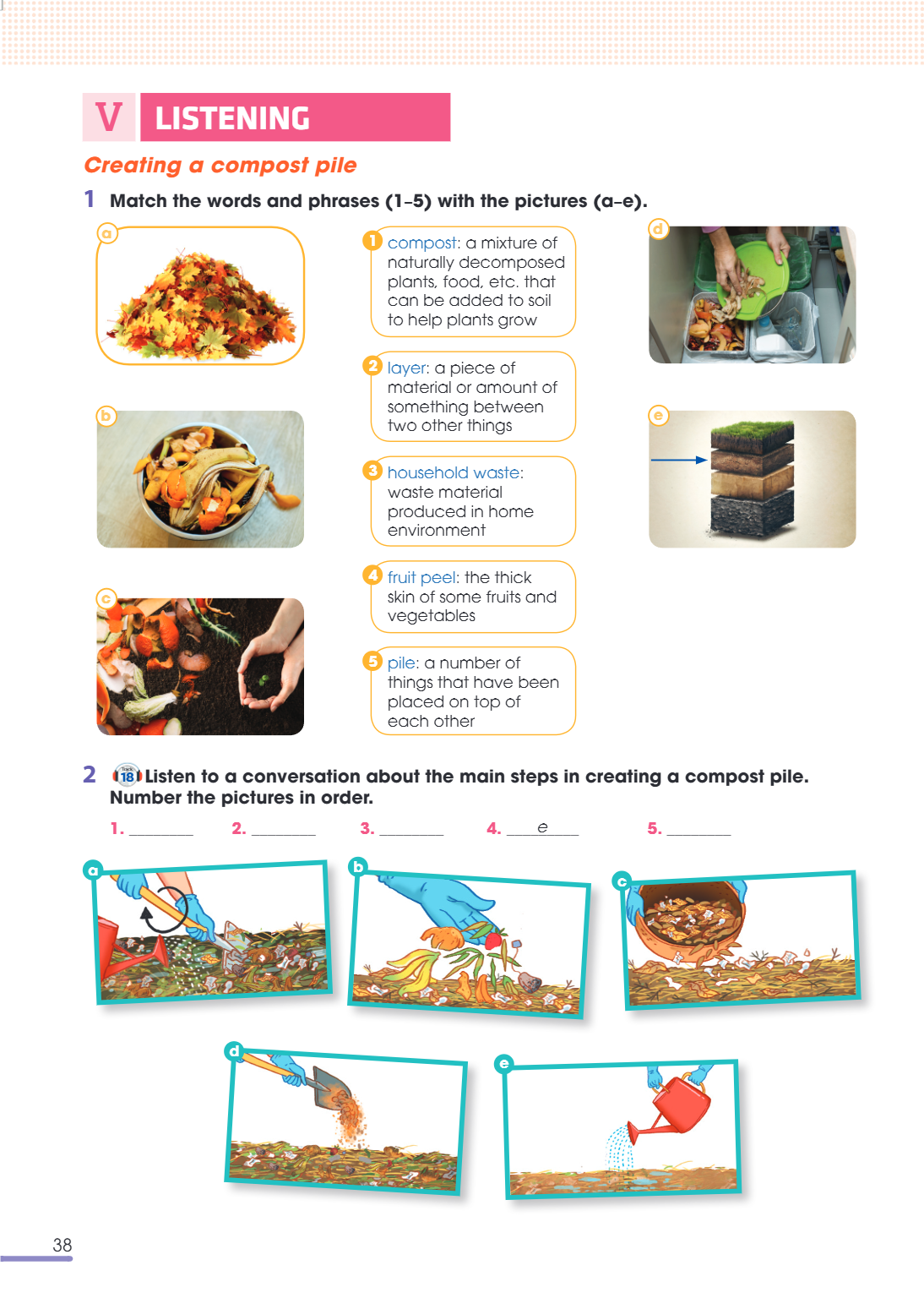
V listening Creating a compost pile 1 Match the words and phrases (1-5) with the pictures (a-e). a d 1 compost: a mixture of naturally decomposed plants, food,
V listening
Creating a compost pile
1 Match the words and phrases (1-5) with the pictures (a-e).
a d
1 compost: a mixture of
naturally decomposed plants, food, etc. that can be added to soil to help plants grow 2 layer: a piece of
material or amount of b something between e
two other things 3 household waste:
waste material produced in home environment 4 fruit peel: the thick c skin of some fruits and
vegetables 5 pile: a number of
things that have been placed on top of each other
2 Listen to a conversation about the main steps in creating a compost pile.
Track
Number the pictures in order.
________ 2. ________ 3. ________ 4. _________ e 5. ________
a b
c
d
e
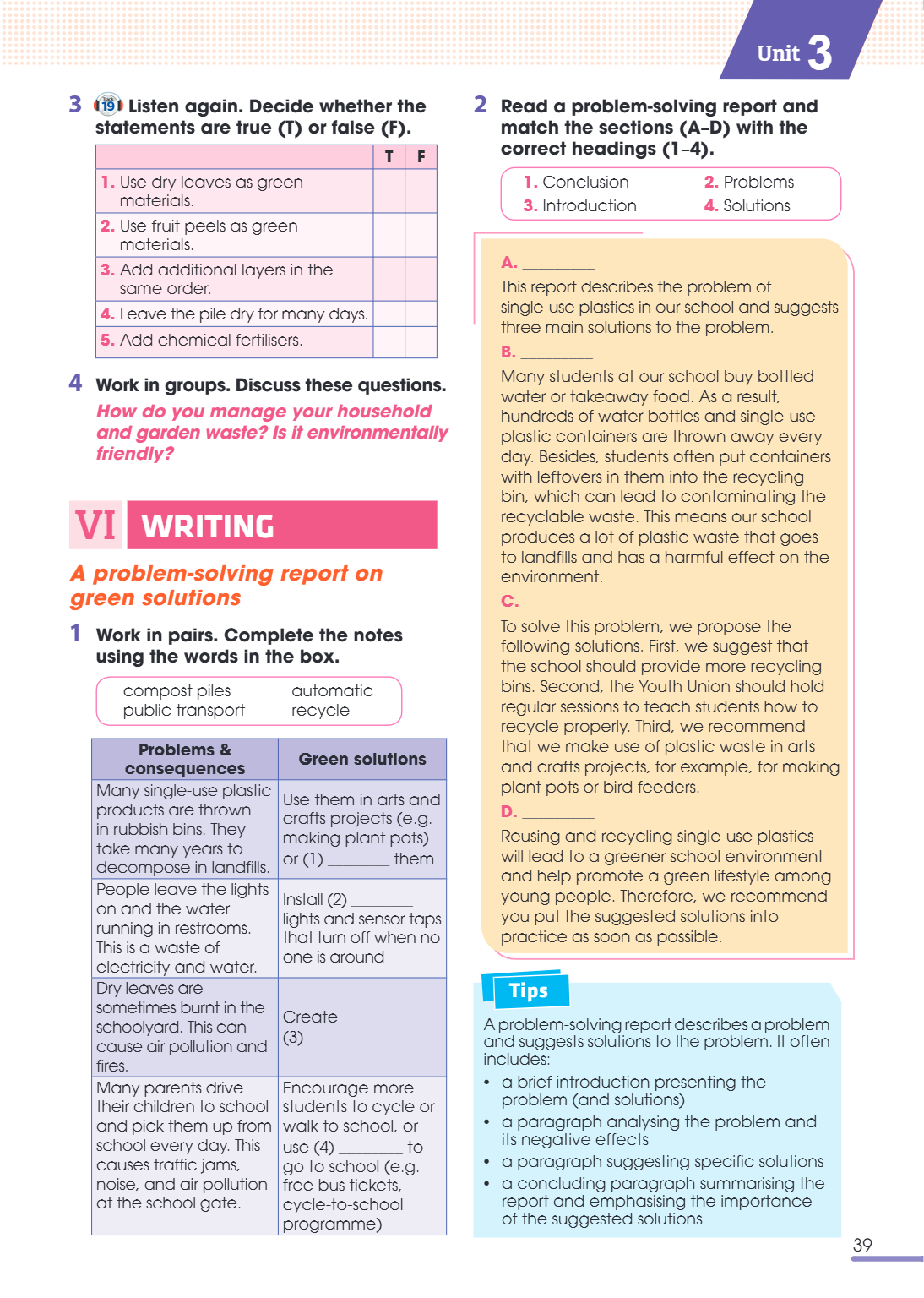
VI Writing A problem-solving report on green solutions 1 Work in pairs. Complete the notes using the words in the box. compost piles automatic public transport
VI Writing
A problem-solving report on green solutions
1 Work in pairs. Complete the notes using the words in the box.
compost piles automatic
public transport recycle
Problems & Green solutions
consequences
Many single-use plastic Use them in arts and products are thrown crafts projects (e.g. in rubbish bins. They making plant pots) take many years to or (1) ________ them decompose in landfills. People leave the lights Install (2) ________ on and the water lights and sensor taps running in restrooms. that turn off when no This is a waste of one is around electricity and water.
Dry leaves are sometimes burnt in the Create schoolyard. This can (3) ________ cause air pollution and fires. Many parents drive Encourage more their children to school students to cycle or and pick them up from walk to school, or school every day. This use (4) ________ to
causes traffic jams,, go to school (e.g.
noise, and air pollution, free bus tickets,
at the school gate., cycle-to-school programme)
Unit3
2 Read a problem-solving report and match the sections (A-D) with the T F correct headings (1-4).
1. Conclusion 2. Problems
3. Introduction 4. Solutions
A. _________
This report describes the problem of single-use plastics in our school and suggests three main solutions to the problem.
B. _________
Many students at our school buy bottled water or takeaway food. As a result, hundreds of water bottles and single-use plastic containers are thrown away every day. Besides, students often put containers with leftovers in them into the recycling bin, which can lead to contaminating the recyclable waste. This means our school produces a lot of plastic waste that goes to landfills and has a harmful effect on the environment.
C. _________
To solve this problem, we propose the following solutions. First, we suggest that the school should provide more recycling bins. Second, the Youth Union should hold regular sessions to teach students how to recycle properly. Third, we recommend that we make use of plastic waste in arts and crafts projects, for example, for making plant pots or bird feeders.
D. _________
Reusing and recycling single-use plastics will lead to a greener school environment and help promote a green lifestyle among young people. Therefore, we recommend you put the suggested solutions into practice as soon as possible.
Tips
A problem-solving report describes a problem and suggests solutions to the problem. It often
includes:
a brief introduction presenting the problem (and solutions)
a paragraph analysing the problem and its negative effects
a paragraph suggesting specific solutions
a concluding paragraph summarising the report and emphasising the importance of the suggested solutions
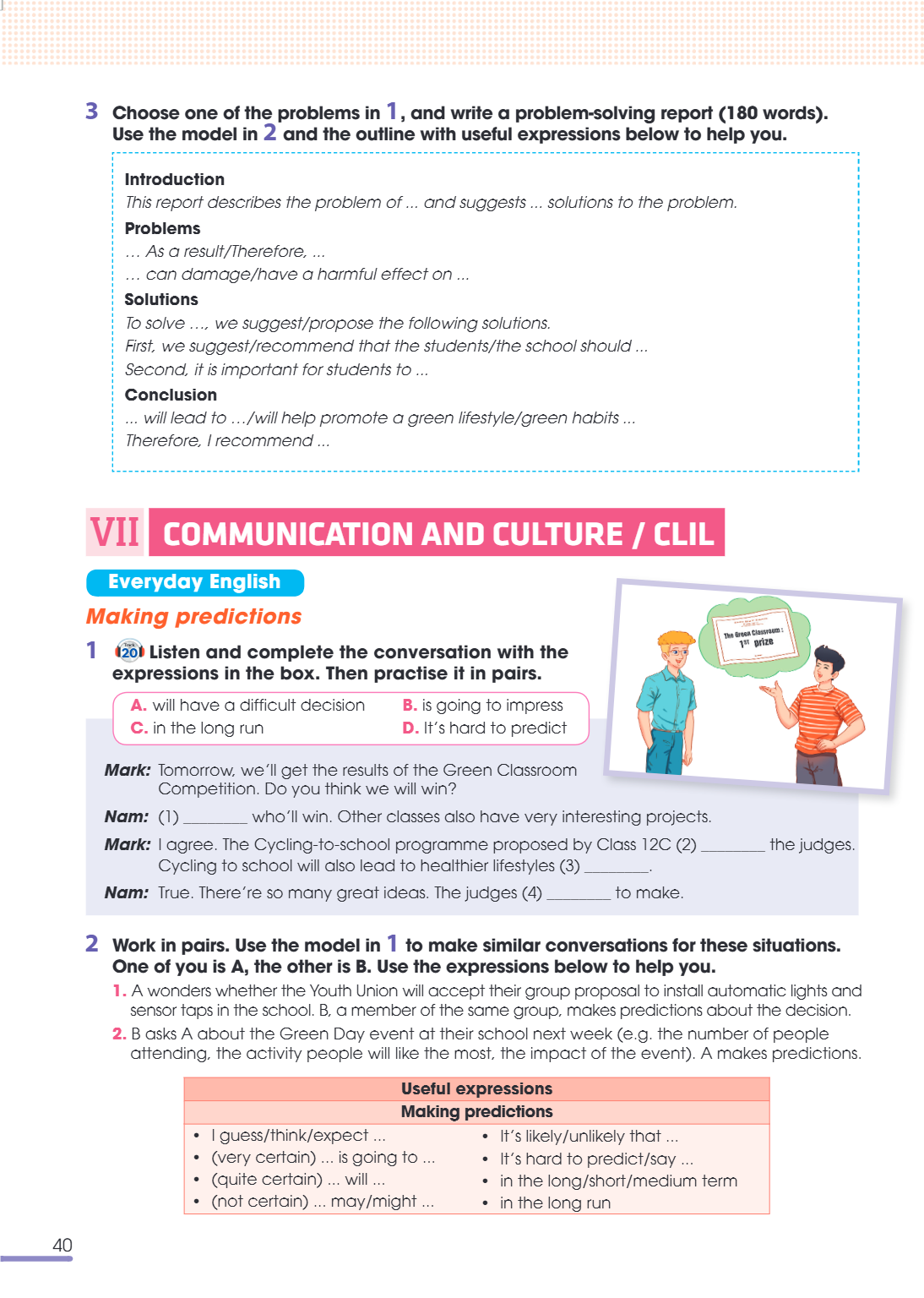
VII Communication and culture / clil Everyday English Making predictions 1 Listen and complete the conversation with the Track expressions in the box. Then prac
VII Communication and culture / clil
Everyday English
Making predictions
1 Listen and complete the conversation with the
Track
expressions in the box. Then practise it in pairs.
A. will have a difficult decision B. is going to impress
C. in the long run D. It's hard to predict
Mark: Tomorrow, we'll get the results of the Green Classroom
Competition. Do you think we will win?
Nam: (1) ________ who'll win. Other classes also have very interesting projects. Mark: I agree. The Cycling-to-school programme proposed by Class 12C (2) ________ the judges.
Cycling to school will also lead to healthier lifestyles (3) ________.
Nam: True. There're so many great ideas. The judges (4) ________ to make. 2 Work in pairs. Use the model in 1 to make similar conversations for these situations.
One of you is A, the other is B. Use the expressions below to help you.
A wonders whether the Youth Union will accept their group proposal to install automatic lights and
sensor taps in the school. B, a member of the same group, makes predictions about the decision.
B asks A about the Green Day event at their school next week (e.g. the number of people
attending, the activity people will like the most, the impact of the event). A makes predictions.
Useful expressions
Making predictions
• I guess/think/expect ... • It's likely/unlikely that ... • (very certain) ... is going to ... • It's hard to predict/say ... • (quite certain) ... will ... • in the long/short/medium term • (not certain) ... may/might ... • in the long run
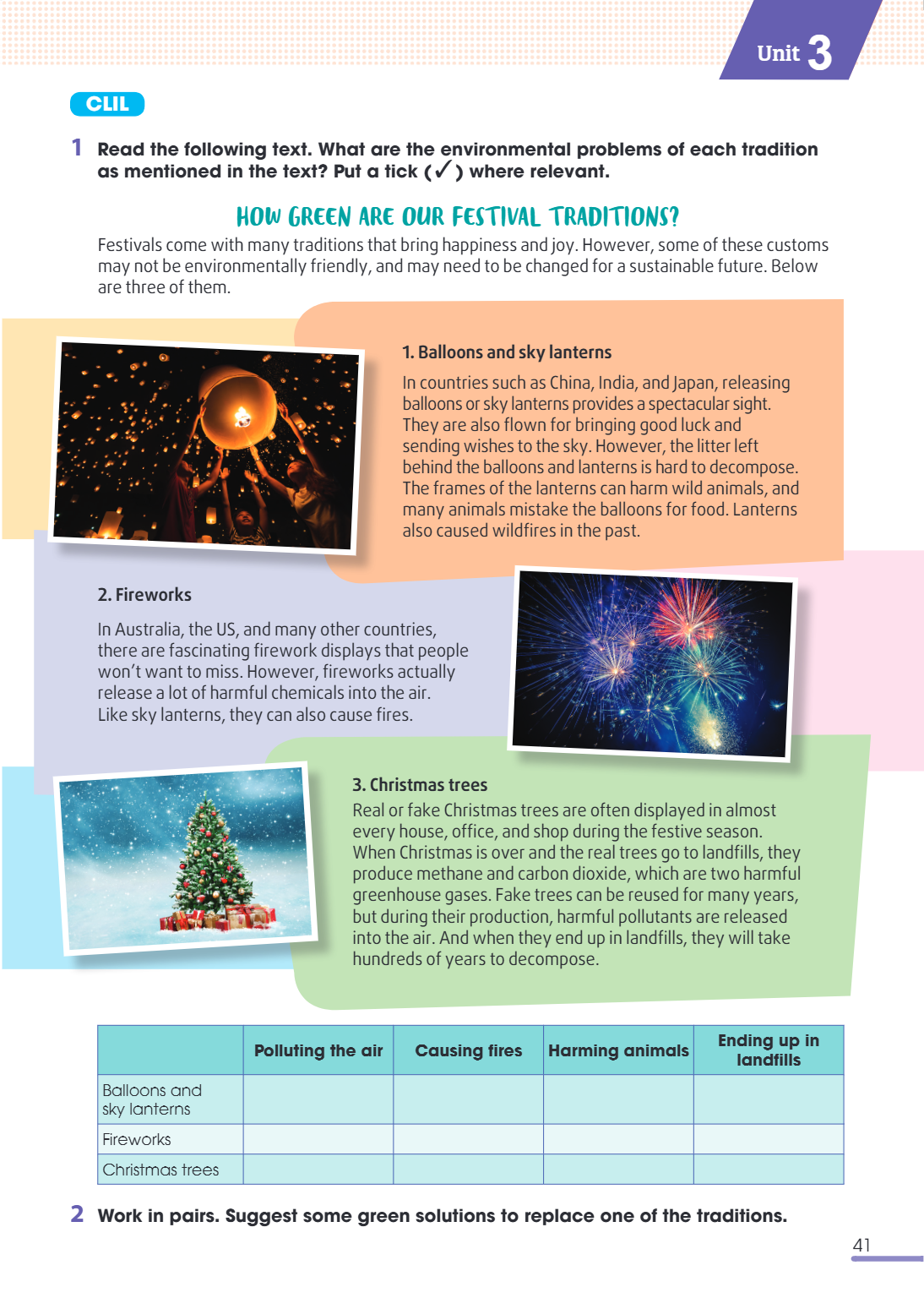
Unit3 CLIL 1 Read the following text. What are the environmental problems of each tradition as mentioned in the text? Put a tick (✓) where relevant. HOW GREEN F
Unit3
CLIL
1 Read the following text. What are the environmental problems of each tradition
as mentioned in the text? Put a tick (✓) where relevant.
HOW GREEN FESTIVAL
Festivals come with many traditions that bring happiness and joy. However, some of these customs may not be environmentally friendly, and may need to be changed for a sustainable future. Below are three of them.
2. Fireworks
In Australia, the US, and many other countries, there are fascinating firework displays that people won't want to miss. However, fireworks actually release a lot of harmful chemicals into the air. Like sky lanterns, they can also cause fires.
1. Balloons and sky lanterns
In countries such as China, India, and Japan, releasing balloons or sky lanterns provides a spectacular sight. They are also flown for bringing good luck and sending wishes to the sky. However, the litter left behind the balloons and lanterns is hard to decompose. The frames of the lanterns can harm wild animals, and many animals mistake the balloons for food. Lanterns also caused wildfires in the past.
3. Christmas trees
Real or fake Christmas trees are often displayed in almost every house, office, and shop during the festive season. When Christmas is over and the real trees go to landfills, they produce methane and carbon dioxide, which are two harmful greenhouse gases. Fake trees can be reused for many years, but during their production, harmful pollutants are released into the air. And when they end up in landfills, they will take hundreds of years to decompose.
Polluting the air Causing fires Harming animals Ending up in
landfills
Balloons and sky lanterns Fireworks Christmas trees
2 Work in pairs. Suggest some green solutions to replace one of the traditions.
VIII LOOKING BACK Pronunciation 21 Read the words and choose the odd one out. Then listen and check. A. fair B. hair C. container D. pair A. near B. ear C. fear
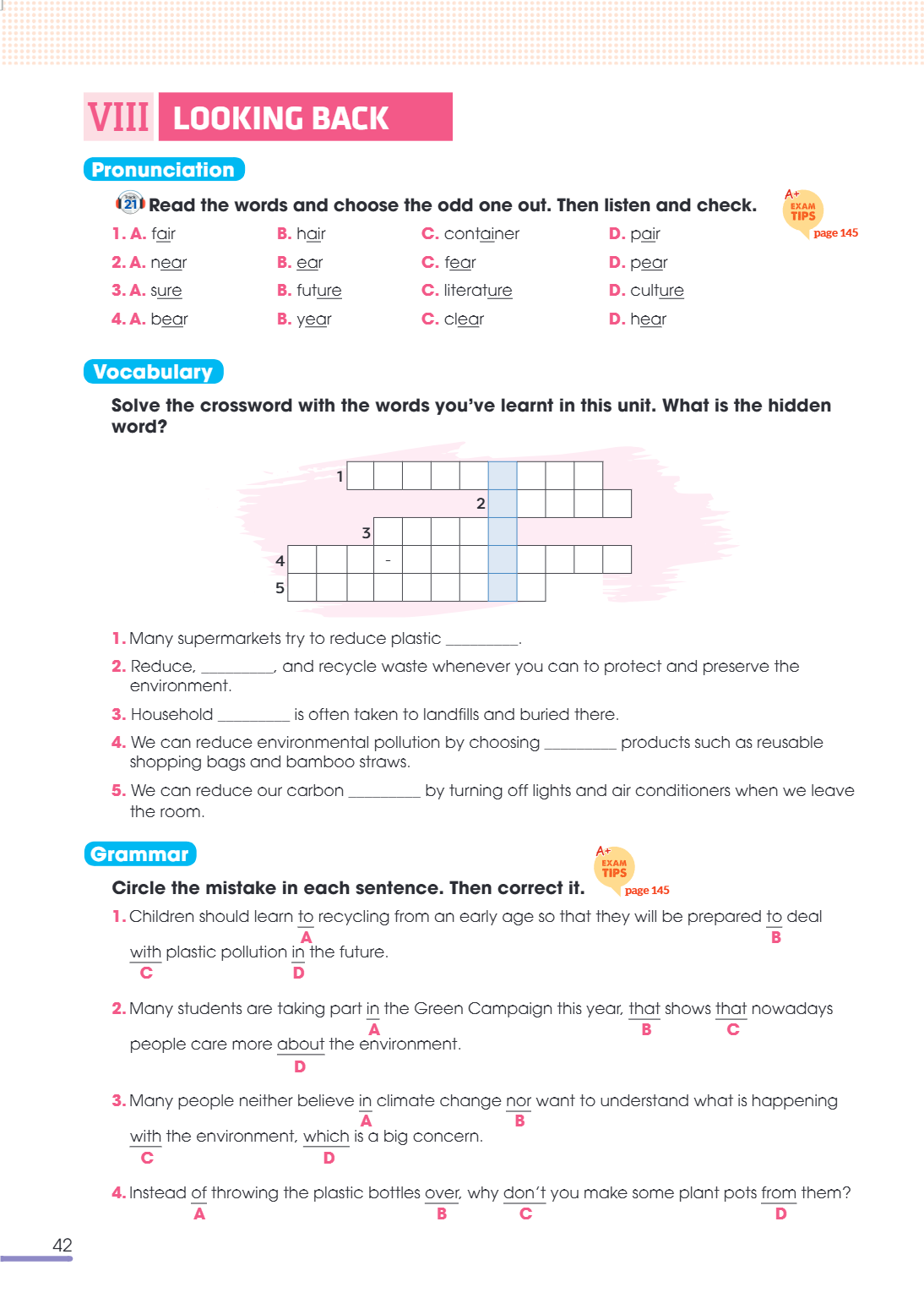
VIII LOOKING BACK
Pronunciation
21 Read the words and choose the odd one out. Then listen and check.
A. fair B. hair C. container D. pair
A. near B. ear C. fear D. pear
A. sure B. future C. literature D. culture
A. bear B. year C. clear D. hear
==A+ EXAM TIPS page 145==
Vocabulary
Solve the crossword with the words you’ve learnt in this unit. What is the hidden word?
| | | | | | | | | | | | | | | | | | | | | | | | | | | | | | | | | | | | | | | | | | | | | | | | | | | | | | | | | | | | | | | | | | | | | | | | | | | | | | | | | | | | | | | | | | | | | | | | | | | | | | | | | | | | | | | | | | | | | | | | | | | | | | | | | | | | | | | | | | | | | | | | | | | | | | | | | | | | | | | | | | | | | | | |
Many supermarkets try to reduce plastic ___________.
Reduce, ___________, and recycle waste whenever you can to protect and preserve the environment.
Household ___________ is often taken to landfills and buried there.
We can reduce environmental pollution by choosing ___________ products such as reusable shopping bags and bamboo straws.
We can reduce our carbon ___________ by turning off lights and air conditioners when we leave the room.
Grammar
Circle the mistake in each sentence. Then correct it. ==A+ EXAM TIPS page 145==
Children should learn to recycling from an early age so that they will be prepared to deal with plastic pollution in the future.
A B
C D
Many students are taking part in the Green Campaign this year, that shows that nowadays people care more about the environment.
A B C
D
Many people neither believe in climate change nor want to understand what is happening with the environment, which is a big concern.
A B
C D
Instead of throwing the plastic bottles over, why don’t you make some plant pots from them?
A B C D
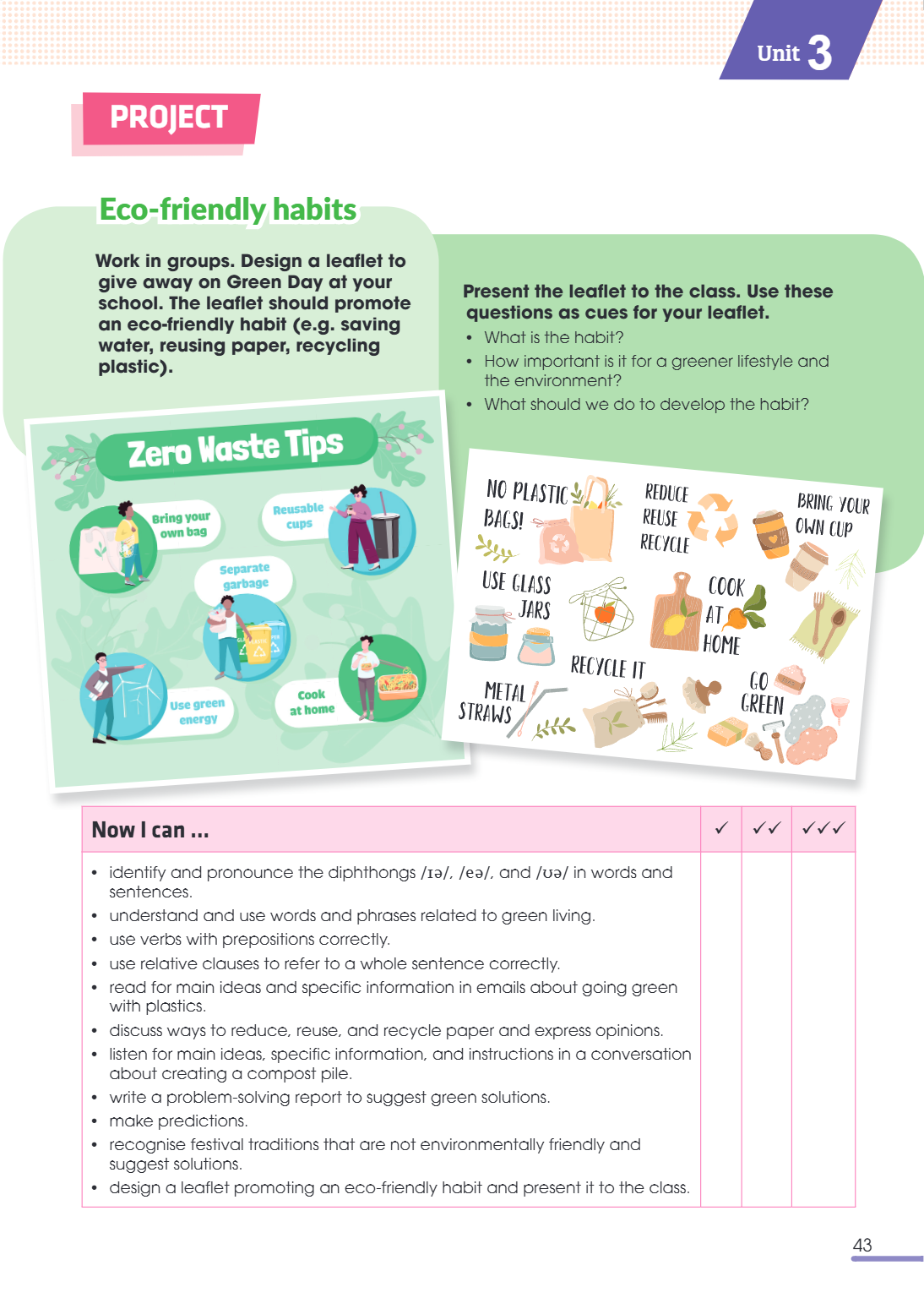
Unit3 Project Eco-friendly habits Work in groups. Design a leaflet to give away on Green Day at your Present the leaflet to the class. Use these school. The lea
Unit3
Project
Eco-friendly habits
Work in groups. Design a leaflet to
give away on Green Day at your Present the leaflet to the class. Use these school. The leaflet should promote questions as cues for your leaflet.
an eco-friendly habit (e.g. saving • water, reusing paper, recycling What is the habit?
plastic). • How important is it for a greener lifestyle and
the environment?
What should we do to develop the habit?
Now can ...   
I
identify and pronounce the diphthongs /ɪə/, /eə/, and /ʊə/ in words and sentences.
understand and use words and phrases related to green living.
use verbs with prepositions correctly.
use relative clauses to refer to a whole sentence correctly.
read for main ideas and specific information in emails about going green with plastics.
discuss ways to reduce, reuse, and recycle paper and express opinions.
listen for main ideas, specific information, and instructions in a conversation about creating a compost pile.
write a problem-solving report to suggest green solutions.
make predictions.
recognise festival traditions that are not environmentally friendly and suggest solutions.
design a leaflet promoting an eco-friendly habit and present it to the class.
Trang 44
Trang 45
Trang 46
Trang 47
Unit 4. URBANISATION This unit includes: LANGUAGE Pronunciation Unstressed words in connected speech Vocabulary Words related to urbanisation Grammar Present pe
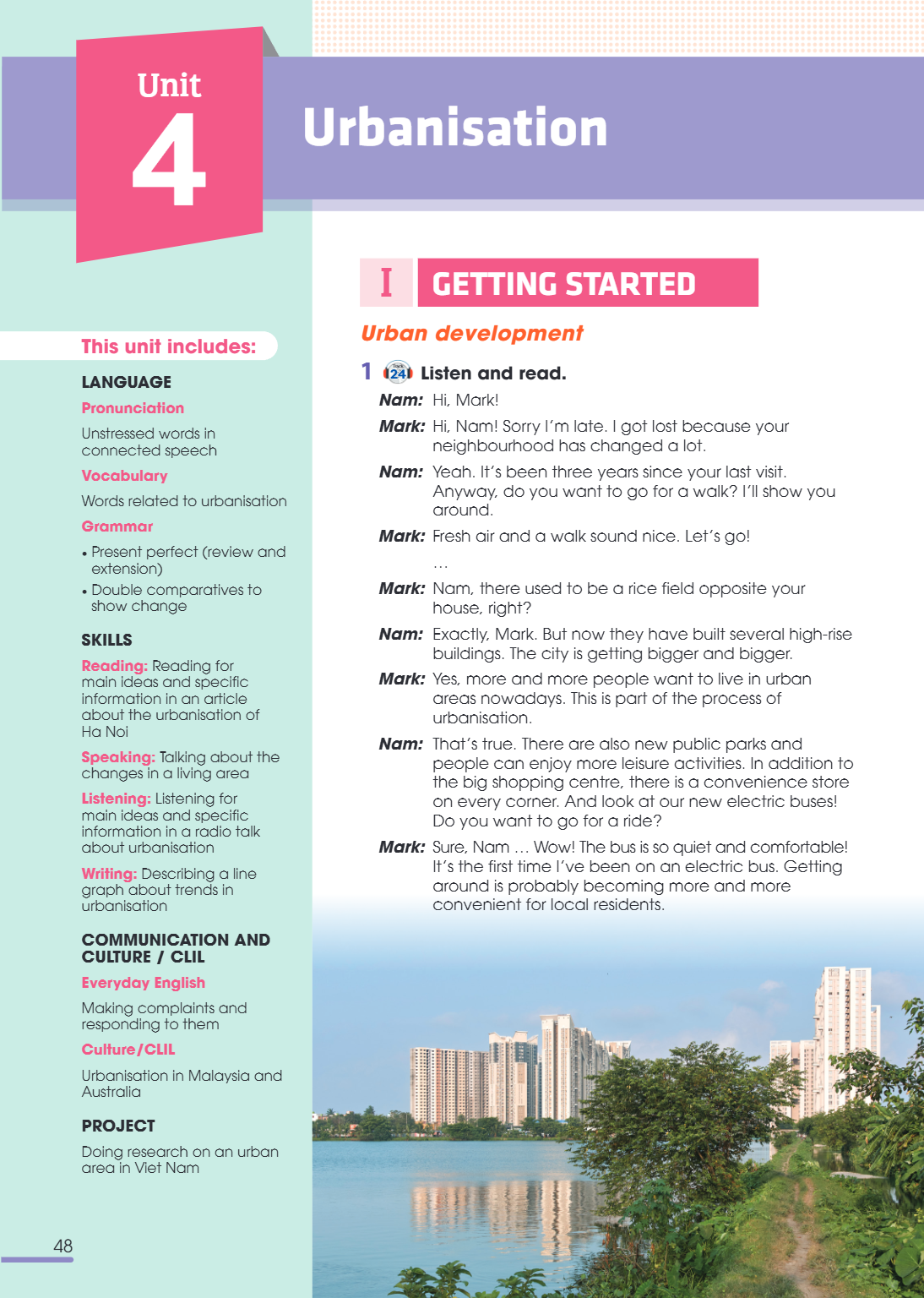
Unit 4. URBANISATION
This unit includes:
LANGUAGE
Pronunciation
Unstressed words in connected speech
Vocabulary
Words related to urbanisation
Grammar
Present perfect (review and extension)
Double comparatives to show change
SKILLS
Reading: Reading for main ideas and specific information in an article about the urbanisation of Ha Noi
Speaking: Talking about the changes in a living area
Listening: Listening for main ideas and specific information in a radio talk about urbanisation
Writing: Describing a line graph about trends in urbanisation
COMMUNICATION AND CULTURE / CLIL
Everyday English
Making complaints and responding to them
Culture/CLIL
Urbanisation in Malaysia and Australia
PROJECT
Doing research on an urban area in Viet Nam
I GETTING STARTED
Urban development
1. Listen and read.
Nam: Hi, Mark!
Mark: Hi, Nam! Sorry I'm late. I got lost because your neighbourhood has changed a lot.
Nam: Yeah. It's been three years since your last visit. Anyway, do you want to go for a walk? I'll show you around.
Mark: Fresh air and a walk sound nice. Let's go!
...
Mark: Nam, there used to be a rice field opposite your house, right?
Nam: Exactly, Mark. But now they have built several high-rise buildings. The city is getting bigger and bigger.
Mark: Yes, more and more people want to live in urban areas nowadays. This is part of the process of urbanisation.
Nam: That's true. There are also new public parks and people can enjoy more leisure activities. In addition to the big shopping centre, there is a convenience store on every corner. And look at our new electric buses! Do you want to go for a ride?
Mark: Sure, Nam ... Wow! The bus is so quiet and comfortable! It's the first time I've been on an electric bus. Getting around is probably becoming more and more convenient for local residents.
II LANGUAGE Pronunciation Unstressed words in connected speech Remember! In connected speech, most grammatical words are not usually stressed. These words inclu
II LANGUAGE
Pronunciation
Unstressed words in connected speech
Remember!
In connected speech, most grammatical words are not usually stressed. These words include:
• articles: a, an, the
• prepositions: above, for, of, to, until, etc.
• personal pronouns: I, you, we, they, he, she, it
• possessive adjectives: my, your, our, their, her, his, its
• auxiliary verbs: be, have, do, etc.
• conjunctions: and, but, or, etc.
• modal verbs: can, will, etc.
• the expressions: there is, there are, etc.
1 Listen and repeat. Pay attention to the pronunciation of the ==unstressed words==.
==It's been== three years ==since your== last visit.
Fresh air ==and a== walk sound nice.
==It's the== first time ==I've been on an== electric bus.
==I== guess urbanisation ==can== also cause problems.
2 Listen and identify the unstressed words in the following sentences. Then practise saying the sentences in pairs.
A new convenience store has been opened near my house.
There are still a lot of problems in our cities today.
It is much more expensive to buy a house in a big city.
My father was offered a new job and his office will be in a high-rise building.
Vocabulary Urban life 1 Match the words with their meanings. 1 afford (v), a to become larger in size, number, or importance 2 housing (n), b the number of peop
Vocabulary Urban life
1 Match the words with their meanings.
1 afford (v), a to become larger in size, number, or importance
2 housing (n), b the number of people not having a job
3 expand (v), c to have enough money to buy or do something
4 seek (v), d houses, flats, etc. that people live in
5 unemployment (n), e to look for something or somebody
2 Complete the sentences using the correct forms of the words in 1 .
1. Higher _________ can result in increasing crime rates in big cities.
2. Not many young couples can _________ to buy their own house in big cities.
3. There is a shortage of affordable _________ in big cities.
Since they started using farmland for building houses, many towns have _________ into cities.
Many people are leaving the countryside in order to _________ better opportunities in big cities.
Grammar Present perfect (review and extension)
Remember!
We use the present perfect to describe something that started in the past and is still happening now, or something that was completed in the very recent past. Example: A lot of young people have moved to big cities to work or study.
We also use the present perfect to say how many times something has happened with the following structure:
It/This/That + be + the first/the second time + Subject + have/has (done) ...
Example:
This is the second time I have visited this city. It is not the first time I have heard about urbanisation.
We often use the present perfect for a unique experience with the following structure:
It/This/That/Noun or Gerund phrase + be + the best/the worst/the only/the most beautiful/
... + Subject + have/has (ever done) ... Example:
That is the worst meal I have ever had in this city.
Moving to the city is the best decision my parents have ever made in their life.
Unit4 1 Circle the underlined part that is incorrect in each of the following sentences. 1. This is the first time I saw such a tall building in my life. B C pa
Unit4
1 Circle the underlined part that is incorrect in each of the following sentences.
1. This is the first time I saw such a tall building in my life.
B C page 145 A D
2. Mount Fuji in Japan is the most beautiful place we had ever visited.
B C
A D
This has been the second time my mother has warned me not to spend all my money on clothes. B C
A D
Double comparatives to show change
Remember!
We use double comparatives to show change. Example: Towns are getting bigger and bigger. The air is becoming more and more polluted. There are more and more high-rise buildings in the city.
We also use double comparatives to say that two things change together. Example:
The bigger the city gets, the more crowded it becomes. The more we invest in rural areas, the more we can help people there.
Housing is getting more and more expensive in big cities, so many local residents
page 145
can't afford to buy their own place.
A. Many local residents in big cities can't buy their own place because housing is becoming
more expensive every day.
B. More and more local residents can't afford their own place in big cities because housing is
too expensive.
C. Housing is getting affordable enough for many local people to buy their own place.
D. Housing in big cities has become the most expensive these days, so many local residents
can't afford their own place.
2. The more people move into big cities, the higher the unemployment is.
A. The higher the unemployment is, the more people move into big cities.
B. More people moving into big cities causes higher unemployment.
C. More people move into big cities despite the high rate of unemployment.
D. More people move into big cities because there are more employment opportunities there.
3. The more houses are built, the less space we have for plants and trees.
A. Although more houses are built, we still have some space for plants and trees.
B. The fewer houses we build, the less space we have for plants and trees.
C. We have less space for plants and trees because more houses are built.
D. Plants and trees are the reasons why more houses can't be built.
3 Work in pairs. Make true sentences about urbanisation in an area that you know,
using double comparatives and the present perfect.
Example: Urbanisation haschangedmy home town a lot. The local authority hasexpandedthe roads and people from the nearby villages. They havecome to work in the local factories.
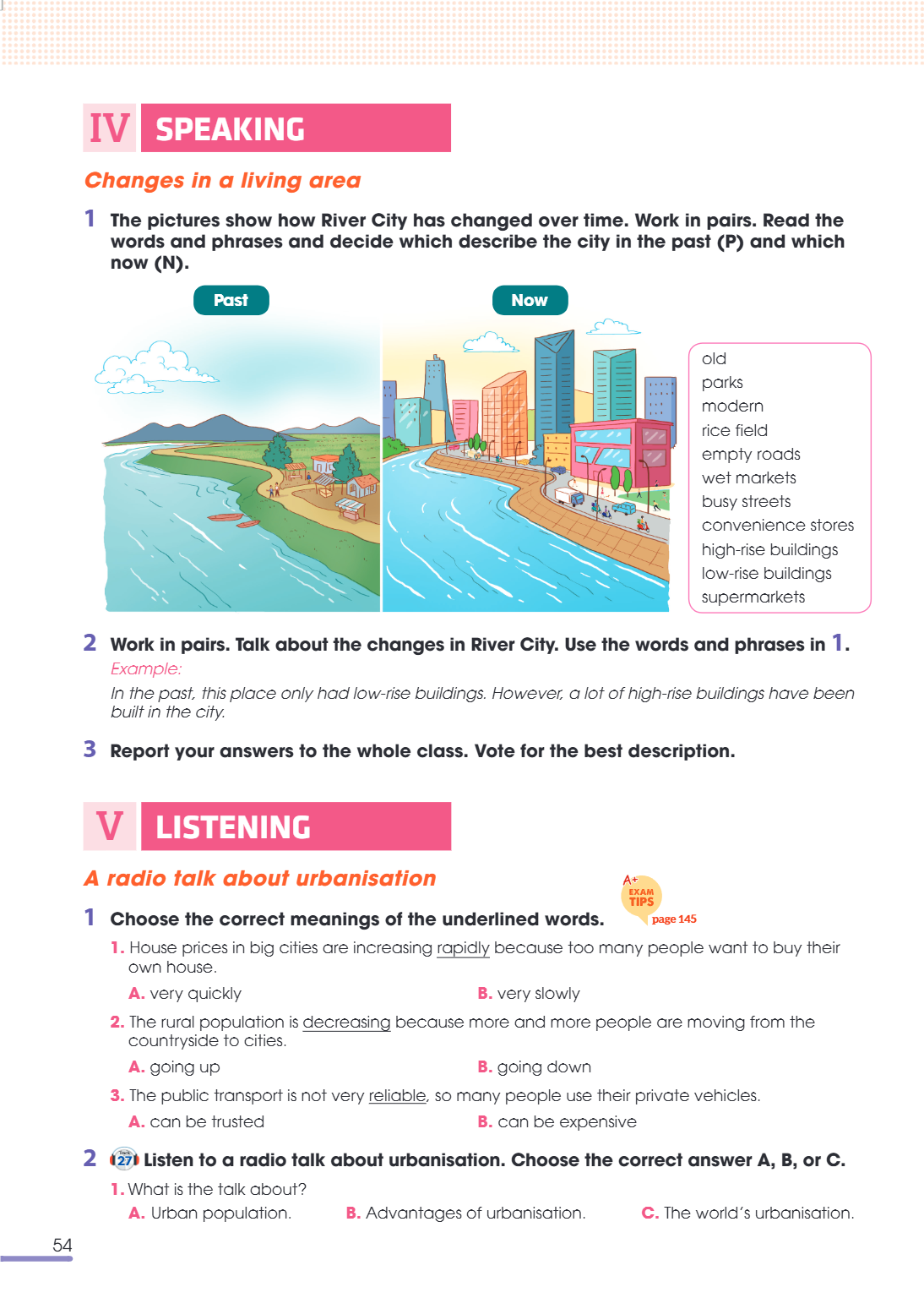
III reading Urbanisation of Ha Noi 1 Work in pairs. Look at the pictures in the article in 2 below. Discuss the following questions. What can you see in each pi
III reading
Urbanisation of Ha Noi
1 Work in pairs. Look at the pictures in the article in 2 below. Discuss the following
questions.
What can you see in each picture? 2 Read the article. Choose the correct meanings of the highlighted words.
Ha Noi Then and Now
‛Ha Noi Then and Now' exhibition has attracted thousands of visitors this week. The pictures have brought back childhood memories to old residents while helping younger generations see how the city has changed over the years.
In the ‛Then' hall, visitors can see pictures of 20th-century
Ha Noi. Back in 1954, it was a small city with a population of about 530,000 residents in an area of about 152 sq km. The capital's famous Old Quarter or ‛36 old streets' dates back hundreds of years, with each street focusing on a different trade or craft.
. The way Hanoians got fascinating mixture of French colonial buildings and traditional
around Eastern architecture
The ‛Now' pictures show a modern city with a population of over 8 million people. Over the years, the urban area has gradually expanded to over 3,000 sq km including many of the surrounding villages. As rural residents move into Ha Noi,
the government is providing more affordable housing. More high-rise buildings have also been built. Ha Noi has improved its transport infrastructure, building new roads and bridges. It is modernising bus services using more electric ones. The Ha Noi Metro opened to the public in 2021 and is expected to include more lines by 2030. A new image of Ha Noi
Transport in Ha Noi now
page 145
An old street in Ha Noi ‛My parents couldn't afford a motorbike or car. Most residents used to get around by bicycle or on foot,' said an 80-year-old visitor. Trams, which began service in 1901, were a popular means of public transport until 1991. Buses were not very frequent then. People lived and worked in low-rise buildings. The city was a
However, urbanisation has created new problems. ‛As more people come to seek better job opportunities, the city is getting more and more crowded. This has led to more traffic jams and higher unemployment rates,' said a 21-year-old student. Air pollution is also causing concern among city residents.
Unit 4. The 20th century residents A. people who live in a particular place B. buildings in a particular place colonial A. connected with the native country B.
Unit 4. The 20th century
residents
A. people who live in a particular place
B. buildings in a particular place
colonial
A. connected with the native country
B. connected with a country that controls another country
gradually
A. slowly, over a period of time
B. quickly, over a short time
modernising
A. making something attractive
B. making use of the latest technology, design, etc.
concern
A. a feeling of satisfaction
B. a feeling of worry about something important
3 Read the article again. Put the main ideas in the order they appear in the article.
The correct order is: 1. ______ 2. ______
3. ______ 4. ______
A. Ha Noi's modern infrastructure and architecture
B. The challenges of urban growth
C. Ha Noi as a small city with old streets selling different products
D. 20th-century transport and architecture
4 Read the article again and complete the table using no more than THREE words and/or a number for each gap.
Ha Noi, 20th century, Now
Area, - about (1) ______ sq km (1954), - over 3,000 sq km
Population, - about 530,000 people (1954), - over (2) ______ people
Public transport, - (3) ______ and buses, - modern buses and (4) ______
Architecture, - mainly (5) ______, - more high-rise buildings
5 Work in pairs. Discuss the following questions.
Which one do you prefer to live in: Ha Noi in the past or Ha Noi at present? Why?
V LISTENING A radio talk about urbanisation A+ EXAM TIPS page 145 1. Choose the correct meanings of the underlined words. House prices in big cities are increas
V LISTENING
A radio talk about urbanisation
A+ EXAM TIPS page 145
1. Choose the correct meanings of the underlined words.
House prices in big cities are increasing rapidly because too many people want to buy their own house.
A. very quickly
B. very slowly
The rural population is decreasing because more and more people are moving from the countryside to cities.
A. going up
B. going down
The public transport is not very reliable, so many people use their private vehicles.
A. can be trusted
B. can be expensive
2. Listen to a radio talk about urbanisation. Choose the correct answer A, B, or C.
What is the talk about?
A. Urban population.
B. Advantages of urbanisation.
C. The world's urbanisation.
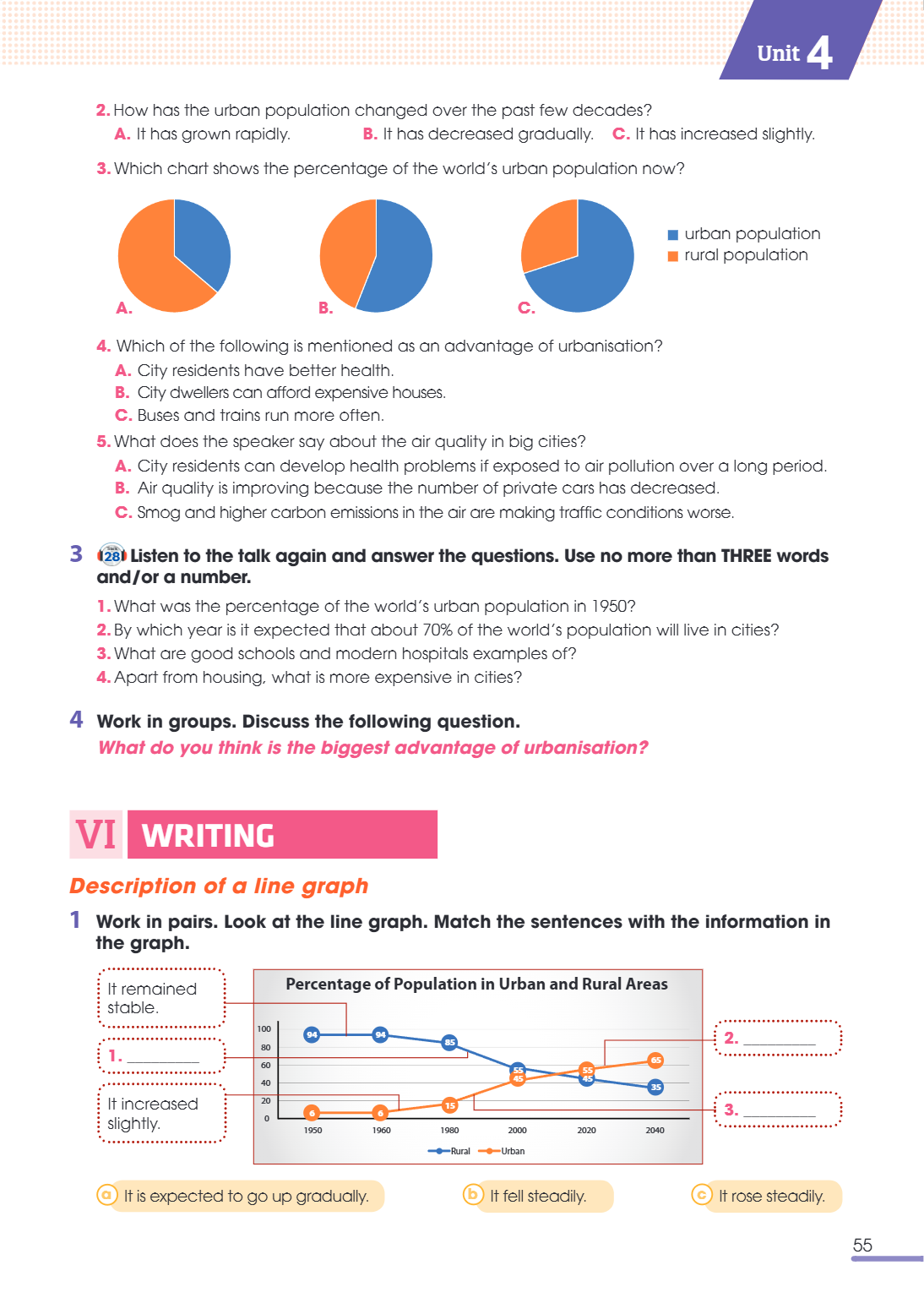
VI Writing Description of a line graph 1 Work in pairs. Look at the line graph. Match the sentences with the information in the graph. It remained Percentage of
VI Writing
Description of a line graph
1 Work in pairs. Look at the line graph. Match the sentences with the information in
the graph.
It remained Percentage of Population in Urban and Rural Areas stable.
100 94 94 2. _________
_________ 80 85
60 65
55 55
40 45 45
35
It increased 20 3. _________
15
slightly. 6 6
1950, 1960, 1980 Rural, 2000 Urban, 2020, 2040
a It is expected to go up gradually. b It fell steadily. c It rose steadily.
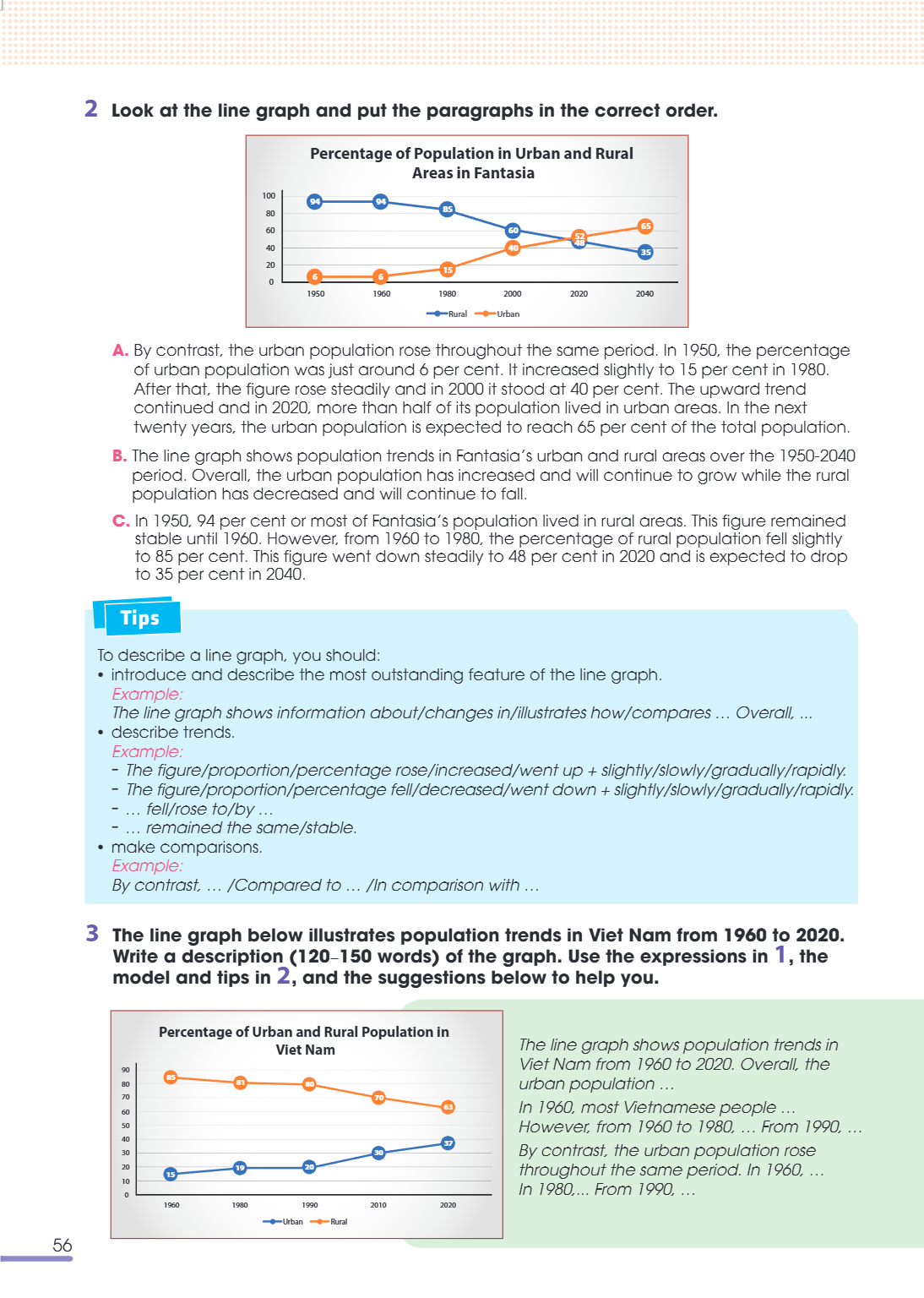
2 Look at the line graph and put the paragraphs in the correct order. Percentage of Population in Urban and Rural Areas in Fantasia 100 94 94 80 85 60 60 65 52
2 Look at the line graph and put the paragraphs in the correct order.
Percentage of Population in Urban and Rural Areas in Fantasia
100
94 94
80 85
60 60 65
52 48
40 40 35
20 15
6 6
0
1950, 1960, 1980 Rural, 2000 Urban, 2020, 2040
A. By contrast, the urban population rose throughout the same period. In 1950, the percentage
of urban population was just around 6 per cent. It increased slightly to 15 per cent in 1980. After that, the figure rose steadily and in 2000 it stood at 40 per cent. The upward trend continued and in 2020, more than half of its population lived in urban areas. In the next twenty years, the urban population is expected to reach 65 per cent of the total population.
B. The line graph shows population trends in Fantasia's urban and rural areas over the 1950-2040
period. Overall, the urban population has increased and will continue to grow while the rural population has decreased and will continue to fall.
C. In 1950, 94 per cent or most of Fantasia's population lived in rural areas. This figure remained
stable until 1960. However, from 1960 to 1980, the percentage of rural population fell slightly to 85 per cent. This figure went down steadily to 48 per cent in 2020 and is expected to drop to 35 per cent in 2040.
Tips
To describe a line graph, you should:
introduce and describe the most outstanding feature of the line graph. Example: The line graph shows information about/changes in/illustrates how/compares … Overall, ...
describe trends. Example: - The figure/proportion/percentage rose/increased/went up + slightly/slowly/gradually/rapidly. - The figure/proportion/percentage fell/decreased/went down + slightly/slowly/gradually/rapidly. - … fell/rose to/by … - … remained the same/stable.
make comparisons. Example: By contrast, … /Compared to … /In comparison with …
3 The line graph below illustrates population trends in Viet Nam from 1960 to 2020.
Write a description (120-150 words) of the graph. Use the expressions in 1, the
model and tips in 2, and the suggestions below to help you.
Percentage of Urban and Rural Population in
Viet Nam The line graph shows population trends in
Viet Nam from 1960 to 2020. Overall, the 90 urban population …
85
80 81 80
70 70 In 1960, most Vietnamese people …
60 63
However, from 1960 to 1980, … From 1990, …
50
40 37 By contrast, the urban population rose
30 30
throughout the same period. In 1960, …
20 19 20
10 In 1980,... From 1990, …
1960 1980 1990 2010 2020
Urban Rural
VII Communication and culture / clil Everyday English Making complaints and responding to them 1 Listen and complete the conversations Track with the expression
VII Communication
and culture / clil
Everyday English Making complaints and responding to them
1 Listen and complete the conversations
Track
with the expressions in the box. Then practise them in pairs.
A. I promise
B. I want to complain about
C. I'm sorry to have to say this
D. there's nothing we can do about it
1
Ms Lan: Hi, Mai. (1) _________, but there is
always loud music coming from your flat very late at night. I can't sleep because of the noise. Mai: Oh, I'm so sorry, Ms Lan.
(2) _________ this will never happen again.
2
Nam: Excuse me, (3) _________
the bus services in the neighbourhood. Buses are always running late, especially during rush hour. Conductor: I'm sorry, but (4) _________.
There are so many vehicles on the roads now that traffic moves very slowly.
2 Work in pairs. Use the models in 1 to make similar conversations for these
situations. One of you is A, the other is B. Use the expressions to help you.
A has recently moved to a busy urban area. He/She is attending a community meeting chaired by B, who is an urban planner. A is complaining to B about the frequent traffic jams in the area. B is giving a response.
2. B is attending a talk by A, a local
government official, who is discussing problems in their city. B is complaining to A about the city's overcrowded living conditions. A is giving a response.
Unit4
Useful expressions Making complaints
I'm afraid I have a complaint to make ...
Excuse me, I want to complain about ...
I'm afraid there's a problem with/about …
I'm sorry to say this, but ...
I'm angry about ...
Positive response to complaints
I'm so sorry, but this will never occur/ happen again.
I'm sorry. We promise never to make the same mistake again.
Negative response to complaints
Sorry, there is nothing we can do about it.
I'm afraid, there isn't much we can do about it.
Culture/CLIL
Read the text and complete the table.
Urbanisation in Malaysia and Australia
Urbanisation in Malaysia started in the early 1970s. At that time, only around 26 per cent of the population lived in urban areas. After a period of rapid growth, the urban and rural populations were almost equal in the early 1990s. Since then, the urbanisation rate has continued to increase gradually. The urban population, for example, rose from 66 per cent in 2004 to 74 per cent in 2014. At present, Malaysia is known as one of the most urbanised countries in Southeast Asia. It is also one of the most rapidly urbanised regions around the world. According to the latest statistics, over 77 per cent of Malaysia's total population now live in urban areas and cities.
VIII LOOKING BACK Pronunciation TRACK 30 Listen and underline the unstressed words in the following sentences. Then practise saying the sentences in pairs. Ther
VIII LOOKING BACK
Pronunciation
TRACK 30 Listen and underline the unstressed words in the following sentences. Then practise saying the sentences in pairs.
There are more than fifty new skyscrapers in the city.
People can get around easily by the new metro instead of getting stuck in traffic jams.
Many young people go to big cities looking for better job opportunities and higher salaries.
There have been a lot of changes in my home town, and most of them have been welcomed by residents.
Vocabulary
Complete the text, using the correct forms of the words in the box.
housing unemployment afford expand seek
Urbanisation brings a lot of changes. First, people living in rural areas move to cities to (1) _________ better jobs and improve their lives. As a result, urban areas are (2) _________. Second, more high-rise buildings are built to provide (3) _________ for the increasing number of urban residents. However, it is too expensive, so many people cannot (4) _________ to buy their own house. In addition, many people find it hard to find jobs in overcrowded cities, so (5) _________ rates there are rising.
Grammar Choose the correct answer A, B, C, or D. This is the best experience I _________ in this city. A. have had B. have That is the second house they _______
Grammar
Choose the correct answer A, B, C, or D.
This is the best experience I _________ in this city. A. have had B. have
That is the second house they _________ this year. A. buy B. have bought
The more we use private vehicles, _________ polluted the air becomes. A. less and less B. the less
Life in rural areas is becoming _________ difficult for farmers because of falling prices of
vegetables and agricultural products.
A. less and less B. fewer and fewer
Unit4
page 145
C. had, D. will have
C. bought, D. had bought
C. the more, D. more and more
C. more and less, D. more and more
Project
An urban area
Work in groups. Do some research on a newly-
created urban area in Viet Nam. Present your findings to the class. Use these questions as cues for your presentation:
Where is the place?
What was it like in the past?
How has it changed since urbanisation started?
What are the positive and negative effects of urbanisation?
Now can ...   
I
pronounce unstressed words in sentences correctly.
understand and use words related to urbanisation.
use the present perfect with It/This/That is the first/best … structures correctly.
use double comparatives to show change correctly.
read for main ideas and specific information in an article about the urbanisation of Ha Noi.
talk about the changes in a living area.
listen for main ideas and specific information in a radio talk about urbanisation.
describe a line graph about trends in urbanisation.
make complaints and respond to them.
understand the urbanisation in Malaysia and Australia.
do research on an urban area in Viet Nam and give a group presentation about it.
Unit 5. THE WORLD OF WORK This unit includes: LANGUAGE Pronunciation Stressing auxiliary and modal verbs Vocabulary Words related to work Grammar Simple, compou
Unit 5. THE WORLD OF WORK
This unit includes:
LANGUAGE
Pronunciation
Stressing auxiliary and modal verbs
Vocabulary
Words related to work
Grammar
Simple, compound, and complex sentences (review and extension)
SKILLS
Reading: Reading for main ideas, specific information and inference in job advertisements
Speaking: Giving opinions about different jobs
Listening: Listening for main ideas and specific information in a phone conversation about a job vacancy
Writing: Writing a job application letter
COMMUNICATION AND CULTURE / CLIL
Everyday English
Expressing anxiety and responding to it
Culture
Unusual jobs around the world
PROJECT
Doing research on suitable part-time jobs for students
I GETTING STARTED
Our parents' jobs
1. Listen and read.
Lan: Come in, Mark. Did you find my place easily?
Mark: Yes, I actually met your dad in the street and he showed me the way. He said he was on his way to work.
Lan: That's right. My dad is a factory worker, so he works in shifts. Today he's on the night shift.
Mark: Working night shifts must be really hard. When does he sleep?
Lan: He goes to bed right after he comes home in the morning when there's no one at home. My mum's usually at work then. She teaches at a primary school.
Mark: Working with kids must be fun.
Lan: Yes, she loves her job though teaching can be tiring. Getting up in front of the class and putting up a performance every day seem so stressful.
Mark: I agree. My mum used to be a teacher, but she gave up her job to look after me and my brother.
Lan: How about your dad?
Mark: He has a nine-to-five job. He's an accountant at a bank.
Lan: Working with numbers must be difficult.
Mark: Yes, but it's not just numbers. You need to learn so many regulations and build good working relationships with clients. Lan: I guess he often goes on bus
Mark: Yes, but it's not just numbers. You need to learn so many regulations and build good working relationships with clients.
Lan: I guess he often goes on business trips.
Mark: Not really, but he works overtime. He sometimes comes back home when I'm already in bed.
Lan: You're good at maths, so you should follow in his footsteps.
Mark: Definitely not. Neither I nor my brother wants to become an accountant. I'm interested in computer programming because it opens up so many job opportunities. What about you, Lan?
Lan: Well, I love working with children, so I want to become a primary school teacher like my mum.
Mark: Didn't you say last year you wanted to become a scientist?
Lan: (laughing) Yeah ...
2 Read the conversation again and put a tick (✓) in the appropriate column.
Who ..., Lan's dad, Mark's dad, Lan's mum
1. is a factory worker?
2. is a bank accountant?
3. works in shifts?
4. is a primary school teacher?
3 Match the words/phrases to make phrases mentioned in 1.
1, work, a, business trips
2, go on, b, job
3, nine-to-five, c, shift
4, night, d, overtime
4 Complete the sentences with phrases or clauses in the box based on the conversation in 1.
a. because it opens up so many job opportunities
b. so she wants to become a primary school teacher like her mum
c. a difficult job
d. though teaching can be tiring
1. In Lan's opinion, being an accountant is _______.
2. Mark wants to study computer programming _______.
3. Lan likes to work with children, _______.
4. Lan's mum loves her job _______.
II. LANGUAGE Pronunciation Stressing auxiliary and modal verbs Remember! Auxiliary and modal verbs are usually not stressed in connected speech; however, they h
II. LANGUAGE
Pronunciation
Stressing auxiliary and modal verbs
Remember!
Auxiliary and modal verbs are usually not stressed in connected speech; however, they have stress in the following situations:
when they are not followed by the main verb in short responses.
Example:
Can we walk to the cinema? – Yes, we can.
when they are contracted with not in negative sentences.
Example:
You haven't applied for the job yet.
when they are used to emphasise disagreement with the previous statement.
Example:
A: Nam wasn't interested in that job.
B: He was interested in the job.
1. Listen and repeat. Pay attention to the ==stressed== words.
I don't like working with numbers, but my brother ==does==.
I will help you with your maths homework if I ==can==.
A: You ==haven't== submitted your application letter for the job yet.
B: I ==have==.
My brother ==couldn't== ride a bike two months ago, but he ==can== now.
2. Listen and underline the stressed auxiliary and modal verbs in the following sentences. Then practise saying the sentences in pairs.
I would help you find a job if I could.
When he started his first job, he wasn't used to working in an office, but he is used to it now.
A: Are you ready for the interview?
B: Yes, I am.
A: Is your father a teacher?
B: He was, but he's retired now.
Vocabulary
Work
1. Match the words with their meanings.
1, challenging (adj), a, worth doing, especially by making you feel satisfied that you have done something useful
2, relevant (adj), b, money added to somebody's salary as a reward for good work
3, bonus (n), c, difficult in an interesting way that tests your ability
4, employ (v), d, related to a subject or to something happening or being discussed
5, rewarding (adj), e, to have someone work or do a job for you and pay them for it
2. Complete the sentences with the words in 1.
The company has to ________ more workers to meet the production targets.
Peter wants to become a pilot although he knows it is a ________ job.
Workers will receive a generous ________ if they achieve their performance goals.
Consider completing your course before you apply for this job because it will require ________ qualifications.
Working as a babysitter could be a ________ experience if you enjoy working with children.
Unit5 Grammar Simple, compound, and complex sentences (review and extension) Remember! A simple sentence includes one independent clause. Example: My brother di
Unit5
Grammar Simple, compound, and complex sentences (review and extension)
Remember!
A simple sentence includes one independent clause. Example: My brother didn't apply for the job.
A compound sentence contains at least two or more independent clauses joined by a coordinating conjunction such as and, but, or, nor, yet, so, a correlative conjunction such as not only … but also, or a conjunctive adverb such as as a result, moreover, in fact, on the other hand. Example: My brother didn't apply for the job, but he was offered an apprenticeship. Being a nurse is a very tiring job; moreover, you don't earn a high salary.
A complex sentence contains one independent clause and at least one dependent clause joined by a subordinating conjunction such as when, while, because, although, if, so that. Example:
When I was younger, I wanted to become a driver. Because my brother is often late for work, he is never promoted.
1 Combine the following simple sentences, using the words in brackets.
1.He left school with no academic qualifications. He found a well-paid job. (although)
 ________________________________________________________________________________________
2. People learn English well. They will have a better chance of getting a job. (if)
 ________________________________________________________________________________________
This job requires good language skills. It also requires communication skills. (not only … but also)
 ________________________________________________________________________________________
4. My dad attended a cooking course. He can open his own restaurant. (so that)
 ________________________________________________________________________________________
2 Work in pairs. Add more clauses to the following sentences to make compound or
complex sentences.
I want to become a doctor. I admire teachers.
There are jobs that no longer exist. Some jobs will be done by robots in the future. Example: I want to become a doctor because I want to help sick people.
Although my grades are not very good,
I want to become a doctor.
III reading Job advertisements 1 Work in pairs. Look at the pictures and discuss what you know about the jobs. _________ Tech World Magazine Online is looking t
III reading
Job advertisements
1 Work in pairs. Look at the pictures and discuss what you know about the jobs.
_________
Tech World Magazine Online is looking to fill two vacancies in its technology section. We want people who understand electronic products and can communicate their opinions clearly. We offer flexible working hours and a bonus based on the number of times people view, share, and comment on your reviews. Contact us at info@techworldmagazine.com
_________
is looking, We are looking for hard-working people to
events. for, join our team, welcoming customers and arranging window displays.
to guests,, You will need to work from Mon - Fri, 9 a.m. - 6 p.m.
and willing, No experience is required. On-the-job training is given to all employees. We offer an hourly wage plus additional
and, benefits such as free meals and overtime pay. Apply in person at TH Fashion, 32 Tran Hung Dao,
or, Mon - Wed, 10 a.m. - 2 p.m. Ask for Mrs Lan.
_________
The English department at Ha Noi School currently has five part-time vacancies open. Main responsibilities:
Supervising classroom activities
Supporting teachers
Checking attendance Requirements:
Excellent English skills
Must be responsible, enthusiastic, and organised Successful applicants will be required to work 20 hours per week. If you're interested, send your application to recruiting@hnschool.com
Unit 5. 2 Read the adverts and choose the correct meanings of the highlighted words and phrase. vacancies A. jobs which are available for someone to do B. all t
Unit 5.
2 Read the adverts and choose the correct meanings of the highlighted words and phrase.
vacancies
A. jobs which are available for someone to do
B. all the jobs in a company
flexible
A. able to change quickly according to the situation
B. able to stick to the chosen job
reviews
A. articles expressing opinions about new products, books, films, etc.
B. the act of reading materials to prepare for an exam
on-the-job training
A. the work experience you need to get a job
B. teaching employees how to do a job at their workplace
casual
A. not regular; for a short period of time
B. permanent; long-term
3 Read the adverts again and choose the most suitable headline for each one.
A. Shop assistants wanted
B. Volunteers needed
C. Job vacancies: Teaching assistants
D. Babysitter wanted
E. Want to be a product reviewer?
4 Read the adverts again and decide which job is most suitable for the following people. Write 1, 2, 3, 4, or 5.
Job
a. A person without any knowledge or skills for the job.
b. A woman who loves playing with kids and helping them grow.
c. A person who is available to do unpaid work on Saturdays and Sundays.
d. A person who speaks English extremely well.
e. A person who is interested in technology and can express his/her opinions well.
5 Work in pairs. Discuss the following questions.
Which of the jobs in the adverts do you find the most interesting? Why?
IV SPEAKING Giving opinions about different jobs 1. Read the descriptions of the following jobs. What do you think about each job? Write the adjectives that des
IV SPEAKING
Giving opinions about different jobs
1. Read the descriptions of the following jobs. What do you think about each job? Write the adjectives that describe the nature of the job in the table. Use the words in the box to help you.
boring lonely
challenging repetitive
demanding rewarding
exciting stressful
important tiring
Jobs, Main responsibilities, Adjectives
Teaching assistant, supervising classroom activities, supporting teachers, and checking attendance, rewarding, interesting, fun
Event volunteer, greeting and talking to guests, and sorting donations
Product reviewer, testing products and writing reviews of them
Shop assistant, welcoming customers, arranging window displays, and selling goods
Babysitter, looking after children while parents are away, playing with them, keeping them safe, and feeding them
2. Work in pairs. Talk about the jobs in 1 using the adjectives. Compare your answers and explain your opinions and feelings.
Example:
A: I think working as a teaching assistant is a very rewarding job. I can help students who have questions or need encouragement during the lesson.
B: I agree, but it seems like a challenging job. You'll have to be patient and explain the same thing over and over again. It can get very repetitive. Personally, I'd rather be an event volunteer.
A: Why? You won't even get paid for that.
B: I know, but I'll meet interesting people and learn important skills like communication and time management. Besides, volunteer experience can help me find a better job later on.
A: Oh, I get it.
3. Work in groups. Compare your answers in 1 and 2, and report to the whole class. Use the questions below as cues.
Which is the most common adjective to describe each job in the table?
Which job do most people in your group like/dislike?
What are the most common reasons?
Unit5 V listening Enquiry about a job vacancy 1 Choose the correct meanings of the underlined words and phrases. page 145 1. I hope the job will not interfere w
Unit5
V listening
Enquiry about a job vacancy
1 Choose the correct meanings of the underlined words and phrases.
page 145
1. I hope the job will not interfere with my performance at school.
A. prevent something from succeeding
B. try to influence a situation
2. The server was standing next to our table, ready to take our order.
A. the way in which things are arranged
B. a request for food or drinks in a restaurant
3. The man paid the bill and left the restaurant.
A. a piece of paper that tells you how much you must pay
B. a list of all the food and drinks you have had at a restaurant
4. She waited on tables at the local café to support herself at university.
A. served food or drinks, especially to customers in a café or restaurant
B. cleaned the tables in a café or restaurant
2 Listen to a conversation between Mark and a restaurant manager, and decide whether the statements are true (T) or false (F).
Track
T F
1. Mark is interested in working as a part-time server in a restaurant.
2. The part-time servers will only work six hours a week.
3. Mark will get training if he is accepted for this job.
4. Mark doesn't need to have an interview for this job.
3 Listen to the conversation again and complete the notes. Use no more than
Track
TWO words or a number for each gap.
JOB ENQUIRY
Vacancy part-time server
Number of hours per week (1) _________
(2) _________ customers and show them to their tables present and explain the menu Duties take customers' orders
serve food and drinks collect (3) _________
be able to (4) _________ customers Required qualities and skills be friendly
good (5) _________ and a good memory Interview time (6) _________
4 Work in pairs. Discuss the following questions.
According to what you hear, what qualities and skills are required as a server? Are they useful for any other jobs?
VI WRITING A job application letter 1 Read the job application letter for a part-time server below. Label the parts of the letter (1–4) with the phrases in the
VI WRITING
A job application letter
1 Read the job application letter for a part-time server below. Label the parts of the letter (1–4) with the phrases in the box.
WE'RE HIRING!
Viet Organic Garden is hiring a part-time server and a part-time receptionist. We are looking for hard-working people who can work at weekends. Please send your letter of application to vietorganicgarden@webmail.com.
A. Reason for writing, B. Relevant qualities and skills
C. Other relevant information, D. Relevant experience
8181 Truong Chinh Road, Dong Da Ward, Ha Noi
Viet Organic Garden
1036 Hang Dau Street, Hoan Kiem Ward, Ha Noi
Ha Noi, 14 October, 20...
Dear Sir or Madam,
Re: Application for the position of part-time server
I am writing to apply for the position of the part-time server, which you advertised on your website on 10 October. I believe having a part-time job is a great opportunity to learn valuable skills.
1. _______
I am in my final year of secondary school. I have some experience in the hospitality industry. Last summer, I waited on tables for two months at a fast-food restaurant. My responsibilities included greeting customers and taking their orders. I also served food and drinks, answered questions about the menu, and made sure all customers enjoyed their meals.
2. _______
I am a friendly, hard-working, and caring person with a love for people and good food. I can also speak English, so I can wait on foreign customers.
3. _______
I would be delighted to meet you in person to discuss my application. I will be free for an interview any afternoon during the week. I have attached my CV for reference. If my application is successful, I will be available to start work after 24 October.
4. _______
Thank you for your consideration. I look forward to hearing from you soon.
Yours faithfully,
An Nguyen Van An
Tips
The main purpose of writing an application letter is to introduce yourself in the most effective way and persuade the employer to give you an interview. You should:
make sure your letter of application follows a standard format.
start your letter by stating the position you apply for and explaining why you are interested in it.
give some information about yourself and describe any relevant experience.
highlight relevant qualities and skills.
show your interest in the job.
indicate when you will be available for an interview and when you can start work.
use professional, formal, and polite language.
end with a brief closing paragraph and your signature.
VII Communication and culture / clil Everyday English Expressing anxiety and responding to it 1 Listen and complete the conversations with the expressions in th
VII Communication and culture / clil
Everyday English Expressing anxiety and responding to it
1 Listen and complete the conversations with the expressions in the box. Then practise them in pairs.
Track
A. Don't worry. You'll be fine B. I'm really nervous about it C. stop worrying about it D. I'm so worried about 1
Minh: I've got an interview for a part-time job tomorrow and (1) _________. Nam: Oh, (2) _________. You'll be fine. 2
Mai: (3) _________ the presentation on common part-time jobs for students. I haven't
prepared enough.
Mark: (4) _________. I think you'll do it well. 2 Work in pairs. Use the models in 1 to make similar conversations for these
situations. One of you is A, the other is B. Use the expressions below to help you.
A is worrying about his/her first day at work as a teaching assistant. B is comforting him/her.
B is a new part-time employee of a company. He/She is worrying about having sent the email
to the wrong customer. A is his/her colleague. She is comforting him/her.
Useful, expressions
Expressing anxiety, Responding
• I'm really worried/nervous about … • I can't concentrate on anything. • I couldn't sleep last night. • I can't help/stop thinking about it. • I'm afraid that I'll make a mistake during …, • Stop worrying/thinking about it. • You'll be fine. • You've got nothing to worry about.
VIII LOOKING BACK Pronunciation 37 Read the conversations and underline the stressed auxiliary and modal verbs. Listen and check. Then practise saying the sente
VIII LOOKING BACK
Pronunciation
37 Read the conversations and underline the stressed auxiliary and modal verbs. Listen and check. Then practise saying the sentences in pairs.
A: Have you started working for the new company?
B: Yes, I have. I started last week.
A: Can people with no experience apply for this job?
B: Yes, they can. We provide on-the-job training.
A: Do you like your job?
B: Yes, I do. I wasn't interested in the job at first, but I'm quite interested in it now.
A: You haven't sent the email to the customer.
B: I have.
Vocabulary
Choose the correct words to complete these sentences.
I have some flexible/relevant information for the job you're looking for.
You have to improve your communication skills if you want to be employed/applied in the hospitality industry.
The company will give you a bonus/wage for your good performance at work.
Physically challenging/interesting jobs can allow you to exercise while you work.
Unit5 Circle the mistake A, B, C, or D in each sentence. Then correct it. page 145 1. Despite my grandfather has retired, he still works as a volunteer teacher
Unit5
Circle the mistake A, B, C, or D in each sentence. Then correct it.
page 145
1. Despite my grandfather has retired, he still works as a volunteer teacher in the
B C
A D
local school.
2. I quitted my previous job so it was very tiring.
B C
A D
I decided to join the English club such that I can practise my English more frequently. B C
A D
4. The job will give you not only a good salary but a good chance for promotion.
B C
A D
Project
Student part-time jobs
Work in groups. Think of suitable and useful jobs that students can do while as cues for your presentation.
studying at school or university. Use these questions
What is the job?
What are the main responsibilities of the job?
What qualities and skills do you need to do the job?
What are the benefits of having this job?
Now can ...   
I
identify and pronounce stressed auxiliary and modal verbs.
understand and use words related to work.
use simple, compound, and complex sentences correctly.
read for main ideas, specific information and inference in job advertisements.
give opinions about different jobs.
listen for main ideas and specific information in a phone conversation about a job vacancy.
write a job application letter.
express anxiety and respond to it.
recognise some unusual jobs around the world.
do research on suitable part-time jobs for students and present the information to the class.
Trang 72
Trang 73
Trang 74
Trang 75
Unit 6. ARTIFICIAL INTELLIGENCE This unit includes: LANGUAGE Pronunciation Homophones Vocabulary Words and phrases related to science and technology Grammar Act
Unit 6. ARTIFICIAL INTELLIGENCE
This unit includes:
LANGUAGE
Pronunciation
Homophones
Vocabulary
Words and phrases related to science and technology
Grammar
Active and passive causatives
SKILLS
Reading: Reading for specific information in an article about AI applications in education
Speaking: Discussing applications of AI in education
Listening: Listening for specific information and instructions for operating a home robot in a conversation with an AI expert
Writing: Writing an essay about the advantages and disadvantages of home robots
COMMUNICATION AND CULTURE / CLIL
Everyday English
Getting attention and interrupting
CLIL
The evolution of robots
PROJECT
Researching or designing a new AI application in our daily lives
I GETTING STARTED
A visit to a high-tech centre
1. Listen and read.
Teacher: Hello, class. Please meet Jessica. She's a human-like robot and will be your guide today.
Jessica: Good morning, everybody. Welcome to the New Tech Centre.
Nam: Hi, Jessica. I'm so excited as I've never met a talking robot before. Let's have a photo taken together!
Jessica: OK, I'll get someone to take a picture of us, but let's go first to the robot exhibition where you'll see a collection of human-like robots from around the world. Please follow me. ... OK, do you have any questions?
Mai: They look so real! Can we interact with them?
Jessica: Yes, you can. They're all capable of answering questions and translating from different languages. Let me get this robot activated so you can talk to him.
Mai: Hello, what's your name? What languages can you speak? Where do you live?
Robby: Hello, my name's Robby. I can speak English, Vietnamese, Chinese, and German. I live in the New Tech Centre.
Mai: Wow! You're so smart, Robby. Nam: Jessica, where shall we go next? Jessica: Next, we'll visit the Research and Development area. Please follow me. Here sci
Mai: Wow! You're so smart, Robby.
Nam: Jessica, where shall we go next?
Jessica: Next, we'll visit the Research and Development area. Please follow me. Here scientists and engineers explore and create new AI technologies. AI has many practical applications such as facial recognition and virtual assistants.
Mai: I noticed a facial recognition screen at the entrance of the centre.
Jessica: That's right. We have all visitors' identity checked to improve the centre security. Now, what else would you like to see?
...
2 Read the conversation again and answer the questions.
Why is Nam excited?
What can human-like robots do?
What are some examples of AI applications?
Where did Mai see a facial recognition screen?
3 Find words in 1 with the following meanings.
1 c______ able to do things well
2 a______ caused to work or act
3 a______ the practical uses of something
4 r______ the act of identifying what something is
4 Complete the sentences with words or a phrase from 1.
Let's have a photo ______ together.
I'll get someone ______ a picture of us.
Let me get this robot ______, so you can talk to him.
We have all visitors' identity ______ to improve the centre security.
II LANGUAGE Pronunciation Homophones Remember! Homophones are words that have the same pronunciation but different spelling and meanings. Example: I have two bo
II LANGUAGE
Pronunciation
Homophones
Remember!
Homophones are words that have the same pronunciation but different spelling and meanings.
Example: I have two books, too.
/tuː/ /tuː/
1. Listen and repeat the following homophones.
1, to, two, 2, there, their
3, where, wear, 4, board, bored
5, hour, our, 6, allowed, aloud
7, know, no, 8, right, write
2. Choose the correct words to complete the sentences. Listen and repeat. Then practise saying the sentences in pairs.
There are more than ==two==/to types of robots.
We want to know ==wear==/where AI technologies are used today.
==There==/Their have been some worries about AI taking over the world.
Robots can work for long ==ours==/hours without feeling tired.
We have ==no==/know idea about the future of AI in space exploration.
Vocabulary
Science and technology
1. Match the words with their meanings.
Words, Meanings
1 advanced (adj), a a computer programme that can have a conversation with a human being, usually over the Internet
2 chatbot (n), b to examine the nature or structure of something
3 artificial intelligence (n), c modern and recently developed
4 programme (v), d to tell a machine to operate in a specific way
5 analyse (v), e the study and development of computer systems that can copy human behaviour
Unit6 2 Complete the sentences using the correct forms of the words from 1 . 1. _________ is now part of our everyday lives. With its human-like appearance and
Unit6
2 Complete the sentences using the correct forms of the words from 1 .
1. _________ is now part of our everyday lives.
With its human-like appearance and ability to walk and talk, Sophia is considered the most
_________ robot in the world.
3. Robots must be _________ to perform human-like activities.
4. This programme uses students' answers to _________ their language proficiency.
5. Many businesses use _________ to offer real-time customer support.
Grammar Active and passive causatives
Remember!
The active causative is used when the subject causes the object to do something. The pattern means ‛to cause someone to do something'.
have + someone + bare infinitive get + someone + to-infinitive
Example: The AI expert had his assistant activate the new robot.
I will get more people to join the technology club.
The passive causative is used when the thing is done for the subject by someone else. The pattern means ‛to cause something to be done'.
have/get + something + past participle
Example: The AI expert had/got the new robot activated.
1 Rewrite the sentences using active or passive causatives.
1. A robot cleans my house every day.
 I ______________________________________________________________________________________.
2. My dad arranged for someone to repair our robot vacuum cleaner.
 My dad _______________________________________________________________________________.
3. The shop arranged for a robot to put together our furniture in 10 minutes.
 We ____________________________________________________________________________________.
4. They will upgrade his computer to improve its performance.
 He ____________________________________________________________________________________.
2 Work in pairs. Make predictions about applications of robots in the future, using
causatives.
Examples:
People will have robots do all the delivery services for them. People will have all dangerous jobs done by robots.
III reading AI applications in education 1 Work in groups. Discuss what the pictures in the article below show and where you might find these things. 2 Read the
III reading
AI applications in education
1 Work in groups. Discuss what the pictures in the article below show and where
you might find these things. 2 Read the article. Choose the correct meanings of the highlighted words.
Tech News
Artificial Intelligence (AI) has had a huge impact on education. Here are some examples from around the world.
A. Digital portfolio
To apply for a university or a job, secondary school students usually need to support their applications with a list of relevant qualifications and work experience. Thanks to AI, they can now effortlessly do that online. A team from two famous universities in Singapore has invented an AI digital portfolio.This app collects data from the learning and working experience that students upload onto the app. Then the data is sorted into sets of skills which students can use for their job or university applications.
B. Educational chatbots
AI chatbots are being used in many
schools and universities
the world. They can help students engaged in their learning by providing a more interactive experience. These virtual can explain concepts answer specific questions, and give
feedback on homework. Students can seek support from AI chatbots during and after classes so they can understand the better. They can also create groups on chatbots to share ideas
projects and activities. Engaging
with each other using conversational AI can help students create a better and friendlier learning environment.
page 145
C. Virtual reality
around Schools in Hong Kong are bringing fascinating
keep, learning to the classroom through the power of virtual reality (VR). This new way of teaching helps students learn valuable skills, provides ‛hands-on'
tutors, experiences when studying history or geography,
clearly, and limits potential dangers of chemistry or physics
experiments. Guided virtual tours transport students back in time to study the history that of Hong Kong or take them lessons to tropical forests to explore
endangered species. about
D. Personalised learning
Experts in Israel have created a technology platform to support personalised learning. It collects data from students about what they know and do not know,
analyses performances using AI, then offers them suitable assignments. This app has served as the main distance-learning platform for many Israeli secondary school students who are preparing for advanced examinations in physics. There are also thousands of chemistry and biology students who benefit from this software.
Unit6 1. portfolio A. collection of someone's prizes B. collection of someone's work such as drawings or documents C. collection of someone's learning and worki
Unit6
1. portfolio
A. collection of someone's prizes
B. collection of someone's work such as drawings or documents
C. collection of someone's learning and working experience
2. virtual
A. not made of natural things
B. made, done, or seen on the Internet or a computer rather than the real world
C. very similar to the real world but appearing in a different form
3. hands-on
A. doing something yourself rather than just talking about it
B. asking people to do something
C. doing something by hand
4. platform
A. a floor of a building
B. a kind of computer system or software
3 Read the article again and choose the correct answer A, B, C, or D.
1. What can students in Singapore upload on their digital portfolio? page 145
A. Their curriculum vitae.
B. Their test results.
C. Their study and work experience.
D. Descriptions of their skills.
2. Which of the following can AI chatbots NOT do according to Paragraph B?
A. Explain lessons.
B. Provide physical support.
C. Answer questions.
D. Comment on homework.
3. Which is one benefit of using VR in Hong Kong schools?
A. Organising field trips that take place online.
B. Replacing real-life travel.
C. Reducing the costs of doing experiments.
D. Creating more ways of communication.
4. Which group of students do NOT benefit from personalised learning app?
A. Physics.
B. Language.
C. Biology.
D. Chemistry.
5. Which AI applications are useful for students who need additional tutoring?
A. Digital portfolio and personalised learning.
B. All the apps mentioned above.
C. Educational chatbots and virtual reality.
D. Personalised learning app and educational chatbots.
4 Complete each of the following sentences with ONE word from the article.
_________ at Singaporean secondary schools can benefit from the digital portfolio.
Learners create project groups on _________ so that they can engage with each other.
Students in Hong Kong can go on virtual trips to learn about the _________ of their city.
The AI application in Israel has been used as the primary distance-learning _________ by
advanced physics students.
5 Work in groups. Discuss the following question.
Which of the AI applications do you think your school can adopt?
V LISTENING Operating a home robot 1. Work in pairs. Discuss the following questions. Would you like to have a robot to help you in your daily life? What would
V LISTENING
Operating a home robot
1. Work in pairs. Discuss the following questions.
Would you like to have a robot to help you in your daily life?
What would you like it to do for you?
2. Listen to the first part of a conversation between Nam and an AI expert. Decide whether the following statements are true (T) or false (F).
T, F
1., They are talking about an educational robot.
2., Ally is the most advanced robot using AI at the New Tech Centre.
3., Ally can see, hear, speak, and even teach maths and science.
4., This robot runs on batteries.
3. Listen to the second part of the conversation and complete each gap in the diagram with no more than TWO words.
HOW TO OPERATE ALLY
Download the Ally connect app.
↓
Log in the app using the (1) _________ at the back of Ally's head.
↓
Press the Start button and choose a (2) _________.
↓
To ask questions, just say (3) '_________', and ask your questions.
↓
Open the (4)_________ and choose the Standby mode.
4. Work in pairs. Discuss the following questions.
Do you want to have the same type of robot? Why/Why not?
VI Writing An essay about the advantages and disadvantages of home robots 1 Work in pairs. Read the notes and decide which are advantages (+) and which are disa
VI Writing
An essay about the advantages and disadvantages of home robots
1 Work in pairs. Read the notes and decide which are advantages (+) and which
are disadvantages (-) of home robots. Then add the sentences (A-D) in the box to support each advantage or disadvantage.
Advantages/ Ideas Disadvantages
_________ Robots can do repetitive and boring jobs.
l
_________ (2) _________
l
_________ Robots need expensive spare parts.
l
_________ (4) _________
l
A. They may lose their critical thinking skills.
B. They can work without a break and provide 24/7 service.
C. They can interact and play games with people.
D. They need to be programmed to perform each task.
2 Write an essay (180-200 words) about the advantages and disadvantages of
home robots, using the ideas in 1 and the suggested outline below.
Unit6
People will have more time for leisure activities and family bonding. (1) _________
l
Humans can become dependent on AI technologies. They may become lazy.
l
The cost of development and maintenance of robots is high. (3) _________
l
They can answer questions about many topics. They can provide information and entertainment.
l
Introduction
People are beginning to use home robots.
They have advantages and disadvantages.
Body
Advantages: Using home robots has several advantages. __________________________
Disadvantages: __________________________________________________________________
Conclusion
Home robots may make lives easier and happier, but there are certain problems as well.
VII Communication and culture / clil Everyday English Getting attention and interrupting 1 Listen and complete the conversations with the expressions in the box
VII Communication and culture / clil
Everyday English Getting attention and interrupting
1 Listen and complete the conversations with the expressions in the box.
Track
Then practise them in pairs.
A. I'm sorry for interrupting B. Do you mind
C. Hey D. May I have your attention
1
Nam: (1) _________, Nick! Nick: Yes, Nam. Nam: (2) _________ if I ask you a few questions about our project
on robots? Nick: Not at all. Go ahead.
2
Speaker: (3) _________, please? Today, I'm going to talk about some
applications of AI in education.
Phong:, (4) _________, but could you please explain the topic of your talk?
Speaker:, Sure, we're going to find out how AI can support teachers and students.
Phong:, I understand now. Thanks.
2 Work in pairs. Use the models in 1 to make similar conversations for these situations.
One of you is A, the other is B. Use the expressions below to help you.
A is at a museum or robot exhibition where he/she can see B in the crowd, A wants to get B's
attention.
A is a scientist giving a talk on the use of AI at home. B is in the audience, and he/she wants
to interrupt the scientist to ask a question.
Useful, expressions
Getting attention, Interrupting
Formal • May I have your attention, please? • Could I ask you a question? • Can I have a few seconds/a moment of your time? Informal • Look!/Listen!/Watch! • Excuse me! • Sorry to bother you. • Hey!, Formal/Semi-formal • I'm sorry for interrupting/to interrupt, but I don't quite understand ... • Sorry for the interruption, but could you (repeat) ... • This will only take a minute. Would you mind (telling me) ... • I apologise for the interruption, but I have an important question about ... • Pardon me/Excuse me, I have … Informal • Hold on! • Just a second.
Unit6 CLIL 1 Read the text and complete the timeline showing the evolution of robots. The evolution of robots The word ‛robot' was first used in 1920. It comes
Unit6
CLIL
1 Read the text and complete the timeline showing the evolution of robots.
The evolution of robots
The word ‛robot' was first used in 1920. It comes from the Czech word ‛robota', which means ‛forced labour' used in a play by Karel Čapek to describe artificial people. In 1949, the British inventor William Grey Walter introduced the first machine which could slowly move in response to light stimulus. Ten years later, the first industrial robotic arm was installed at a General Motors plant in the US. Such robots are mostly used in car and computer industries. The first robot to use Artificial Intelligence was known as Shakey. It was developed at Stanford Research Institute between 1966 and 1972. Shakey could observe its surroundings, create a plan, and find its way across a room or push a box along the floor. Twenty years later, a walking robot called Dante, which was capable of climbing steep slopes, was built to go into active volcanoes. The late 1990s marked a milestone in the history of robots when Kismet, a robotic head designed to provoke and react to emotions, was created. Since the beginning of the 21st century, more robots have been created to improve our life. The first self-driving car was launched on 8 October 2005 when a Volkswagen Touareg named ‛Stanley' won a racing competition across the desert. In 2012, the AI expert Geoffrey Hinton and his team created the first accurate visual recognition system. In 2016, Sophia, a human-like robot was introduced. Sophia can imitate human gestures and facial expressions and is able to answer certain questions and to make simple conversations. In the future, we may see more robots and AI applications. Whether we accept them or not, they will continue to play an important role in all aspects of our lives.
First machine that Shakey (first AI robot) Stanley Sophia could move slowly
Industrial robotic arm (2) _________ (4) _________ system
2 Work in pairs. Discuss the following questions.
What types of AI are widely used in Viet Nam? How do you think robots and AI will develop in Viet Nam in the future?
VIII Looking back Pronunciation Listen and underline the homophone of the word in bold in each sentence. Track Then practise saying the sentences in pairs. Peop
VIII Looking back
Pronunciation
Listen and underline the homophone of the word in bold in each sentence.
Track
Then practise saying the sentences in pairs.
People are not allowed to talk aloud in the library.
Students felt very bored when their teacher kept writing on the board.
Where can I buy some new clothes to wear to the party?
Robots don't know how to say ‛No'.
Vocabulary
Complete the sentences using the correct forms of the words in the box.
activate artificial intelligence application virtual
1. In the future, we might see more _________ of AI in every aspect of life.
Websites use _________ to learn about users' shopping preferences and recommend products
or services.
3. It is quite simple to _________ this robot and ask it to perform some tasks.
Computer software is used by travel agents to create _________ tours of popular destinations.
Grammar
Choose the option A, B, C, or D that is closest in meaning to each of the given sentences.
1. I am going to have my broken laptop fixed by the computer shop.
A. I am going to ask the computer shop to fix my broken laptop. page 145
B. I am going to learn how to fix my broken laptop at the computer shop.
C. I am going to fix my laptop with the computer shop.
D. Someone advised me to fix my broken laptop at the computer shop.
2. When we were away, our home robot walked and fed our pets.
A. We had our pets walk and feed our home robots when we were away.
B. We bought a robot when we were away, which could walk and feed our pets.
C. We had our home robot walk and feed our pets when we were away.
D. Our pets walked and ate with our home robot when we were away.
3. A mechanic installed a smart lock on her front door yesterday.
A. A mechanic had her install a smart lock on her front door yesterday.
B. A mechanic had a smart lock installed on her front door yesterday.
C. She and a mechanic installed a smart lock on her front door yesterday.
D. She got a mechanic to install a smart lock on her front door yesterday.
4. We often use an app called Essy to check our essays.
A. An app called Essy often has us check our essays.
B. We often get our essays checked by an app called Essy.
C. An app called Essy often has our essay checked for us.
D. We often have an app called Essy checked by our essays.
Unit6 Project AI in our daily lives Your class is organising a Technology Fair. The theme is ‛AI in our daily lives'. Work in groups. Think of a way of using AI
Unit6
Project
AI in our daily lives
Your class is organising a Technology Fair. The theme is ‛AI in our daily lives'. Work in groups. Think of a way of using AI in your daily life. This can be an existing or a new application. Use these questions as cues.
What is the AI application? (If it's a new application, give it a name.)
What is its purpose?
How does it work?
How will it improve your life?
Present your idea to the class in the form of an oral presentation, a poster, or a leaflet.
Now can ...   
I
identify and pronounce homophones in connected speech.
understand and use words and phrases related to science and technology.
use active and passive causatives correctly.
read for specific information in an article about AI applications in education.
discuss applications of AI in education.
listen for specific information and instructions for operating a home robot in a conversation with an AI expert.
write an essay about the advantages and disadvantages of home robots.
get attention and interrupt.
understand the evolution of robots.
research or design a new AI application in our daily lives and give a group presentation about it.
Unit 7. THE WORLD OF MASS MEDIA This unit includes: LANGUAGE Pronunciation Linking /r/ between two vowels Vocabulary Words and phrases related to the mass media
Unit 7. THE WORLD OF MASS MEDIA
This unit includes:
LANGUAGE
Pronunciation
Linking /r/ between two vowels
Vocabulary
Words and phrases related to the mass media
Grammar
Adverbial clauses of manner and result
SKILLS
Reading: Reading for main ideas, specific information, and the writer's views in an article comparing digital media and traditional media
Speaking: Comparing different types of mass media
Listening: Listening for specific information and attitudes towards fake news on the Internet
Writing: Describing pie charts
COMMUNICATION AND CULTURE / CLIL
Everyday English
Making small talk
Culture
Mass media types around the world
PROJECT
Comparing two types of mass media
I GETTING STARTED
Promoting a charity event
1. Listen and read.
Mark: Hi, Mai. What's up? You look so worried!
Mai: I'm so stressed! The school charity club is planning a music show, and I'm in charge of the publicity for the event. But it's so difficult to think of ways to attract people's attention. There hasn't been much interest so far.
Linda: Why don't you place an advert in the local newspaper? Everybody reads it, and I'm sure an advert there can help draw attention to the event.
Mai: It'll be too expensive. I'm afraid we can't afford to promote the show as if it were a big profit-making event.
Mark: I see ... How about putting up posters in the area?
Mai: Well, they're not expensive, but there're so many of them that viewers may not pay enough attention to our poster.
Mark: How about the Internet?
Mai: You mean running commercials online? That will cost lots of money, too.
Mark: Not necessarily. We can post information on social media sites, which is free and effective. In fact, they are such popular tools of communication nowaday
Mark: Not necessarily. We can post
information on social media sites, which is free and effective. In fact, they are such popular tools of communication nowadays that everybody uses them to advertise products and events, and connect with people. Mai: I've thought of that, but I don't
have a big social media presence like you do. Linda: Well, perhaps you should consider all
of our suggestions. First, I'll phone the local newspaper to see if they offer any discounts for charity advertising. Mark: And I can help you promote the
event on the Internet. Let's get together this afternoon to design some posters, too. Mai: Thanks so much! See you then.
Read the conversation again and circle the correct answers.
1. Advertising in the local newspaper is cheap/
expensive, but it will attract/won't attract people's attention.
2. Posters are expensive/not expensive, but
people may/may not notice them.
3. Posting information on social media sites is a
very popular way of promoting/selling things.
4. Linda/Mark will help Mai with promoting the
event on the Internet.
3 Find words in 1 with the following meanings.
the activity of ensuring that p__________ somebody or something
gets a lot of attention from lots of people v__________ people who watch or look
at something 3 c__________ advertisements on television,
on the radio, or on a website p__________ the ability to make a strong
impression on other people
Match the two clauses to make sentences used in 1 .
1 They can't afford a that everybody uses
to promote the, them to advertise
show, products and events, and connect with
2 Mai doesn't people.
have a big social media presence b as if it were a big
profit-making event. 3 There're so many
posters
c like Mark does. They are such popular tools of d that viewers may not communication pay enough attention nowadays to their poster.
II language Pronunciation Linking /r/ between two vowels Remember! In natural and fast connected speech, a linking /r/ sound can appear between the vowel of one
II language
Pronunciation Linking /r/ between two vowels
Remember!
In natural and fast connected speech, a linking /r/ sound can appear between the vowel of one word ending in /ɑː/, /ɔː/, /ɜː/, /ə/, /ɪə/, /eə/, or /ʊə/ and the vowel of the next word.
1 Listen and repeat. Pay attention to the linking /r/. Then practise saying the
Track
sentences in pairs.
I'm sure‿an advert there can help draw‿attention to the event.
We can't afford to promote the show as if it were‿a big profit-making event.
Perhaps you should consider‿all of our suggestions.
I'll phone the local newspaper to see if they offer‿any discounts for charity advertising.
2 Mark (ff) the places where the linking /r/ can appear. Listen and check.
Track
Then practise saying the sentences.
I saw an interesting advert about the charity event.
Traditional mass media, for example, TV and newspapers, are still popular.
There are more adverts on TV nowadays.
There is a law against sharing private photos without permission.
Vocabulary The mass media
1 Match each word (1-5) with its meaning (a-e).
1 reliable (adj) 4 the press (n)
a to add the most recent
information to something b newspapers and magazines 2 bias (n)
c a strong feeling in favour
of or against a group of people d that is likely to be true or
correct 5 (v) 3 fake news (n) update
e reports or stories that are not
true
Unit7 2 Complete the following text using the correct forms of the words in 1 . Nowadays, information on the Internet is (1) _________ very quickly. The Interne
Unit7
2 Complete the following text using the correct forms of the words in 1 .
Nowadays, information on the Internet is (1) _________ very quickly. The Internet has also changed (2) _________, and forced newspapers and magazines to move online. However, not all information on the Internet is (3) _________. Some information sources on the Internet may spread (4) _________, which confuses people. Others may contain strong (5) _________ against certain groups of people in society such as women or old people. Therefore, users should be careful when accessing information on the Internet.
Grammar Adverbial clauses of manner and result
Remember!
An adverbial clause is a dependent clause that functions as an adverb. There are different types of adverbial clauses.
An adverbial clause of manner explains how something is done. It uses subordinating conjunctions such as as, as if, and like. Example: He's acting as if he were my father. Note: We use the subjunctive were with all pronouns after as if.
An adverbial clause of result indicates the result of an action or a situation. It often uses subordinating conjunctions such as so … that and such … that. Example: The weather was so hot that we couldn't sleep.
1 Combine the sentences using suitable adverbial clauses.
My brother was looking at me nervously. I thought he was guilty of something.
 My brother was looking at me nervously like ______________________________________________.
There is so much information available online. People sometimes get confused.
 There is so much information available online ____________________________________________.
The injured reporter was talking in front of the camera. The pain didn't affect him at all.
 The injured reporter was talking in front of the camera ____________________________________.
The Internet is a very powerful tool. As a result, it allows people to share information and ideas
from around the world.  The Internet is such a powerful tool ______________________________________________________.
2 Work in pairs. Talk about a type of mass media you use in your everyday life, using
adverbial clauses of manner and result.
Example:
I like watching TV so much that I always have
the TV on at home. There are so many interesting
programmes to watch that it is sometimes
impossible to watch them all. When I'm not
home, I watch my favourite TV channels on my smartphone.
III reading Digital media vs. traditional media 1 Work in pairs. Read the first section of the article. Discuss the following questions. Do you think that digit
III reading
Digital media vs. traditional media
1 Work in pairs. Read the first section of the article. Discuss the following questions.
Do you think that digital media can replace traditional media? Why/Why not?
2 Read the article. Match the highlighted words with their meanings.
D EBATE CORNER
Digital media is any form of media that is created, viewed, and distributed via electronic devices.Examples of digital media include websites, social media, videos, video games, digital advertising, software, and electronic books. With the development of technology and smart devices in recent years, digital media saw a sharp rise. This raises the question of whether digital media will replace traditional media such as printed newspapers, broadcast TV, and radio. Below are two opinion pieces sent to our Debate Corner this week. Nowadays, it is much easier
convenient to access information via digital media. Most digital content accessible. All it takes is a few clicks, and you can read the latest news, watch videos, or see online adverts. In addition, digital media forms are more interactive. customers can provide instant which can be used to solve any problems. In return, almost every organisation
reach its target customers easily via digital media. Furthermore, digital
flexible since information can be easily and frequently. By contrast, articles in printed newspapers or adverts on TV cannot be changed immediately. With more than 75 million social media users in Viet Nam and the number is increasing, it will not be long before traditional media becomes a thing of the past.
and more
Digital media is very convenient, but its
is also freely, strengths are also its own weaknesses. Since anyone with access to computers and the Internet can post or share information online, it raises the question
For example,, of how credible it is. On the other hand,
feedback, traditional media offers information from
reliable sources that are fact-checked. can Moreover, let us not forget that digital
media relies on the Internet and smart devices to work well.There are still remote media is more or disadvantaged areas in Viet Nam where
updated access to technology is limited or too
expensive. Many people also still struggle with technology. So although digital media is on the rise, traditional media such as printed newspapers, broadcast TV, and radio is here to stay. Pham Hoa Minh Quang
1 distributed 2 accessible 3 interactive 4 credible
a that can be trusted or believed b that allows information to be passed continuously and in
both directions between different devices or users c that can be reached, used, seen, etc. d given to a large number of people
Unit7 3 Read the article again. Write Q next to Quang's opinion, H next to Hoa's opinion, and N if it is not their opinion. Digital media will replace tradition
Unit7
3 Read the article again. Write Q next to Quang's opinion, H next to Hoa's opinion,
and N if it is not their opinion.
Digital media will replace traditional media in our country soon. _________
Digital media will replace traditional media, but that won't be soon. _________
Traditional media will become more accessible in the future. _________
Both traditional and digital media will be in use in the future. _________
The future is uncertain for both traditional and digital media. _________
4 Read the article again. Choose the correct answers.
1. What are the three main reasons that Quang gives to support his view?
(Circle THREE correct choices)
A. All digital media content is free to use.
B. Digital media can be accessed easily.
C. Information on digital media can be updated many times.
D. Users can interact with content and post opinions on digital media.
E. Customers are more flexible online.
2. Why does Quang mention the fact that many organisations can reach their customers via
digital media?
A. To prove that advertisements on digital media are highly accessible.
B. To suggest that customers can interact well on digital media.
C. To show that digital media allows interaction between both sides.
D. To prove that digital media forms are easier to use than traditional ones.
3. What are the three main reasons that Hoa gives to support her view?
(Circle THREE correct choices)
A. Information on digital media cannot always be trusted.
B. The government only supports the use of traditional media.
C. People in areas with limited access to technology still use traditional media.
D. Not everyone is comfortable with technology.
E. Traditional media forms are friendlier to users than digital ones.
4. Why does Hoa say ‛here to stay' in her opinion piece?
A. To show that digital media will only continue to be used in her country.
B. To confirm her opinion that traditional media has become a part of life and will continue
to be popular.
C. To emphasise that printed newspapers can easily be sent to remote places.
D. To state her opinion that digital media is on the rise.
5 Work in pairs. Discuss the following questions.
After reading the article, who do you agree with, Hoa or Quang? Why?
IV speaking Types of mass media 1 Work in pairs. Discuss the different in the table below. types of mass media. Make notes Language support page 144 Cost of cre
IV speaking
Types of mass media
1 Work in pairs. Discuss the different in the table below.
types of mass media. Make notes
Language support page 144
Cost of creating Presentation Audience and Reliable sources/ content and style publicity credible content advertising on it
Television Very high Audio and visual Very large Generally reliable/
credible
Printed newspapers Leaflets and brochures Emails Social media
2 Work in groups. Discuss the following situations and decide on the most suitable
type of media to use in each situation. Provide reasons for your choice.
Language
Your school's music club is organising a small concert. You want to promote the event support
and expect an audience of 30-50 people. page 144
Example:
A: I think we should write an event promotion email and send it to 100 people. I assume
30 per cent of them will show some interest.
B: Email is free of charge, but many people think email advertising or marketing is not
credible. So I'm afraid they won't pay much attention to email messages.
C: How about promoting it on social media? We can choose several social networks and
create an event page for each one. …
Your school's social awareness club wants to raise awareness of cyberbullying among
teenagers. You have some information and videos you want to share with as many students at your school as possible.
Your charity club is collecting books and winter clothes for children in disadvantaged areas.
You want to inform as many people as possible about the activity.
3 Report your answers to the whole class. Vote for the best idea for each situation.
VI WRITING Description of pie charts 1. Work in pairs. Study the pie charts on page 96 and choose the correct answer A or B. In general, which news source was v
VI WRITING
Description of pie charts
1. Work in pairs. Study the pie charts on page 96 and choose the correct answer A or B.
In general, which news source was very popular with both age groups?
A. Television.
B. Printed newspapers.
Which news source was least popular among young adults?
A. Printed newspapers.
B. Online news sites.
Which news source was least popular among old people?
A. Printed newspapers.
B. Online news sites.
Printed newspapers were old people's _________ choice of news source. A. top B. second Other sources of news were chosen by around _________ of the people in bo
Printed newspapers were old people's _________ choice of news source.
A. top
B. second
Other sources of news were chosen by around _________ of the people in both age groups.
A. a quarter
B. half
2 Complete the following description of the charts in 1. Use the words and phrases in the box.
as opposed to meanwhile
while most popular
The pie charts compare the main news sources for young adults and old people according to a survey in 2022.
Overall, television was the (1) _________ source of news for both age groups. It was chosen by 42 per cent of old people, and more than one third of young adults. (2) _________, more young adults turned to the Internet for news. The figure was 33 per cent for young adults (3) _________ just 6 per cent for old people. By contrast, printed newspapers were the second choice of news source for old people with 29 per cent (4) _________ only 6 per cent of young adults reported getting their news from printed newspapers. In both age groups, around a quarter relied on other sources for news.
Tips
To describe pie charts, you should:
• introduce and describe the most outstanding feature of the pie charts, e.g. The pie charts show information about/illustrate/compare ... Overall, ...
• make comparisons, using comparatives and superlatives, e.g. ... was more ... than .../was the most ...
• compare data, using linking words at the beginning of the sentence, e.g. similarly, by contrast, meanwhile, at the beginning of a clause, e.g. while, whereas, or at the beginning of a noun phrase, e.g. as compared with, as opposed to, both.
3 Write a description (120–150 words) of the charts below. Use the model and tips in 2 to help you.
Unit 7 VII COMMUNICATION AND CULTURE / CLIL Everyday English Making small talk 1. Listen and complete the conversations with the expressions in the box. Then pr
Unit 7
VII COMMUNICATION AND CULTURE / CLIL
Everyday English
Making small talk
1. Listen and complete the conversations with the expressions in the box. Then practise them in pairs.
A. how has your day been
B. It's a lovely day, isn't it
C. I like your shoes
D. I heard on the radio today that
1
Julie: ______ the flower festival is going to be held in our city.
Mai: Really? I love flowers. I went to a flower festival in Da Lat once. It was amazing!
2
Mai: Hi, ______ so far?
Mark: I've been very busy! I'm working on promoting a charity event. It's a lot of work!
Mai: Sounds very stressful! Have you thought of inviting a famous celebrity?
3
Linda: ______! They look very stylish. Where did you get them?
Mai: Thank you. I saw them advertised on a fashion website and bought them online. I'll send you the link.
Linda: That'd be great. Thanks.
4
Nam: ______?
Linda: Yeah, it's so beautiful outside! Last week, the weather was awful.
Nam: I know, it was raining all the time. Have you got any plans for the weekend?
2. Work in pairs. Use the models in 1 to make similar conversations for these situations. One of you is A, the other is B. Use the tips and expressions below to help you.
A and B don't know each other. They are at a birthday party of a mutual friend. A starts a conversation with B. They make small talk and discover they are both interested in a career in the media industry.
A and B are both members of their school's Media Club. They are not close friends. They meet in the local park by chance. B starts a conversation with A. They make small talk and find out they are both in charge of promoting a school event.
Remember!
Small talk is an informal, polite conversation with strangers, classmates, or friends. People make small talk to get conversations started and get to know each other. Below are some good small talk topics:
The weather
What a beautiful day! Lovely day, don't you think? It's so hot today, isn't it? It looks like it's going to rain.
Films, TV shows, popular music, and books
Have you watched ...? Have you heard (about) ...? Are you reading ...?
- Current events Did you hear about ...? Did you catch the news today? I read in the press today that ... I heard on the radio today that ... - The day or weekend How was your day/weekend? Has anything exciting happened today? Are you doing anything fun after school/at the weekend? - Observations I like/love your (hat). Can I ask where you got it? Your (cakes) are delicious! Thanks for (making them for the party). Nice place, isn't it?
VIII LOOKING BACK Pronunciation 55 Work in pairs and mark ( ⌣ ) the places where the linking /r/ can appear. Listen and check. Then practise saying the sentence
VIII LOOKING BACK
Pronunciation
55 Work in pairs and mark ( ⌣ ) the places where the linking /r/ can appear. Listen and check. Then practise saying the sentences.
Peter and I are discussing the news in the local press.
There is a huge poster on the wall advertising the public event.
The village is far away in the mountains, but the villagers have a fast Internet connection.
The singer is the focus of media attention.
Vocabulary
Solve the crossword with the words you've learnt in this unit. What is the hidden word?
Broadcast TV, radio, and printed newspapers are typical examples of traditional mass ________.
We should only use information which comes from ________ sources.
The press report has strong ________ in favour of male consumers.
The Internet makes information easily ________ to everyone using a computer or a smart device.
Unit 7. Grammar Circle the mistake in each sentence. Then correct it. The Internet has become so a convenient tool that people can't live without it. A B C D My
Unit 7.
Grammar
Circle the mistake in each sentence. Then correct it.
The Internet has become so a convenient tool that people can't live without it.
A B C D
My sister has never been to Mexico, but she writes a blog about it on the Internet as like she had spent a lot of time there.
A B C D
There are so many adverts in the local press so I get really annoyed.
A B C D
Today it does not take much time for news to reach people around the world as if it used to take in the past.
A B C D
PROJECT
THE PROS AND CONS OF MASS MEDIA
Work in groups. Choose two types of mass media you are interested in and compare them. Give a group presentation. Use these questions as cues.
What are the mass media types?
How are they similar or different?
What are the advantages and disadvantages of each type?
Which of them do you think will be more popular in the future? Why?
Now I can ...
✓, ✓✓, ✓✓✓
• identify and pronounce linking /r/ between two vowels.
• understand and use words and phrases related to the mass media.
• use adverbial clauses of manner and result correctly.
• read for main ideas, specific information, and the writer's views in an article comparing digital media and traditional media.
• compare different types of mass media.
• listen for specific information and attitudes towards fake news.
• describe pie charts.
• make small talk.
• learn about two types of mass media used around the world.
• prepare a comparison of two types of mass media and present it to the class.
Unit 8. WILDLIFE CONSERVATION This unit includes: LANGUAGE Pronunciation Assimilation Vocabulary Words related to conserving wildlife Grammar Adverbial clauses
Unit 8. WILDLIFE CONSERVATION
This unit includes:
LANGUAGE
Pronunciation
Assimilation
Vocabulary
Words related to conserving wildlife
Grammar
Adverbial clauses of condition and comparison
SKILLS
Reading: Reading for main ideas and specific information in news items about wildlife conservation
Speaking: Suggesting activities for a wildlife conservation event
Listening: Listening for main ideas and specific information in a talk about the threats facing tigers
Writing: Writing a problem-solving report on protecting tigers
COMMUNICATION AND CULTURE / CLIL
Everyday English
Expressing concern
CLIL
The International Union for Conservation of Nature (IUCN) Red List
PROJECT
Designing a poster about an endangered species
a small gibbon
I GETTING STARTED
At a rescue centre
1. Listen and read.
Ms Smith: Welcome to the Endangered Primate Rescue Centre! If you have any questions during the tour, don't hesitate to ask me.
Mark: I've just seen a monkey in the enclosure. So are primates just monkeys, Ms Smith?
Ms Smith: No, primates are a group of mammals that includes not just monkeys, but also humans and apes.
Mark: What's the difference between apes and monkeys?
Ms Smith: Well, apes don't have tails and are larger than monkeys. Their brains are also larger. They're as good at using tools as they're at learning sign language.
Mai: So how many primates live here?
Ms Smith: The centre is home to more than 170 primates representing 14 species. They're housed in large enclosures.
Mark: I can hear some sounds. Is someone singing?
Ms Smith: We're close to the gibbons' enclosure, and the male and female gibbons are singing. Gibbons are the smallest of the apes, and all seven species are regarded as threatened. In fact, five of them are listed as critically endangered.
2 Read the conversation again and decide whether the statements are true (T) or false (F). T, F 1. Humans belong to the same group of mammals as apes and monkey
2 Read the conversation again and decide whether the statements are true (T) or false (F).
T, F
1. Humans belong to the same group of mammals as apes and monkeys.
2. Apes can learn sign language, but can't use tools.
3. Gibbons are endangered because they are the smallest of the apes.
4. Derek's owner kept him in a cage and gave him the wrong type of food.
Mai: What is the main threat to gibbons?
Ms Smith: It's habitat loss due to deforestation and illegal hunting. Poachers make a big profit out of selling gibbons as pets and for making traditional medicine and food.
Mai: So we can help gibbons if we stop keeping them as pets.
Ms Smith: That's right. Now let me show you Derek, the gibbon we rescued last week. He was locked in a cage for two years as an illegal pet.
Mai: Oh no, he's so thin.
Ms Smith: Yes. Gibbons can become ill or weak unless they're fed the right type of food. After examining Derek, our veterinarian also found head injuries. So we'll give him a suitable diet and monitor him for several weeks before we release him into the national park.
...
3 Match the words and phrases with their meanings.
1 threatened species, a to watch and check something carefully over a period of time
2 critically endangered species, b plants and animals that are in danger of disappearing
3 monitor, c to let someone go free after having kept them somewhere
4 release, d plants and animals that are likely to become endangered in the near future
4 Complete the sentences using clauses from 1.
________, don't hesitate to ask the guide.
Apes are as good at using tools ________.
We can help gibbons ________.
________ unless they're fed the right type of food.
II LANGUAGE Pronunciation Assimilation Remember! Assimilation is a process in which a sound is changed into another because of the influence of a neighbouring s
II LANGUAGE
Pronunciation
Assimilation
Remember!
Assimilation is a process in which a sound is changed into another because of the influence of a neighbouring sound. Below are some typical cases of assimilation.
Sound ..., before ..., becomes ..., Examples
/n/, /p/, /b/, /m/, /m/, on purpose /ɒm ˈpɜːpəs/ in bed /ɪm 'bed/ in May /ɪm 'meɪ/
/t/, /p/, /b/, /m/, /p/, hot potato /'hɒp pə'teɪtəʊ/ not bad /'nɒp 'bæd/ that man /'ðæp 'mæn/
/d/, /p/, /b/, /m/, /b/, bad penny /'bæb 'peni/ good boy /'gʊb 'bɔɪ/ red meat /'reb 'miːt/
/θ/, /s/, /s/, math solver /'mæs 'sɒlvə/
1. Listen and repeat the examples above. Pay attention to the highlighted sounds.
2. Listen and underline the parts where assimilation occurs. Then practise reading the sentences in pairs.
Apes are larger than monkeys.
If fed properly, the bear will recover soon.
Both species benefit from living together.
Ten per cent of the world's population was infected by the virus.
Vocabulary
Conserving wildlife
1 Match the words with their meanings.
1, extinct (adj), a, to continue to live or exist, usually despite difficulty or danger
2, survive (v), b, the situation in which a person or animal is kept somewhere and is not allowed to leave
3, captivity (n), c, to protect the natural environment
4, conserve (v), d, when a particular type of plant or animal stops existing
5, rare (adj), e, not common or frequent; very unusual
Unit8 2 Complete the sentences using the words in 1 . 1. Wild animals need to live in their natural habitats in order to _________. 2. Many _________ animals ar
Unit8
2 Complete the sentences using the words in 1 .
1. Wild animals need to live in their natural habitats in order to _________.
2. Many _________ animals are in urgent need of protection.
3. Scientists estimate that every day around 150 species become _________.
4. All the animals looked fit and healthy after being released from _________.
5. A new law has been introduced to _________ wildlife in the area.
Grammar Adverbial clauses of condition and comparison
Remember!
An adverbial clause of condition gives the potential outcome of a situation or condition, real or imagined. It uses subordinating conjunctions such as if, provided that, until, or unless. Example: What would you buy if you won the lottery? We can't release injured animals into the wild unless they are treated and fully recovered.
An adverbial clause of comparison describes how something such as a skill, size, or amount compares to something else. It uses subordinating conjunctions such as than, as … as, or as. Example: There are more endangered species today than there were 50 years ago. Gibbons are as famous for their beautiful singing as they are for their swinging movements
through the trees.
1 Combine the sentences using adverbial clauses of condition or comparison.
Use the conjunctions in brackets and make any necessary changes.
You must release the sea turtle into the sea. Otherwise, it will die soon. (if)
 ________________________________________________________________________________________
Raising people's awareness is important to preserve wildlife. Imposing strict laws is also
important. (as … as)  ________________________________________________________________________________________
We must stop poaching. Otherwise, many endangered species will become extinct. (unless)
 ________________________________________________________________________________________
4. A monkey is very intelligent. You may not think it is. (more … than)
 ________________________________________________________________________________________
2 Work in pairs. Make sentences about endangered animals using adverbial
clauses of condition or comparison.
Example: Punishment for hunting endangered animals is not as harsh as it should be.
If we don't protect giant pandas, they will soon become extinct.
III reading Wildlife conservation news 1 Work in pairs. Discuss the following questions. Do you often read news stories about wildlife? If yes, what are they ab
III reading
Wildlife conservation news
1 Work in pairs. Discuss the following questions.
Do you often read news stories about wildlife? If yes, what are they about? There are TWO extra headlines.
2 Read the news items and choose the most suitable headline for each one.
A. Plans to help coral reefs recover
B. Sea turtle protection efforts supported by hundreds of volunteers
C. The effect of diving activities on coral reefs
D. Wildlife art exhibition to raise public awareness and funds
E. Young wildlife artists to hold exhibition of vulnerable species
_________
More than 600 volunteers participated conservation activities held on Con Dao Island last week. Volunteers made sure that their spawning ground is safe. They also rescued turtle eggs and buried them in the sand. Sea turtles are threatened with extinction worldwide, and their populations have decreased dramatically in many places. That is why sea turtle conservation programmes are organised annually around the world. They attract many volunteers and help raise public awareness about the threats to sea turtle species.
_________
Local authorities are taking measures to restore the coral reef ecosystem in Nha Trang Bay. They will organise regular clean-ups of the seabed and removal of marine debris. Diving clubs will also help by having their professional divers collect broken pieces of coral, re-grow them in underwater nurseries, and then re-attach them to reefs. Coral cover is expected to increase, which will help restore natural habitats and promote marine biodiversity in the bay. In addition, the bay's management board will also monitor the number of swimmers and divers to avoid putting too
much stress on the ecosystem.
in sea turtle
_________
An exhibition entitled ‛Paint for wildlife' will be held in Ha Noi next week. It will include more than 30 paintings by secondary school students across the country. Visitors will also have the opportunity to meet the young artists and discuss the stories behind their beautiful paintings. All of them will be on sale to raise money for the protection of endangered and vulnerable species. The event organisers hope to raise public awareness of wildlife conservation through art and contribute to efforts to save rare and endangered animals.
IV speaking Activities for conserving wildlife for conserving wildlife? Rank each activity in order of its importance to page 145 conserving wildlife. Activitie
IV speaking
Activities for conserving wildlife
for conserving wildlife? Rank each activity in order of its importance to
page 145
conserving wildlife.
Activities Ranking
1. Organising art or
photography exhibitions of wildlife
2. Volunteering to help local
wildlife
Avoiding activities, e.g.
diving or swimming in the area that may harm the ecosystem
4. Inviting guest speakers to talk
about wildlife conservation
5. Watching documentaries
about wildlife
6. Raising funds for
endangered species
7. Holding writing and speaking
competitions about wildlife conservation, e.g. writing essays and debating
V LISTENING Endangered species 1. Work in pairs. Look at the pictures and discuss the following questions. What is happening to the tigers in the pictures? What
V LISTENING
Endangered species
1. Work in pairs. Look at the pictures and discuss the following questions.
What is happening to the tigers in the pictures? What can we do to protect the tigers?
2. Choose the correct meanings of the underlined words and phrases.
1. Natural habitats have been degraded by human activity.
A. made worse in quality
B. made endangered
2. Forest clearance to meet other land needs can destroy the natural habitats of many species.
A. removing broken trees
B. cutting down trees and other plants
3. Reducing the demand for wild animal parts can help stop poaching.
A. the need or desire for particular goods
B. things that someone forces you to do
4. Animals bred in captivity would probably not survive if they were released into the wild.
A. born while being kept in special facilities
B. born while living in the forest
Unit 8. LIFE FOR OTHER SPECIES 3. Listen to a talk and choose the correct answer A, B, or C. What is the talk mainly about? A. Threats facing tigers. B. Ways to
Unit 8. LIFE FOR OTHER SPECIES
3. Listen to a talk and choose the correct answer A, B, or C.
What is the talk mainly about?
A. Threats facing tigers.
B. Ways to protect tigers.
C. The world's tiger population.
Which line graph shows the population of tigers over the past 100 years?
Wild tiger population, Wild tiger population, Wild tiger population
A, B, C
As their habitats become smaller, tigers _______.
A. look for food in forests
B. enter farmers' houses
C. attack farm animals
What have the tiger breeding farms led to?
A. The creation of conservation centres.
B. An increase in poaching.
C. A decrease in the use of tiger parts.
4. Listen to the talk again and complete the notes. Use ONE word or a number for each gap.
TIGERS
Estimated population in 2023, There were about (1) _______ wild tigers left in the world.
Threats facing tigers, • Habitat loss: - Tigers' habitats have been (2) _______ or degraded by human activity. - Habitat loss forces tigers to (3) _______ in small, unnatural environments. • Poaching and illegal trade in tiger parts: - Tigers were poached for their (4) _______ used to make fur coats and home decorations. - Tigers are also poached for their bones, teeth, and other body parts, which are used to make traditional (5) _______.
5. Work in pairs. Discuss the following questions.
Which threats are facing tigers in Viet Nam? Which one is the most serious?
VII COMMUNICATION AND CULTURE / CLIL Everyday English Expressing concern 1 Listen and complete the conversations with the expressions in the box. Then practise
VII COMMUNICATION AND CULTURE / CLIL
Everyday English
Expressing concern
1 Listen and complete the conversations with the expressions in the box. Then practise them in pairs.
A. Has something happened?
B. Is there something wrong?
C. Is there anything I can do to help?
D. Do you feel better now?
1
Nam: Hi, Linda. Why didn't you come to Cuc Phuong National Park with us yesterday? We were worried about you. (1) ______
Linda: I had a stomach ache, so I had to stay at home and rest.
Nam: Sorry to hear that. (2) ______
Linda: I'm fine now. Thanks for asking.
2
Mai: You look worried. (3) ______
Nam: No, I'm just a bit nervous about my presentation on wildlife protection tomorrow.
Mai: (4) ______
Nam: If you could look at my slides, it would be great. Thanks so much in advance, Mai.
2 Work in pairs. Use the models in 1 to make similar conversations for these situations. One of you is A, the other is B. Use the expressions on page 109 to help you.
A looks worried because he/she hasn't collected enough information about endangered species for his/her biology project. B expresses concern about him/her.
B didn't join a school field trip to the Endangered Species Rescue Centre. A expresses concern about him/her.
Unit8 Useful expressions Expressing concern Are you all right?/Are you OK? • What's the matter?/What's up? How are things?/How are you getting on? • You look a
Unit8
Useful expressions Expressing concern
Are you all right?/Are you OK? • What's the matter?/What's up?
How are things?/How are you getting on? • You look a bit tired. Are you feeling all right?
Is there anything I can do? • You look worried/upset. Has something happened?/Is there something wrong?
CLIL
1 Read the following text. Put a tick (✓) if the animals in the table are classified as
endangered and a cross (✗) if they are not.
THE IUCN RED LIST
The International Union for Conservation of Nature (IUCN) Red List divides species into seven levels of conservation: Least Concern, Near Threatened, Vulnerable, Endangered, Critically Endangered, Extinct in the Wild, and Extinct. It uses a set of precise criteria to evaluate extinction risks and decides which species need protection. An endangered species is one that meets any of the following criteria:
Population reduction rate
A species is classified as endangered when its population has declined between 50 and 70 per cent. This decline is measured over 10 years or longer.
Geographic range
Geographic range describes the area where a species is found. If the area that a species lives on, known as its area of occupancy, is estimated to be less than 500 square kilometres, then the species is classified as endangered.
Population size
A species is classified as endangered when there are fewer than 2,500 mature individuals. When a species population declines by at least 20 per cent or two generations within five years, it is also classified as endangered.
Animals Endangered or not Siberian sturgeon
Rate of population decline: between 50 and 80
per cent over the past 60 years - Causes of decline: overfishing, poaching, and
habitat loss
Ethiopian banana frog
Location: in southern Ethiopia - Area of occupancy: less than 2,000 square
kilometres
Snaggletooth shark
Location: in the tropical, coastal waters of the
Indian and Pacific Oceans - Area of occupancy: enormous, from southeast
Africa to the Philippines and from China to Australia
Tahiti reed-warbler
Location: only on the Pacific Island of Tahiti - Population: fewer than 1,000 individuals - Area of occupancy: around 420 square kilometres
2 Work in groups. Name some endangered animals in Viet Nam. Share what you
know about them.
VIII Looking back Pronunciation Underline the parts where assimilation occurs. Listen and check. Then practise Track saying these sentences in pairs. 1.Have you
VIII Looking back
Pronunciation
Underline the parts where assimilation occurs. Listen and check. Then practise
Track
saying these sentences in pairs. 1.Have you been to the new conservation park in town?
Animals are brought to the park from different places.
My sister follows a special diet and doesn't eat red meat.
We got back home from a trip to the animal rescue centre.
Vocabulary
Choose the correct answers to complete these sentences.
To survive/rescue, the young cubs should be released into the wild when they are aged eight
to ten months.
Many volunteers are participating in a campaign to conserve/degrade the rainforests.
The animals looked so weak because they were kept in captivity/extinction for a long time.
Many species of animals are becoming extinct/common because of habitat loss.
Grammar
People continue to buy clothes made of wild animal skins. This will encourage poaching
and illegal trade in body parts.
page 146
A. If people continue to buy clothes made of wild animal skins, this will encourage poaching
and illegal trade in body parts.
B. If poaching and illegal trade in body parts are encouraged, people will continue to buy
clothes made of wild animal skins.
C. Unless people continue to buy clothes made of wild animal skins, this will encourage
poaching and illegal trade in body parts.
D. Unless people are encouraged to poach and trade body parts illegally, they will continue
to buy clothes made of wild animal skins.
Sharks are not dangerous. People think they are dangerous.
A. Sharks are as dangerous as people think.
B. Sharks are not as dangerous as people think.
C. Sharks are more dangerous than people think.
D. Sharks are thought to be more dangerous.
We should try our best to conserve wildlife in the area. Otherwise, many wild animals may not survive.
A. Unless many wild animals survive, we will try our best to conserve wildlife in the area.
B. If we try our best to conserve wildlife in the area, many wild animals may not survive.
C. Unless we try our best to conserve wildlife in the area, many wild animals may not survive.
D. If we do not try our best to conserve wildlife in the area, many wild animals may survive.
The baby gibbon grew very quickly. We didn't expect that.
A. The baby gibbon didn't grow quickly as we expected.
B. The baby gibbon grew as quickly as we expected.
C. The baby gibbon expected that it would grow quickly.
D. The baby gibbon grew more quickly than we expected.
Unit8 Project Protecting endangered species Work in groups. Make a poster about an endangered species and suggest ways to Use these questions as cues for your p
Unit8
Project
Protecting endangered species
Work in groups. Make a poster about an endangered species and suggest ways to Use these questions as cues for your poster and presentation.
protect it. Present your poster to the class.
What is the species?
What are the threats facing these animals?
What IUCN level of conservation are they in?
What should be done to protect them?
Now can ...   
I
identify and use assimilation in connected speech to sound natural.
understand and use words related to conserving wildlife.
use adverbial clauses of condition and comparison correctly.
read for main ideas and specific information in news items about wildlife conservation.
suggest activities for a wildlife conservation event.
listen for main ideas and specific information in a talk about the threats facing tigers.
write a problem-solving report on protecting tigers.
express concern.
understand the criteria on the International Union for Conservation of Nature (IUCN) Red List.
collect information about an endangered species and give a poster presentation.
Trang 112
Trang 113
Trang 114
Trang 115
Unit 9. CAREER PATHS This unit includes: LANGUAGE Pronunciation Sentence stress and rhythm Vocabulary Phrases related to choosing a career path Grammar Three-wo
Unit 9. CAREER PATHS
This unit includes:
LANGUAGE
Pronunciation
Sentence stress and rhythm
Vocabulary
Phrases related to choosing a career path
Grammar
Three-word phrasal verbs
SKILLS
Reading: Reading for main ideas and specific information in an article about things to consider when choosing a career path, and understanding text structure
Speaking: Talking about the things to consider when following different career paths
Listening: Listening for main ideas and specific information in a conversation about a career in teaching
Writing: Writing a curriculum vitae (CV)
COMMUNICATION AND CULTURE / CLIL
Everyday English
Asking for and giving clarification
CLIL
In-demand careers for the future
PROJECT
Doing a survey on school-leavers' career plans
I GETTING STARTED
Q&A with a career adviser
1. Listen and read.
Mr Kien: ... So, I've talked to you about future job opportunities. I hope you'll continue to keep up with the rapid changes in the job market. Have you got any questions?
Nam: Yes, do you think we need to have a university degree to pursue a career?
Mr Kien: Well, it depends on the industry and the field of work that you're interested in. There're many jobs that don't require a university degree. For example, you may consider becoming a flight attendant, car mechanic, or repair worker.
Nam: But how do you get a job without a degree or any experience? Employers look down on job applicants without a university degree.
Mr Kien: No, they don't. You need to show that you're hard-working and willing to learn. Many companies hire school-leavers and provide on-the-job training.
Mai: So, when do you think we should start thinking about our careers?
Mr Kien: Well, the sooner, the better. However, the best time is when you start senior secondary school.
Mai: I read that AI will replace many workers in the future. How do I make sure that the job I choose won't be taken over by a robot?
Mr Kien: That's a good question. Many factory jobs and jobs in customer service have already become automated. As AI continues to develop, more human employees may be replaced. That's why it's important to choose jobs that involve a high level of human interaction, critical thinking, and decision-making.
Nam: So, are these the most important job skills we'll need in the future? Mr Kien: That's right! No matter what career you may consider, you'll need these skil
Nam: So, are these the most important job skills we'll need in the future?
Mr Kien: That's right! No matter what career you may consider, you'll need these skills. Good communication and teamwork will always be in demand. These soft skills will help you adapt to changes and come up with solutions to challenging problems.
Nam: Thank you very much for your answers.
2 Read the conversation again. Decide whether the following statements are true (T) or false (F).
T, F
1. According to Mr Kien, school-leavers need to have a university degree to start a career.
2. Mr Kien mentions three jobs that you can do without a degree.
3. Mr Kien encourages students to start thinking about their future careers when they leave school.
4. Mr Kien advises students to develop soft skills, which will help them deal with difficult situations.
3 Find words and phrases in 1 with the following meanings.
p_______ to try to achieve something over a period of time
a_______ done by machines or computers
i_______ d_______ wanted by a lot of people
s_______ s_______ personal qualities that enable you to communicate well with other people
a_______ to change your behaviour in order to be more successful in a new situation
4 Complete the text using phrasal verbs from the conversation in 1.
The career adviser hopes that students will continue to (1) _______ the rapid changes in the job market. He assures Nam that employers don't (2) _______ people without a university degree. The adviser also tells students to develop soft skills, which can help them (3) _______ solutions to challenging problems in the workplace.
II LANGUAGE Pronunciation Sentence stress and rhythm Remember! Content words (e.g. main verbs, nouns, adjectives, and adverbs) are often stressed, while grammat
II LANGUAGE
Pronunciation
Sentence stress and rhythm
Remember!
Content words (e.g. main verbs, nouns, adjectives, and adverbs) are often stressed, while grammatical words (e.g. conjunctions, pronouns, prepositions, auxiliaries, and articles) are not.
This combination of stressed and unstressed syllables produces the rhythm of spoken English.
To sound natural and fluent, you should try to stress the correct words in your spoken sentences.
1. Listen and repeat. Pay attention to the sentence stress and rhythm.
It depends on the industry and the field of work that you're interested in.
There're many jobs that don't require a university degree.
These soft skills will help you adapt to changes and come up with solutions to challenging problems.
2. Underline the stressed words in the sentences. Listen and check. Then practise saying the sentences with a natural rhythm.
I'd like to apply for the position of Assistant Teacher.
We've received a lot of application letters.
We've chosen the best applicants to interview.
Successful applicants will start work in the new office.
Vocabulary
Choosing a career path
1. Match the words/phrase (1–5) with the phrases (a–e) to make phrases with the meanings below.
1 have, a stressful situations, to manage difficult situations
2 develop, b one's passion for, to try to achieve something you like very much
3 deal with, c an outgoing personality, to be friendly and energetic, and to find it easy to talk to people
4 gain, d soft skills, to build abilities to communicate with others and work well
5 pursue, e work experience, to get experience of a particular job
2. Complete the sentences using the correct forms of the phrases in 1.
She left her current job in order to ________ music.
I have earned some money and ________ from my previous part-time jobs.
If you ________, it will be an advantage when you apply for this job.
In addition to technical knowledge, you also need to ________ such as communication and teamwork skills.
Your working environment may not always be pleasant. Sometimes, you have to ________.
Unit 9 Grammar Three-word phrasal verbs Remember! In addition to two-word phrasal verbs, there are three-word phrasal verbs that usually consist of a verb, an a
Unit 9
Grammar
Three-word phrasal verbs
Remember!
In addition to two-word phrasal verbs, there are three-word phrasal verbs that usually consist of a verb, an adverb, and a preposition.
Some three-word phrasal verbs may have an obvious meaning that we can guess from the parts. e.g. walk away from, climb out through.
Example:
The driver walked away from the burning car.
The thief climbed out through the window.
Many three-word phrasal verbs have an idiomatic meaning which is difficult to guess from their individual parts.
live up to, meet someone's expectations
cut down on, reduce
get on with, have a good relationship with
put up with, accept an unpleasant situation/person without complaining
go in for, have something as an interest or a hobby
get through to, contact somebody by phone
look forward to, expect something because you enjoy it
keep up with, learn about the current developments of
Example:
She gets on with all the members of her team.
I can't put up with his bad behaviour any longer.
Three-word phrasal verbs need an object, which always comes immediately after the preposition, and not in any other place.
1. Match the verbs in 1–4 with the adverbs (a–d) and the prepositions in A–D to make complete sentences.
1. I have tried to contact the employment agency several times, but I haven't been able to get ...
2. After graduating from a medical school, my father had to work very hard to keep ...
3. I have sent them my CV and application letter. Now, I'm looking ...
4. As the factory gets more automated, its management plans to cut ...
a up
b forward
c down
d through
A ... to hearing from them.
B ... on staff.
C ... to anyone.
D ... with medical knowledge.
2. Work in pairs. Make true sentences about the career path of someone you know, using three-word phrasal verbs.
Example:
My eldest sister is very good at English, and my parents wanted her to become a teacher of English. However, she didn't live up to my parents' expectations. Instead, she went in for a game design competition and became a game designer.
III reading Future career choices 1 Work in pairs. Discuss the following questions. 1. What are your career plans? 2. What do you need to do to prepare for your
III reading
Future career choices
1 Work in pairs. Discuss the following questions.
1. What are your career plans?
2. What do you need to do to prepare for your future career?
phrases with the closest meaning to the highlighted words or phrase. page 145
Career experts' advice
A. _________
First, learn about yourself and discover your personality type, beliefs, soft skills, and interests. For example, if you are passionate about working with people and helping them develop, you may consider becoming a social worker or a teacher. If you are interested in languages, history, art, and architecture, you might look at jobs in the tourist industry. Spend time thinking about what you want to do, and list what you are good at. This can help you come up with a career path that matches your personality.
B. _________
Next, you should take into account any career qualifications you may need. Many jobs require formal education at a university or college. In order to work as a doctor, for example, you will need to study at medical school for some years of general medical training, followed by several years of specialty training. But there are also jobs that don't require any formal qualifications. You can be hired as a server or a barista in a coffee shop, for instance, and you will be given on-the-job training.
C. _________
You should also consider your chances of being hired. Some fields of work may offer very few positions. With technology developing at a fast pace, some jobs such as cashiers and travel agents may become automated or obsolete. However, other jobs are on the rise. Doctors, nurses, and pharmacists, for instance, are in great demand because of ageing populations and increased life expectancy. That is why before you make a decision, you should carefully examine the opportunities that a career path may provide.
1. passionate
A. having strong feelings of enthusiasm for something
B. showing happiness and excitement about something
2. take into account
A. describe B. consider
3. specialty
A. the subject of study that someone knows a lot about
B. the typical food that a restaurant is famous for
4. barista
A. an owner of a coffee shop
B. a person who serves customers in a coffee shop
5. obsolete
A. updated B. out of date
IV SPEAKING Discussion on different careers 1. Work in pairs. Use the given ideas to complete the information about the job of a tour guide. A. attend part-time
IV SPEAKING
Discussion on different careers
1. Work in pairs. Use the given ideas to complete the information about the job of a tour guide.
A. attend part-time courses or complete an apprenticeship
B. may only be employed in the high season
C. be patient, confident, and able to deal with stressful situations
D. good communication skills
To become a tour guide, you need to consider:
Personality and interests:, • (1) _______ • be interested in culture, history, and architecture
Skills and knowledge:, • (2) _______ • knowledge of the local area: cultural, historical, and natural sites and events • knowledge of languages
Education and training:, • diploma in travel and tourism is useful, but a degree is not required • (3) _______ • learn on the job
Employment opportunities:, • (4) _______ • many tour guides are self-employed or combine tour guiding with another job • might be replaced by robots in the future
V LISTENING Beginning a teaching career 1. Choose the correct meanings of the underlined words. I like science because it is a ==fascinating== subject. A. extre
V LISTENING
Beginning a teaching career
1. Choose the correct meanings of the underlined words.
I like science because it is a ==fascinating== subject.
A. extremely interesting
B. completely boring
Lots of university students work as ==tutors== to help school children learn better.
A. teaching assistants
B. private teachers
People with a strong ==character== are honest, responsible, and ==confident==.
A. a set of personal qualities that makes someone different from others
B. a main actor or actress in a film that you admire a lot
You need to send in your ==CV== and an application letter in order TO apply for this job.
A. a letter showing your academic achievements
B. a written record of your education and the jobs you have done
2. Listen to a conversation between Mai Chi and her teacher, Ms Hoa. Put the information in the correct order.
Skills Interests and hobbies Work experience
• Education and qualifications
• (1) ______
• (2) ______
• (3) ______
• References
3. Listen to the conversation again and choose the correct answer A, B, or C.
What is the conversation about?
A. How to qualify to teach in a school.
B. How to get a job as a home tutor.
C. How to become a good teacher.
What do you need to do before starting a teacher training course?
A. Get some teaching experience in the classroom.
B. Get a degree in a related subject.
C. Earn a teaching certificate.
Which of the skills are NOT mentioned by Ms Hoa?
A. Good communication and teamwork skills.
B. Understanding people's feelings.
C. Tutoring skills.
Why does Ms Hoa think reading is an important habit for teachers?
A. It helps them learn new things.
B. It improves their communication skills.
C. It exercises the brain.
According to Ms Hoa, what does 'a reference' mean?
A. An application letter that gives additional information about someone's abilities.
B. A person who agrees to provide information about a job applicant.
C. A record of the things someone has learnt and done.
4. Work in groups. Discuss the following questions.
Would you like to become a teacher? Why/Why not?
Unit 9. VI WRITING Writing your CV 1. Work in pairs. Look at the following job advert and the CV of a student applying for the job. Match the headings in the bo
Unit 9.
VI WRITING
Writing your CV
1. Work in pairs. Look at the following job advert and the CV of a student applying for the job. Match the headings in the box to the correct sections.
Hobbies and interests
Education
Work experience
Skills
CURRICULUM VITAE
Personal details
Full name: Ha Ngoc Nguyen
Phone: 1112345
Email: ngocha@webmail.com
Personal statement
Enthusiastic and hard-working senior secondary school student, currently studying towards a school graduation diploma. Passionate about teaching and learning, with excellent organisation and communication skills. Eager to find a volunteer position to help me gain work experience and prepare for a career in teaching.
A. _______
Nguyen Hue Senior Secondary School, Ha Noi 20XX-present
Nguyen Trai Junior Secondary School, Ha Noi 20XX-20XX
Subjects and predicted grades: English – 9, Maths – 9.5, Literature – 8.5
Awards: Young Leaders Award, Ha Noi Outstanding Student Award
Extracurricular activities: Founding member of the school book club, conducting member surveys to choose reading materials and planning club meetings
B. _______
Childminder 20XX-present
• Supervise two children (aged 7 and 9) every Saturday while parents are away
• Help children do their homework and learn new concepts
Volunteer Tutor – Ha Noi Children's Village Jul – Sep 20XX
• Tutored children aged 8-12 in maths and English at the local orphanage for three months
• Helped teachers make learning materials
C. _______
Fluent English: IELTS score 5.5
Digital skills: Good understanding of common digital software and platforms, basic coding skills
Effective communication skills
Excellent organisation skills
D. _______
Singing, reading, photography
References
Available upon request
TEACHING ASSISTANTS NEEDED
• Do you have a passion for teaching children?
• Are you a good communicator?
• Are you interested in organising learning activities?
We need 10 volunteer teaching assistants to help at a summer camp for primary school students. If this interests you, please send your CV to summercamp@webmail.com
VII COMMUNICATION AND CULTURE / CLIL Everyday English Asking for and giving clarification 1 TRICK Listen and complete the conversations with the expressions in
VII COMMUNICATION AND CULTURE / CLIL
Everyday English
Asking for and giving clarification
1 TRICK Listen and complete the conversations with the expressions in the box. Then practise them in pairs.
A. Can you clarify
B. to put it another way
C. Could you explain it
D. in other words
1
Mr Kien: The job application process can be challenging, so you must start preparing yourself.
Mai: Mr Kien, I'm not sure I understand the process. (1) ________ for me, please?
Mr Kien: Well, (2) ________, it means the steps you must follow when you apply for a job. First, you find a job vacancy, get your CV ready, and send it with an application letter. When you hear from the recruiter, prepare for the job interview. If you're successful, you'll be offered the job.
Mai: I see. Thank you, Mr Kien.
Mr Kien: You're welcome.
2
Mark: Mai, have you got references in your CV?
Mai: I'm still confused about this section. (3) ________ what it should include?
Mark: Well, it should include names of teachers, career advisors, or former employers, (4) ________, people who can provide useful information about you.
Mai: Oh, I understand now. Thank you.
Unit9 2 Work in pairs. Use the models in 1 to make similar conversations for these situations. One of you is A, the other is B. Use the expressions below to hel
Unit9
2 Work in pairs. Use the models in 1 to make similar conversations for these situations.
One of you is A, the other is B. Use the expressions below to help you.
A is a Grade 12 student. B is a career adviser. B is explaining career path options. A is asking for
clarification. B is giving clarification.
B is a new teaching assistant at a language centre. A has worked as a teaching assistant at the
centre for several years. A is describing their job responsibilities. B is asking for clarification. A is giving clarification.
Useful expressions
Asking for clarification Giving clarification
I'm not sure I understand … • In other words, …
Can you clarify … for me? • Let me clarify that.
Could you be more specific? • To put it another way, …
What do you mean by …? • What I mean is …
Sorry, I'm confused about … Could you explain • I'd like to explain that … that again?
CLIL
1 Read the text and answer the questions.
IN-DEMAND CAREERS FOR THE FUTURE
Technology has brought a lot of changes to our lives. The introduction of new technologies and the growth of artificial intelligence have also created a lot of career opportunities. Here are some jobs that we'll be seeing more of in the coming years.
Software developers and other coding careers
Nowadays, coding - or the process of writing computer programs - is becoming a valuable skill that recruiters are looking for. A recent survey of tech workers and employers has found that the job of a software developer will be the most important tech job in the future. Not surprisingly, in many countries, coding has even been added to the primary school curriculum.
Content creators
Over the past few years, the demand for content creators - those creating content for digital channels - has increased dramatically. There are a lot of job opportunities for content creators in different industries such as media, IT, fashion, pop music, travel and food services. Companies need to communicate with their customers, so they will always need talented content creators to help them. As a result, content creation will continue to grow and will still be a career in the future.
Data protection jobs
Personal data should only be collected and used for specific
purposes. However, personal data can also be misused or used illegally to commit offences. Therefore, the demand for data protection officers, who educate employees about data handling, and data detectives, who examine data and detect issues, will go up. There will be plenty of data privacy jobs for people with the right technical and legal skills. The above-mentioned jobs are among the many in-demand jobs of the future. If you are really interested in any of them, try to spend some time exploring them, so you can prepare for your future career.
VIII LOOKING BACK Pronunciation Underline the stressed words in the following sentences. Listen and check. Then practise saying the sentences with a natural rhy
VIII LOOKING BACK
Pronunciation
Underline the stressed words in the following sentences. Listen and check. Then practise saying the sentences with a natural rhythm.
I saw a new job advert on the school noticeboard.
They're seeking a volunteer for their new project.
The heritage site wants to hire a tour guide with the relevant work experience.
My brother doesn't want to apply for a job that requires working with people.
Vocabulary
Complete the text. Use the correct words and phrases in the box.
passion, soft skills, pursue, automated, outgoing personality
The world of work is changing very fast. Most jobs require both technical and (1) _______. There are many employment opportunities for doctors, nurses, or software developers. Other jobs such as travel agents or cashiers may become (2) _______ or obsolete. More jobs will be replaced by robots. That's why it's important to choose and (3) _______ the right career path. To be successful and happy, you also need to have a(n) (4) _______ for your work and a(n) (5) _______.
Grammar
Choose the correct answer A, B, C, or D.
It is important for Grade 12 students to keep _______ with the changes in the university entrance exams.
A. up
B. on
C. down
D. to
My father left his job because he couldn't put _______ with his colleagues' constant complaining.
A. on
B. up
C. along
D. through
The company is planning to cut down _______ staff to reduce costs.
A. in
B. along
C. on
D. at
Many teenagers find it difficult to live _______ to their parents' expectations.
A. in
B. on
C. back
D. up
Unit9 Project School-leavers' career plans Work in groups. Ask questions to collect information from 8-10 classmates about their career plans. Report your surve
Unit9
Project School-leavers' career plans
Work in groups. Ask questions to collect information from 8-10 classmates about their career plans. Report your survey results to the class.
Survey questions
1. What kind of career are you interested in? Why have you
chosen it?
2.How does your career choice relate to your interests?
3. What kind of training do you need in order to pursue your
chosen career path?
4. What skills do you need to develop to be successful?
5. Is your chosen career in high demand? Will there be many
employment opportunities for you (in your area / in the country)?
Now can ...   
I
use sentence stress appropriately to speak with a natural rhythm.
understand and use phrases related to choosing a career path.
use three-word phrasal verbs correctly.
read for main ideas and specific information in an article about things to consider when choosing a career path, and understand text structure.
talk about the things to consider when following different career paths.
listen for main ideas and specific information in a conversation about a career in teaching.
write a curriculum vitae (CV).
ask for and give clarification.
understand in-demand careers for the future.
do a survey on school-leavers' career plans and report it to the class.
Unit 10. LIFELONG LEARNING This unit includes: LANGUAGE Pronunciation Intonation in questions (revision) Vocabulary Phrases related to lifelong learning Grammar
Unit 10. LIFELONG LEARNING
This unit includes:
LANGUAGE
Pronunciation
Intonation in questions (revision)
Vocabulary
Phrases related to lifelong learning
Grammar
Reported speech: reporting orders, requests, offers, and advice
SKILLS
Reading: Reading for main ideas and specific information in a head teacher's message to school-leavers
Speaking: Talking about great role models for lifelong learning
Listening: Listening for main ideas and specific information in a talk about the challenges of lifelong learning
Writing: Synthesising and summarising information to write an article about the benefits and challenges of lifelong learning
COMMUNICATION AND CULTURE / CLIL
Everyday English
Thanking and accepting thanks
Culture
One of the oldest university graduates
PROJECT
Designing a leaflet about a lifelong learning habit
I GETTING STARTED
Learning for life
1. 🎧 Listen and read.
Mark: Hello, Grandma!
Grandma: Oh hi, Mark. I'm glad you're here! Can you help me increase the font size of this text on my laptop? It's too small for me to read.
Mark: Let me show you ... You need to press these two keys together ... See? It's easy, isn't it?
Grandma: It works! Everything's so easy to read now. Thanks, dear. I still have trouble using the laptop. You know, it's taken me so much time to learn computer skills.
Mark: That's fine, Grandma. My teacher says it's never too late to learn something new, especially new technology, because it's rapidly developing. Grandma, you've typed a lot of text! What are you working on?
Grandma: Well, I'm writing a summary of a book I've read recently. You see, my doctor advised me to read every day to boost my memory. And I want to brush up on
Grandma: Well, I'm writing a summary of a book I've read recently. You see, my doctor advised me to read every day to boost my memory. And I want to brush up on my French before I visit my friend in Paris.
Mark: You're amazing, Grandma! Learning languages can improve your thinking skills. Our language teacher has also asked us to try to maintain our language skills after leaving school. Do you know that you can use the Internet to learn a language or watch the news?
Grandma: Really? This could help me stay informed about current events. Can you show me some news sites after I finish my book summary?
Mark: No problem, Grandma. But why do you have to type it?
Grandma: It's for the reading club I've just joined. The club leader encourages us to prepare our book reports and share them with all members in advance.
Mark: Are all club members your age?
Grandma: No, there're some young people as well. Are you interested in joining the next meeting?
Mark: Yes, I'd love to.
Grandma: OK, I'll put your name on the list of attendees then.
2 Read the conversation again. Decide whether the following statements are true (T) or false (F).
T, F
1. Mark's grandma is very good at using technology.
2. Mark's grandma is working on a book summary for her reading club.
3. After typing up her book report, Mark's grandma will learn how to make the text size bigger on her laptop.
4. Mark wants to attend the next meeting of his grandma's reading club.
3 Find three words and a phrase in 1 with the following meanings.
b__________ to make something become better
b__________ u__________ (on) to practise and quickly improve a skill or knowledge of something learnt in the past
m__________ to make something continue at the same level
i__________ having a lot of knowledge about something
4 Match the beginnings with the endings to make complete sentences.
The doctor of Mark's grandma advised her
Mark's language teacher has asked him
The club leader encourages members
Mark's grandma offered
a. to put his name on the list of attendees.
b. to read every day to boost her memory.
c. to try to maintain his language skills after leaving school.
d. to prepare their book reports in advance.
II. LANGUAGE Pronunciation Intonation in questions (revision) Remember! Question types, Intonation patterns Yes/No questions, ↗ (rising, at the end of the sente
II. LANGUAGE
Pronunciation
Intonation in questions (revision)
Remember!
Question types, Intonation patterns
Yes/No questions, ↗ (rising, at the end of the sentence)
Wh-questions, ↘ (falling, at the end of the sentence)
Choice questions, ↗ (rising on each choice before the word 'or'); ↘ (falling, at the end of the sentence)
Question tags, ↘ (falling on the question tag, when almost sure of the answer); ↗ (rising on the question tag, when not sure of the answer)
1. Listen and repeat. Pay attention to the intonation of the following questions.
It's easy, isn't it? ↗
What are you working on? ↘
Are all club members your age? ↗
But why do you have to type it? ↘
Are you interested in joining the next meeting? ↗
2. Mark the intonation in the following questions using ↗ (rising intonation) or ↘ (falling intonation). Then listen and check. Practise saying them in pairs.
What does lifelong learning mean?
Do you have to pay for this online course?
Do students prefer online courses or face-to-face classes?
This is your book, isn't it? I saw your signature on the first page.
Vocabulary
Lifelong learning journey
1 Match 1 to 5 with a to e to make words and phrases with the meanings below.
1 night, a -rounded: having a variety of experiences and a range of skills and interests
2 distance, b education: education for adults that is available outside schools and universities
3 well, c school: classes for adults, held in the evening
4 learning, d learning: a method of education in which people study at home and send their work to their teachers
5 adult, e community: a group of learners who share learning goals and often connect with one another
2 Complete the sentences using the words and phrases in 1.
Lifelong learning can help you to become a(n) ________ person.
Continuing education or ________ helps people keep their knowledge and skills up to date.
As my mother worked during the day, she went to ________ to get nursing qualifications.
Joining a(n) ________ is a great way to meet people with similar interests.
Thanks to the power of the Internet, ________ or remote learning has become very popular.
Unit10 Grammar Reported speech: reporting orders, requests, offers, and advice Remember! When we report orders, requests, offers, and advice, we can use a to-in
Unit10
Grammar Reported speech: reporting orders, requests, offers, and advice
Remember!
When we report orders, requests, offers, and advice, we can use a to-infinitive clause after the reporting verb. Reporting verbs include ask, tell, advise, command, order, instruct, invite, encourage, persuade, remind, warn, etc. Some verbs are followed by an object + to-infinitive clause.
The verbs say and tell are the most common verbs in direct speech, but depending on the context and meaning, we can use different reporting verbs. Example:
Direct speech, Reported speech
‛Sit down and stop interrupting the talk!' the club leader said/told Mark., The club leader told/ordered Mark to sit down and stop interrupting the talk.
‛Could you show me how to register for the course?' I asked my teacher., I asked my teacher to show me how to register for the course.
‛You should take up a sport to keep fit,' my fitness instructor said., My fitness instructor advised me to take up a sport to keep fit.
before the to-infinitive clause. Example:
Direct speech, Reported speech
‛I'll pay for your driving lessons,' my brother said., My brother offered to pay for my driving lessons.
‛OK, Mai, we'll pay for the online course,' Mai's parents said., Mai's parents agreed to pay for the online course.
Example:
Direct speech, Reported speech
‛Don't stay out late, Mark,' his mother said., Mark's mother told/warned him not to stay out late.
1 Rewrite the sentences in reported speech, using the correct forms of the verbs in the box.
ask offer tell advise
1. ‛Find more information about the course you want to apply,' my mother told me.
 My mother _____________________________________________________________________________.
‛Can you send me the list of available online courses?' my friend asked.
 My friend ______________________________________________________________________________.
3. ‛I'll teach you how to use mobile applications,' my brother said.
 My brother _____________________________________________________________________________.
4. ‛You shouldn't waste so much time on social media,' the head teacher said.
 The head teacher ______________________________________________________________________.
2 Work in pairs. Talk about what people around you often say to encourage you to
learn new things every day. Use reported speech to report their orders, requests, offers, and advice.
Example: My parents asked me to read for an hour every day. They also advised me to join the school English club to improve my English. They encouraged me to start a learning journal. They told
me to write down my thoughts about what I am studying in the journal.
III reading Head teacher's message to school-leavers 1 Work in pairs. Discuss the following questions. Have you ever thought of continuing learning after finish
III reading
Head teacher's message to school-leavers
1 Work in pairs. Discuss the following questions.
Have you ever thought of continuing learning after finishing your secondary education?
If yes, how will you continue your learning?
2 Read a letter written by a head teacher to her students on the school website.
page 145
Dear students, In a few weeks' time, you'll complete your secondary education. Some of you may have already made plans for continuing your studies at university or vocational school, while others may wish to start working right away. Whatever choice you make, remember to keep on learning new knowledge and skills. ‛Haven't we learnt enough in secondary school?' many may wonder. In fact, learning does not stop after graduation. It is a lifelong process. It involves creating and maintaining a positive attitude to learning for both professional and personal development. Lifelong learning is especially relevant in today's changing world. It allows you to adapt to changes in the modern workplace and widens your employment opportunities. It helps you make better, informed decisions and become a more well-rounded individual. In addition, it keeps your brain healthy and boosts your memory. Lifelong learning also helps you stay connected with modern ideas and meet new people as you participate in various forms of adult education. ‛Does that mean I have to go to classes again?' The answer is ‛yes' and ‛no'. Yes, because when you start working, you may decide to go to night school or enrol on a distance learning course to learn a skill or get a degree. The answer is also No, because lifelong learning happens all the time. As long as you are motivated, you can learn new knowledge and develop new skills anywhere. Uncle Ho is a great role model for lifelong learning. He never stopped
learning throughout his life despite all the hardships and challenges. He learnt to speak different languages, including English, French, Russian, Italian, German, and Chinese mainly by himself. He even wrote poems in Chinese when he was imprisoned in China to keep his mind sharp. He took regular physical exercise, did traditional martial arts, and enjoyed activities such as swimming and mountain climbing throughout his life. We can all learn from Uncle Ho's lifelong efforts to improve himself. Remember that learning is a lifelong journey. Enjoy every moment of it. Mrs Le Minh Ngoc Head teacher
1. wonder
A. to think about something and try to guess what is true or will happen
B. to walk slowly around an area without a clear purpose
Unit10 2. relevant A. relatively close B. valuable and useful 3. widens A. makes something larger in degree or range B. makes something smaller in degree or ran
Unit10
2. relevant
A. relatively close
B. valuable and useful
3. widens
A. makes something larger in degree or range
B. makes something smaller in degree or range
4. hardships
A. large boats that are hard to operate
B. conditions of life that cause difficulty and suffering
5. imprisoned
A. released from a prison
B. put in a prison
3 Read the letter again. Choose the correct answer A, B, C, or D.
1. What is the main message of the letter? page 146
A. Continue your studies at university or night school after leaving school.
B. Continue learning after leaving school to improve yourself and career.
C. Don't be afraid of the challenges of lifelong learning.
D. It's important to get a degree for your professional development.
2. Which of the following options is NOT mentioned as a choice for school-leavers?
A. Going to university.
B. Finding a job.
C. Going to a vocational school.
D. Volunteering abroad to learn languages.
3. Which of the following is NOT mentioned as a benefit of lifelong learning?
A. You have a better understanding of the world and can make good decisions.
B. It helps you to become successful in the present-day world.
C. It keeps your brain healthy and improves your memory.
D. It helps you stay connected with people and current ideas.
4. Why do some people choose distance learning according to the letter?
A. They may want to earn a degree, but still have a full-time job.
B. It is easier to enrol on a distance learning course.
C. There are many online courses to choose from.
D. It is the easiest way to stay connected with your friends from school.
Which of the following is NOT mentioned as an example of Uncle Ho's lifelong learning?
A. He regularly exercised, did traditional martial arts, and enjoyed outdoor activities.
B. He learnt to use different languages through self-study.
C. He regularly attended evening classes and joined a learning community.
D. He wrote poems in prison to keep his mind sharp. 4 Work in pairs. Discuss the following questions. Imagine this letter is addressed to you. How would you reply to the head teacher? What would you say to her?
IV speaking Great role models for lifelong learning 1 Work in pairs. One of you is A, and the other is B. A reads the information card about Uncle Ho below. B r
IV speaking
Great role models for lifelong learning
1 Work in pairs. One of you is A, and the other is B. A reads the information card
about Uncle Ho below. B reads the information card about Marie Curie (next page).
Student A's card
Uncle Ho as a lifelong learner Marie Curie as a lifelong learner
Managed to learn every day throughout - Managed to go to university _____________
his life (e.g. by reading and writing until _________________________________________ midnight after a working day) _________________________________________ - Learnt to speak French, English, Chinese, -
Spent a lot of time studying ______________ Italian, German, and Russian (mainly _________________________________________ through self-study, had an effective way _________________________________________ to learn new words: writing them on pieces of paper or his arms and revising - Won prizes ______________________________ them throughout the day) _________________________________________ - Kept fit and healthy (e.g. by doing _________________________________________
exercise every day, doing traditional martial arts, and enjoying physical activities)
2 A talks about Uncle Ho as a lifelong learner. B listens and completes the notes
above. Then compare your notes.
Example: Uncle Ho is a great role model for lifelong learning. He managed to learn every day throughout his life. He often learnt by reading and writing until midnight after a working day. ...
3 Switch roles. B talks about Marie Curie as a lifelong learner. A listens and completes
the notes (next page). Then compare your notes.
Example: Marie Curie is a great role model for lifelong learning. She managed to go to university because in her country, Poland, women were not allowed to go to university to study. Marie moved to France and studied physics and maths at Sorbonne University. ...
4 Use the notes to talk about Uncle Ho or Marie Curie as great role models for
lifelong learning. What can you learn from them? Present your talk to the class.
V LISTENING Challenges of lifelong learning 1. Choose the correct meanings of the underlined words. EXAM TIPS page 145 Her job was difficult, but she didn't giv
V LISTENING
Challenges of lifelong learning
1. Choose the correct meanings of the underlined words.
EXAM TIPS page 145
Her job was difficult, but she didn't give up and showed great ==determination== to succeed.
A. the desire to do something challenging without any support
B. the ability to continue trying to do something even when it is difficult
My mother managed to go to university despite many ==obstacles==.
A. difficult situations
B. supporting conditions
There were too many ==distractions== at home, so I started going to the library to study.
A. things that you pay close attention to
B. things that stop you from paying attention to what you are doing
We tried to apply the knowledge we ==acquired== from the course into practice.
A. gained
B. discussed
We need to work together in order to solve ==complex== problems.
A. difficult to deal with
B. easy to deal with
2. Listen to a talk about lifelong learning. Put the main ideas in the order you hear them.
a. You need money, time, and space to continue your pursuit of knowledge and skills.
b. You need to have a strong motivation and determination to become a lifelong learner.
c. Lifelong learning is effective only when you put what you've learnt into practice.
____ 2. ____ 3. ____
3. Listen to the talk again and complete the sentences. Use no more than THREE words for each gap.
Lifelong learners are motivated to expand their ____ and develop new skills.
To become a lifelong learner, you need to be determined to ____.
Reading books and ____ are not enough for effective lifelong learning.
You must be able to use the new knowledge and skills to find a solution to a ____ or create something new.
Not having enough money, time, or space should not prevent you from continuing learning and becoming a ____ person.
4. Work in groups. Discuss the following question.
How do you think we can overcome these challenges and become lifelong learners?
VI Writing An article about the benefits and challenges of lifelong learning 1 Work in pairs. Complete the table about the benefits and challenges of lifelong l
VI Writing
An article about the benefits and challenges of lifelong learning
1 Work in pairs. Complete the table about the benefits and challenges of lifelong
learning. Use the ideas in Reading and Listening to help you.
Benefits Challenges
You have a better understanding of the • You need to have strong motivation and world and can make good decisions. determination to become a lifelong learner.
(1) _________ • (3) _________
(2) _________ • (4) _________
2 Write an article (180-200 words) about the benefits and challenges of lifelong
learning. Use the ideas in 1 and the outline below to help you.
Benefits and Challenges of Lifelong Learning
Lifelong learning is self-motivated learning that is focused on both personal and professional development. This type of learning is essential in today's rapidly changing world. It brings many benefits as it helps us understand the world around us and provides us with better opportunities. Lifelong learners can also face challenges. So, what are these benefits and challenges? Let's start with the benefits. ______________________________________________________________
What about the challenges? _______________________________________________________________
In conclusion, lifelong learning has many benefits, but it can also be challenging. In my opinion, __ _________________________________________________________________________________________.
Trang 137
VIII LOOKING BACK Pronunciation 1. Mark the intonation in the following questions. Then listen and check. Practise saying them in pairs. When was the last meeti
VIII LOOKING BACK
Pronunciation
1. Mark the intonation in the following questions. Then listen and check. Practise saying them in pairs.
When was the last meeting of your reading club?
Is lifelong learning important for career development?
You don't attend night school classes, do you? I've never seen you before.
Is the course held on weekdays or at the weekend?
Vocabulary
Complete the text. Use the correct forms of the words and phrases in the box.
learning community, well-rounded, relevant
adult education, distance learning
Lifelong learning is especially (1) ________ in today's fast changing world. There are many ways to engage in lifelong learning. First, you can attend courses at (2) ________ institutions. Second, you can also take remote or (3) ________ courses with the help of technology. Third, you can join a (4) ________ of people who share common learning goals. And, finally, you can learn by reading widely and researching topics. This will help you become (5) ________ and prepare you to face future challenges.
Grammar
Choose the sentence that is closest in meaning to each of the given sentences.
'You should continue learning after leaving school,' my grandfather said.
A. My grandfather advised me to continue learning after leaving school.
B. I advised my grandfather to continue learning after leaving school.
C. My grandfather didn't want me to continue learning after leaving school.
D. I didn't want my grandfather to continue learning after leaving school.
'I'll help you register for the course,' my sister said.
A. My sister forced me to register for her course.
B. My sister offered to help me register for the course.
C. I wanted to help my sister register for the course.
D. I wanted my sister to register for the course.
'Can you show me how to download this video?' my mother asked.
A. I asked my mother to show me how to download that video.
B. I showed my mother how to download that video.
C. My mother asked me to show her how to download that video.
D. My mother showed me how to download that video.
'Don't enter your sister's room. She is studying,' my father told me.
A. My sister ordered me not to enter her room because she was studying.
B. My sister ordered my father not to enter her room because she was studying.
C. I ordered my father not to enter my sister's room because she was studying.
D. My father ordered me not to enter my sister's room because she was studying.
Unit10 Project A leaflet about a lifelong learning habit Work in groups. Do some research and choose a lifelong learning habit such as reading, self-education,
Unit10
Project A leaflet about a lifelong learning habit
Work in groups. Do some research and choose a lifelong learning habit such as reading, self-education, taking courses or having a variety of hobbies. Design a leaflet about the habit and present it to the class. Use these questions as cues for your leaflet.
What does the lifelong learning habit involve?
How can this habit be developed?
What are the benefits of this habit?
Does this habit present any challenges?
Reading broadens your horizons!
Ways to develop a habit ________________________ ________________________ ________________________ ________________________ ________________________ Today a reader, tomorrow a leader!
Now, can ... I
• use • understand • use • read message • talk • listen challenges • synthesise benefits • thank • learn • design, appropriate rising and falling intonation in questions. and use phrases related to lifelong learning. reported speech to report orders, requests, offers, and advice correctly. for main ideas and specific information in a head teacher's to school-leavers. about great role models for lifelong learning. for main ideas and specific information in a talk about the of lifelong learning. and summarise information to write an article about the and challenges of lifelong learning. and accept thanks. about one of the oldest university graduates. a leaflet about a lifelong learning habit and present it to the class.
Start a
R eading Habit
✓ ✓ ✓
Benefits of reading
Challenges of reading
  
Trang 140
Trang 141
Trang 142
Trang 143
Trang 144
Trang 145
Trang 146
Trang 147
Trang 148
Trang 149
Trang 150
Trang 151
Trang 152
Trang 153
Trang 154
Trang 155
Trang 156
cover-last